 Software Development
 Security Services
 Cloud Services
 AI Services
 Other Services















 TechMagic Academy


AI in Cybersecurity: Exploring the Top 6 Use Cases
Last updated:8 August 2024



Cybercrime like phishing, scams, and data theft keeps climbing, and it's putting organizations at real risk. To fight back, companies are building skilled cybersecurity teams and arming them with modern tools, including Artificial Intelligence, to detect and shut down malicious activity fast and keep their networks protected.
You can see this shift in resource allocation. According to Forbes, 76% of enterprises now prioritize AI and Machine Learning in their IT budgets, largely because the volume of data they have to analyze for threats is too big to handle any other way.
Connected devices are projected to generate 79 zettabytes of data by 2026. At that scale, manual analysis by people simply isn't practical, which is what makes AI so useful in the fight against cybercrime.
In this guide, we’re going to walk you through the role of Artificial Intelligence in cybersecurity: where it helps, where it struggles, and six real use cases from companies like AWS and PayPal.
Key takeaways
- AI now handles the volume human analysts can't. Cybercrime costs are headed toward $10.5 trillion a year, so most enterprises have already shifted security budgets toward AI/ML.
- It covers six jobs well: spotting threats, watching user behavior, automating response, catching vulnerabilities, running security ops, and predicting breaches.
- Companies like AWS, Wells Fargo, Splunk, Plaid, PayPal, and Honeywell are already running this in production, they have fully deployed security AI.
- Real failure modes are biased training data, hallucinated threat calls, teams leaning on it too heavily, a shortage of people who can run it properly, and attackers targeting the training data itself.
- Cybersecurity Artificial Intelligence is not always a good fit for everyone. Thin datasets, legacy systems, or no in-house skills make traditional rule-based security the safer bet for now.
Importance of AI in Cybersecurity
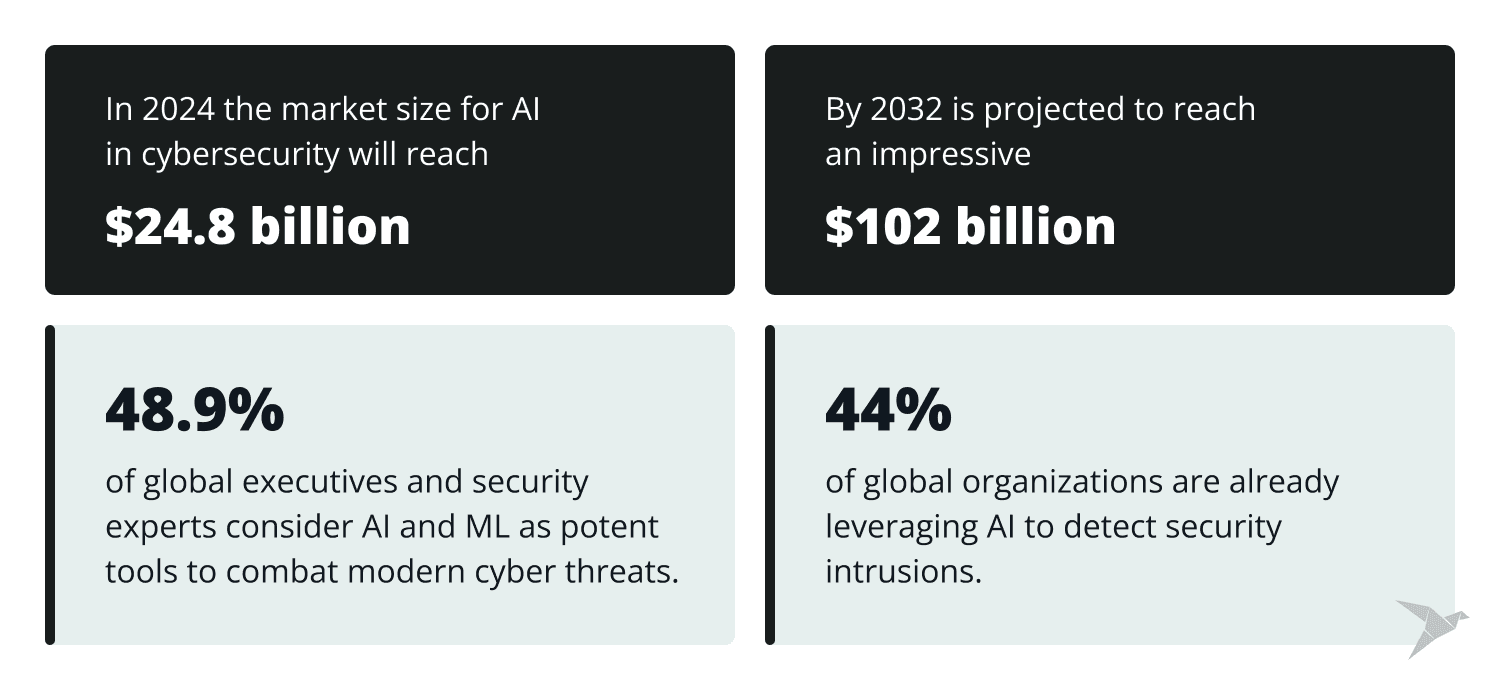
The market tells the story. Per Verified Market Research, the AI-in-cybersecurity market reached $24.8 billion in 2024 and is projected to hit $102 billion by 2032. That growth makes sense once you remember attackers are adopting the same new technology to make their own work easier.
As cyberattacks grow more frequent, attention has turned to what AI can do about them. A survey by The Economist Intelligence Unit found that 48.9% of global executives and security experts see AI and Machine Learning as strong tools against modern security threats. A Pillsbury report added that 44% of global organizations already use AI to detect security intrusions.
Used well, AI helps you build applications that are secure by default, so users don't inherit vulnerabilities. It flags issues precisely, speeds up investigations, and automates parts of the response. Take behavioral biometrics: the system learns how a real user types and moves, then quietly flags the session that doesn't fit, which supports safer app development and a cleaner data environment.
AI also identifies likely-malicious activity and threat actors early, so you can head off a cyberattack before it lands. And the monitoring never sleeps. With automated, around-the-clock monitoring, your systems stay watched at 3 a.m. on a holiday weekend, which is exactly when attackers like to move.
Why exactly is AI Important for Cybersecurity?
Threats keep getting more complex. Social engineering and ransomware slip right past conventional defenses, and the sheer amount of data you have to analyze for risk keeps growing. Old approaches can't keep pace. That's the gap AI fills.
Here are the key reasons AI matters for cybersecurity.
Cost reduction
AI-driven automation lowers costs across security operations. Hand routine work like log analysis, vulnerability assessments, and patch management to AI, and your team stops burning hours on manual effort, which saves both time and human resources.
Better threat detection accuracy saves money too. Traditional security tools throw false positives or miss real threats, so security teams waste time chasing issues that aren't there or overlooking ones that are. AI narrows that gap. From our experience, that's usually where the budget math tips.
Improved scalability
Traditional cybersecurity approaches often buckle under the data volumes that complex, connected environments produce. AI excels at scale, processing and analyzing massive amounts of data from many sources at once.
It reads network traffic logs, system logs, user behavior, and threat-intelligence data side by side. That reach lets AI catch subtle signs of a threat that a human analyst would scroll right past, so your defense stays a step ahead.
Meanwhile, the stakes keep climbing.Cybersecurity Ventures](https://cybersecurityventures.com/cybercrime-damages-6-trillion-by-2021/) predicts global cybercrime will cost $10.5 trillion a year by 2026. According to the ENISA Threat Landscape (ETL) report, the primary threats and trends are:
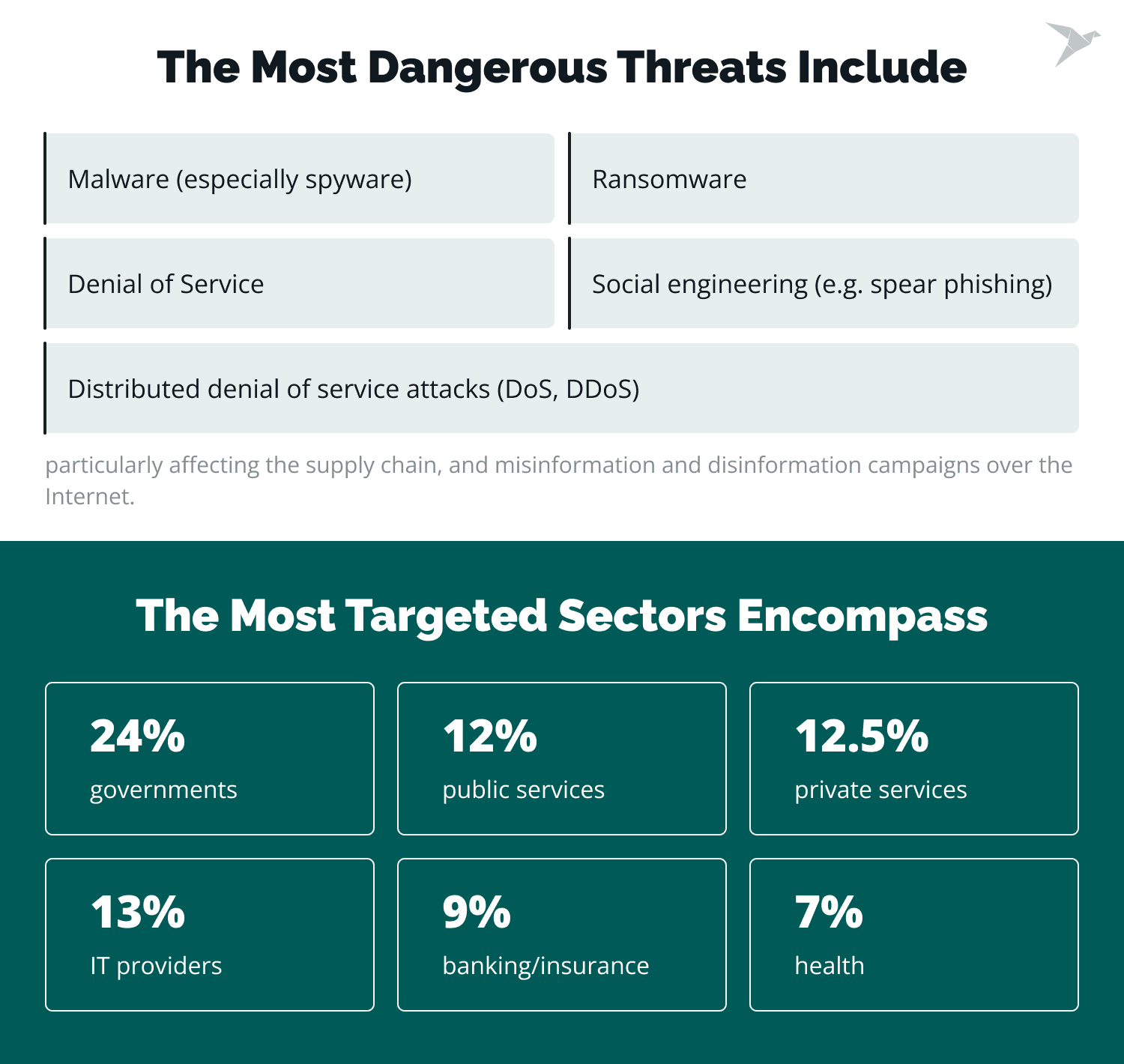
- The most dangerous threats include ransomware, malware, social engineering, and denial-of-service or distributed-denial-of-service attacks (DoS, DDoS), which hit supply chains hard, along with misinformation and disinformation campaigns online.
- The most targeted sectors are governments (24%), IT providers (13%), public services (12.5%), private services (12%), banking and insurance (9%), and health (7%).
- Attackers keep finding new tactics and lowering the barrier to entry. Some now sell subscription services and starter kits, and others use Large Language Models like ChatGPT to write malicious code. AI cuts both ways here: attackers use it to automate and sharpen their methods, which makes those attacks harder to spot.
Learn how we built an AI-powered recruitment assistant using OpenAI stack
Use Сases of Artificial Intelligence in Cyber Security
AI now shows up across the security stack, and 76% of enterprises have already prioritized AI and Machine Learning in their IT budgets. Here are the key use cases where it earns its place.
Use Case 1: Threat detection and prevention
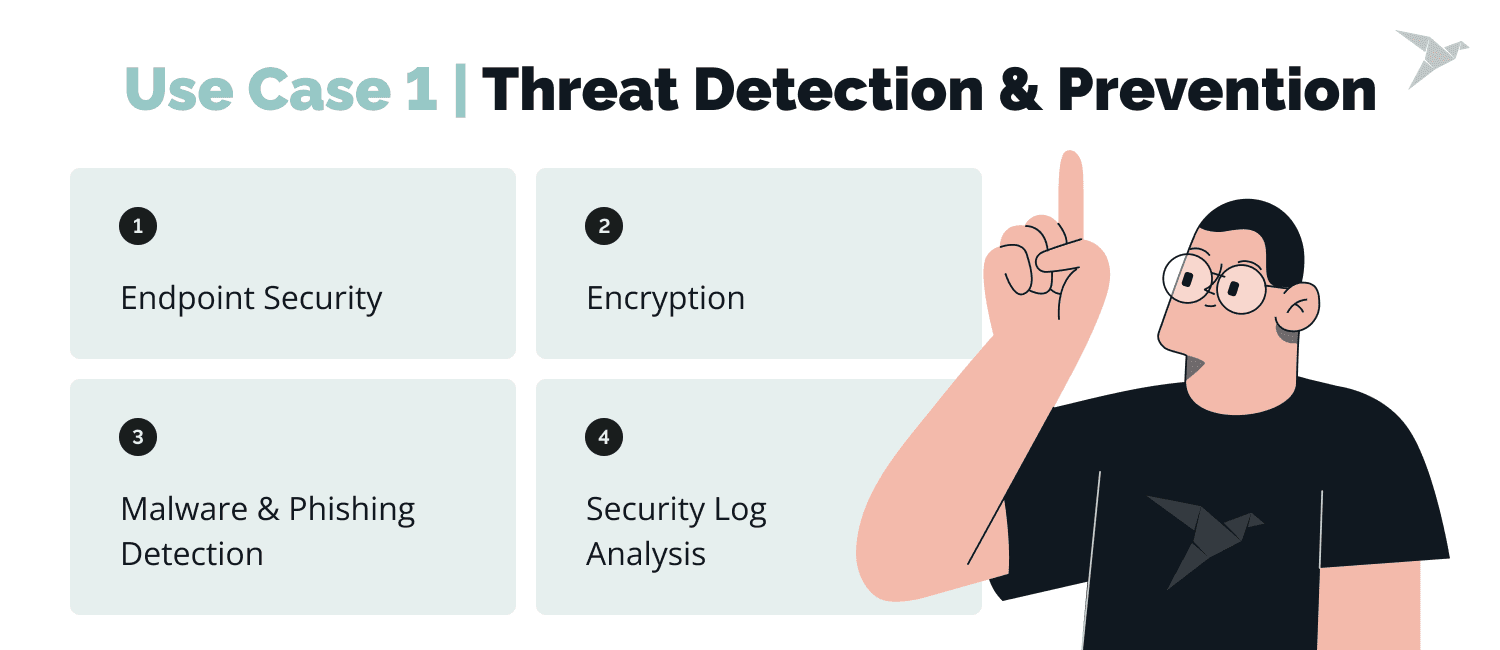
Threat detection is one of AI's strongest areas. It can analyze large amounts of data from different sources and pick out unusual patterns in user behavior that may signal a cyber attack. For example, if an employee unknowingly clicks a phishing email, AI can notice the change in their behavior and alert your security team to a potential security breach.
When it spots a threat, an AI-powered system triggers real-time alerts and notifications, so cybersecurity teams can respond quickly. By automating incident response actions, like isolating affected systems or blocking malicious activities, AI shrinks the attacker's window and limits the impact of a security breach.
Malware and phishing detection
AI-based cybersecurity systems catch far more than older ones. Deep Instinct's Chuck Everette reports that AI models reach security rates of 80% to 92%, well above the 30% to 60% of legacy signature-based malware detection systems.
AI reads email content and context to tell spam, phishing, and legitimate messages apart. Because these Machine Learning models keep improving, they adapt to new threats and recognize sophisticated attacks like spear phishing before the message reaches the corporate network. Researchers at the University of North Dakota proposed a Machine Learning-based phishing detection technique that classified emails as legitimate or phishing with 94% accuracy.
Security log analysis
AI transforms security log analysis. Machine Learning works through large volumes of real-time log data and spots patterns and anomalies, even without a known threat signature, so you can catch and respond to a security breach quickly. It's also good at surfacing potential insider threats by analyzing user activity across many systems and applications.
Endpoint security
With remote work now the norm, securing endpoints matters more than ever. Traditional antivirus solutions and VPNs lean on signature-based detection, which lags behind emerging threats and leaves endpoints exposed.
AI-driven endpoint protection works differently. It establishes baselines of normal endpoint behavior, then flags deviations in real time. Because it keeps learning from network behavior, it can catch potential threats, including zero-day attacks, with no signature update to go on.
AI also strengthens password protection and user account security through advanced authentication. Tools like CAPTCHA, facial recognition, and fingerprint scanners help detect genuine login attempts.
Learn how we built macro-investing app with its own token and reward system
Encryption
But what about encryption, the thing that keeps our data safe? Can AI break it? That's a hard question. Encrypted data is a puzzle, and AI has to work out which pieces fit. Breaking encryption is difficult because it relies on complex math that even AI struggles with.
The good news: encryption algorithms like AES and SHA are designed to be very hard to crack. Their design makes it tough for AI, or any attacker, to predict how they behave. So even with everything AI can do, breaking strong encryption is still a big challenge.
Threat detection in Honeywell
With AI, Honeywell's platform reads huge volumes of data from industrial control systems and looks for anything out of pattern. A threat shows up as an anomaly. The system then detects and blocks malicious traffic before it reaches the equipment it guards.
It gets better with time, too. Every past incident teaches it what an unauthorized access attempt looks like, so the next one gets caught and shut down faster.
Use Case 2: User behavior analytics
AI models use deep learning and Machine Learning to analyze network behavior and detect deviations from the norm continuously. They self-correct as they go. Each pass makes them a little better at telling a real anomaly from ordinary noise, so the defense keeps tuning itself as cyber threats shift.
AI-driven behavioral analytics also sharpens threat hunting. By profiling deployed applications and working through large amounts of user and device data, it surfaces evolving threats and vulnerabilities before they spread.
Learn how threat modeling and attack emulation can protect your AWS environment

User behavior analytics in Amazon
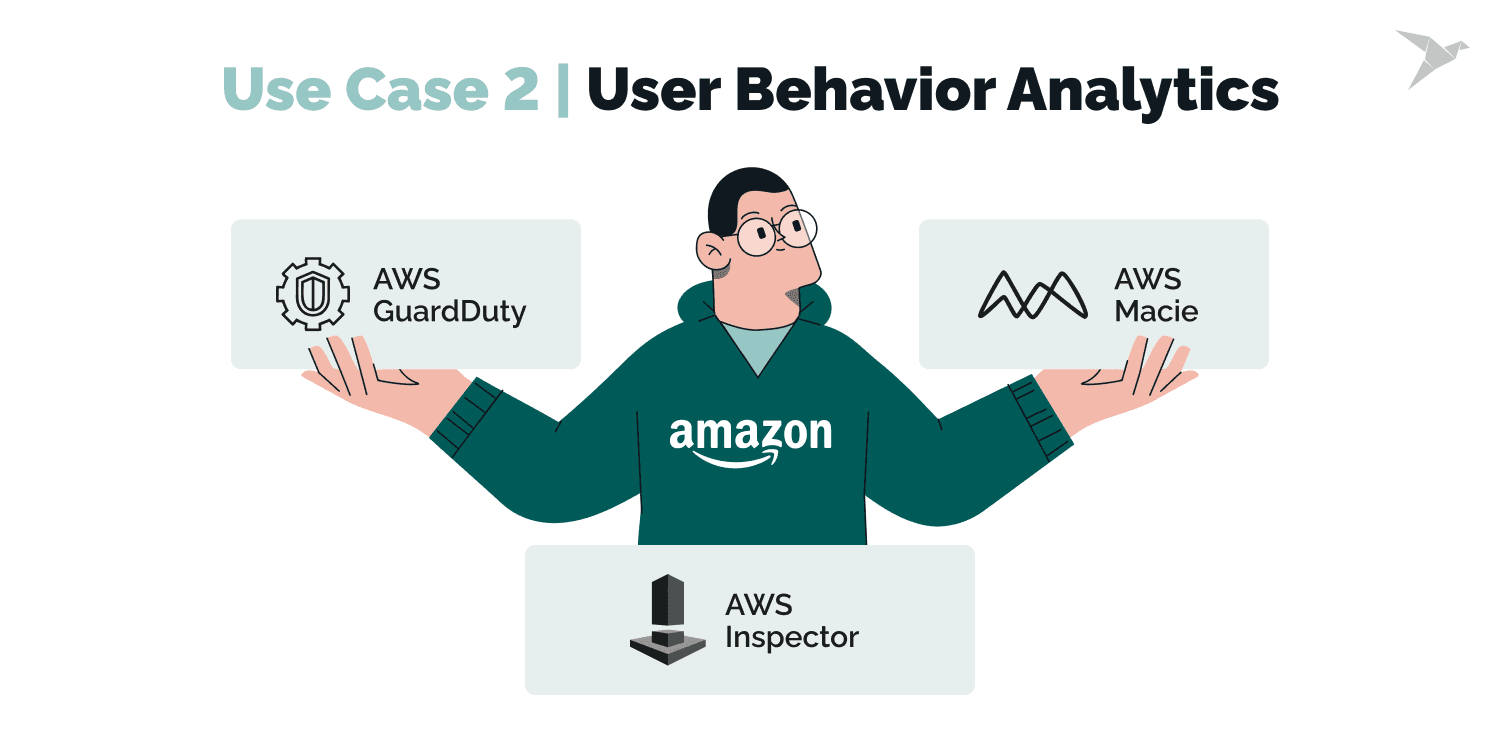
Through Amazon Web Services (AWS), Amazon offers several AI-powered security services that have changed how businesses approach threat detection and prevention:
- AWS GuardDuty is a managed threat detection service that analyzes sources like AWS CloudTrail logs, VPC Flow Logs, and DNS logs to catch abnormal behavior, such as unusual spikes in API calls, atypical network traffic, or unauthorized access to sensitive data.
- AWS Inspector is a continuous monitoring solution that finds security vulnerabilities within an organization's AWS infrastructure.
- AWS Macie is a fully managed data security service that uses Machine Learning to discover, classify, and protect sensitive data in AWS. It runs in-depth analysis to identify critical information like personally identifiable information (PII), financial data, and intellectual property.
Use Case 3: Advanced threat response and mitigation
AI's automation goes past detection into response, handling cyber threats from different vectors. You can use AI-enhanced cybersecurity solutions to rebalance the workload on your security team and optimize incident response times. By mining large amounts of security data and correlating information, AI autonomously generates informed threat responses that line up with technical logs, network traffic patterns, and global threat intelligence.
Advanced threat response and mitigation in Wells Fargo
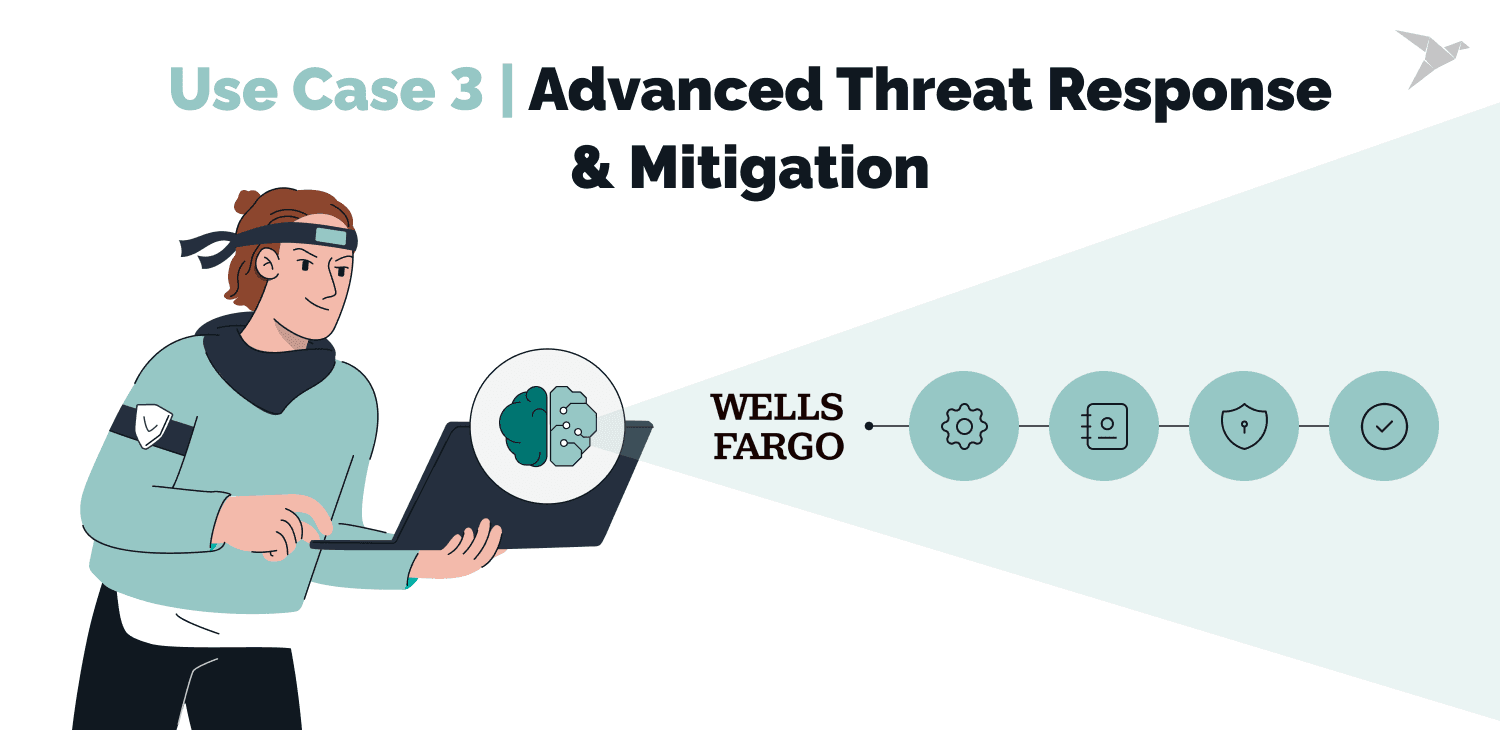
AI-powered threat detection and response platform is at the core of Wells Fargo's cybersecurity strategy. It uses advanced Machine Learning algorithms to analyze large volumes of data, including network traffic, email communications, and files. Processing that in real time, the AI system spots patterns and anomalies that may indicate malicious activities.
Once it detects a potential threat, Wells Fargo's AI system can trigger proactive response measures on its own. For instance, it blocks malicious traffic or isolates infected files before the threat spreads across the network.
Use Case 4: Vulnerability assessment and management
As cybercriminals keep deploying sophisticated methods, organizations struggle to manage the influx of new vulnerabilities. AI-driven solutions like User and Entity Behavior Analytics (UEBA) analyze device, server, and user activities to detect anomalies and zero-day attacks. By protecting against undisclosed vulnerabilities, AI enables real-time defense against high-risk threats.
Vulnerability assessment and management in Splunk
The Splunk Enterprise Security platform uses Machine Learning algorithms to analyze large amounts of data from network logs, system events, and user activity. That AI-driven approach lets the platform detect patterns and anomalies that could signify vulnerabilities or malicious activities in real time.
Its strength is intelligent prioritization. By analyzing data with AI algorithms, the platform assesses the severity and impact of each vulnerability, so security teams can focus on the most critical risks first.
Get strategic guidance and professional risk management

Use Case 5: Security operations and automation
An AI-powered automated threat detection solution processes billions of network requests, endpoint activities, user behaviors, and data points daily. This real-time analysis enables instant action within minutes, a feat that could otherwise take hours or days using manual methods. According to IBM, AI can slash the time taken to detect and respond to cyber threats by a staggering 14 weeks.
AI can autonomously scan systems and networks for weaknesses, streamlining the identification of potential entry points for attackers. By recommending and prioritizing necessary security updates, AI reduces manual effort and minimizes vulnerability exposure. For example, IBM’s managed security services team used these AI capabilities to automate 70% of alert closures and speed up their threat management timeline by more than 50% within the first year of use.
AI automates security operations, streamlining threat identification and elimination. Its intervention reduces response time and minimizes the risk of human error on critical tasks. That frees cybersecurity professionals to focus on strategic decision-making and strengthening defenses.
Security operations and automation in Plaid
Plaid uses advanced Machine Learning algorithms to analyze many data points, including the customer's name, address, and Social Security number. The AI system performs accurate bank account identification and verification in seconds, reducing the potential for errors or fraudulent activities.
That streamlines onboarding for financial institutions and their customers. Plaid's AI-driven platform removes manual intervention and extensive paperwork, accelerating onboarding while enhancing overall data security.
Allocate resources wisely and get the most value from your cybersecurity investment

Use Case 6: Threat intelligence and predictive analytics
AI contributes to breach risk prediction by keeping accurate, detailed IT asset inventories covering every device, user, and application and their access to critical systems. Pair that inventory with threat exposure assessments, and AI can predict the areas most susceptible to cyber breaches.
Because it collects and processes diverse data sources, AI gives security analysts a complete view of the organization's security posture. That situational awareness enables proactive threat hunting, accurate risk assessments, and timely incident response.
Threat intelligence and predictive analytics in PayPal
A key application of AI in PayPal's cybersecurity strategy is transaction analysis. With the sheer volume of daily transactions on the platform, manual scrutiny for signs of fraud would be a monumental task. AI's rapid processing does it, examining each transaction for potential red flags.
PayPal also extends this to identifying and blocking malicious websites. As cybercriminals keep devising new phishing and scam tactics, the system scans websites for malicious content or signs of potential cyber threats.
When Not to Use AI in Cyber Security?
AI is a powerful tool, yet not always the right one. A few situations where it might be wise to avoid AI in cybersecurity:
- If you have a small or outdated dataset, AI may not perform effectively. A traditional rule-based system or expert analysis might be a better fit.
- If your organization lacks the necessary skills or resources, AI adoption can be challenging and error-prone.
- If your company relies heavily on legacy infrastructure, transitioning to AI-based cybersecurity solutions can be difficult and costly.
- If you lack the necessary hardware or cloud resources, AI deployment may be impractical.
Organizations that aren't ready for AI-based protection can still rely on traditional cybersecurity services to maintain a strong security posture.
Challenges of Implementing AI in Cybersecurity
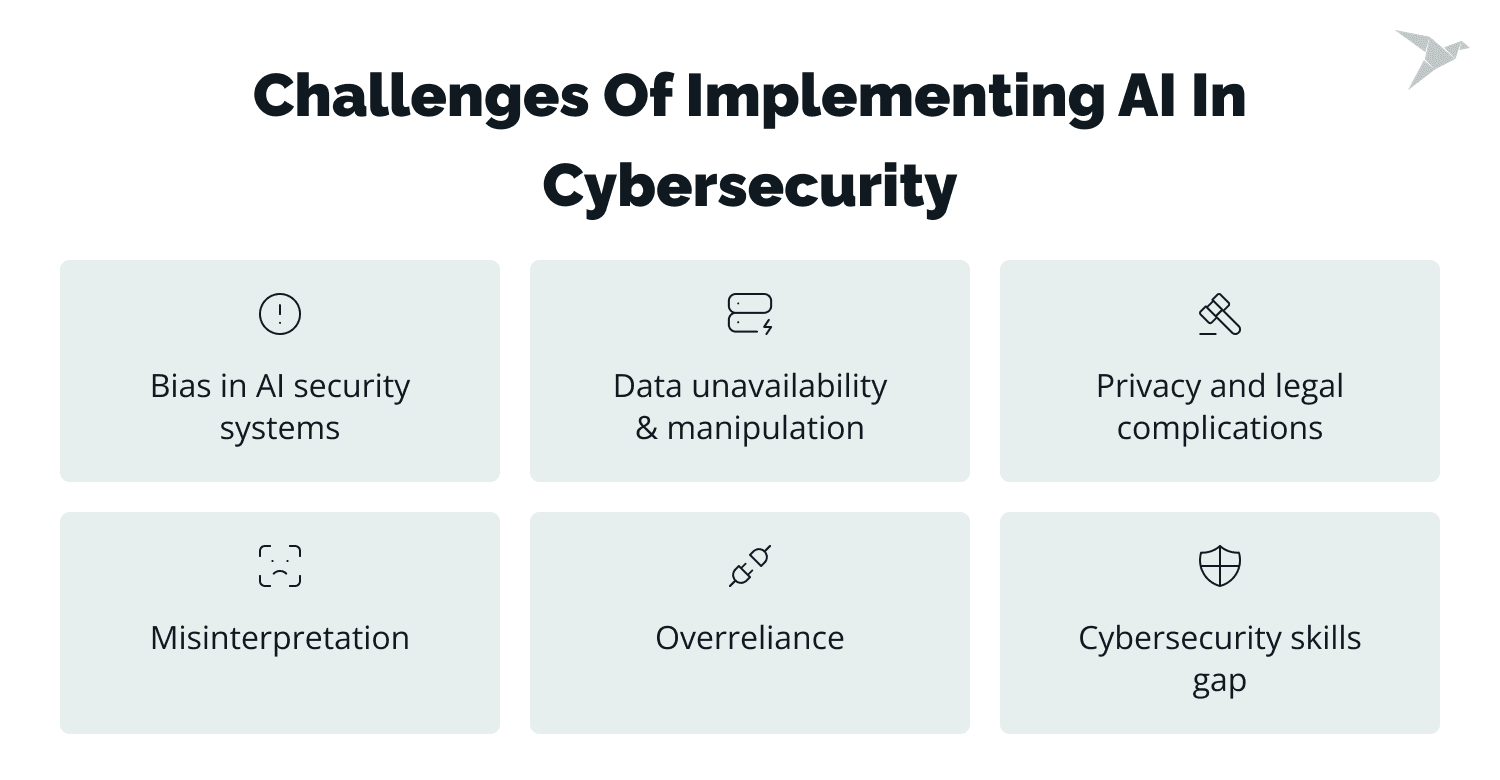
AI offers real potential in cybersecurity, but it comes its own challenges. You can harness AI effectively if you understand and mitigate these obstacles. Here are the key ones.
1. Bias in AI security systems
Like humans, AI can absorb bias from the data it's trained on. If the training data is biased, the system can produce discriminatory outcomes that affect cybersecurity decision-making. Leading AI platforms invest in ongoing, thoughtful ML training to reduce that bias and get fairer results.
2. Misinterpretation
Even advanced AI systems are prone to "AI hallucinations." They can misinterpret information and make decisions based on incomplete or false data from their training. The result can be incorrect threat assessments: real threats slip through, or false positives pile up and block legitimate operations or lock out authorized users.
3. Overreliance
Lean on AI too hard, and its errors can accumulate, leaving the organization exposed to novel cyber-attacks that exploit AI-managed defenses. Human oversight remains indispensable.
4. Cybersecurity skills gap
Unfortunately, there aren't enough skilled security professionals and IT specialists who can deploy and manage AI systems well. Without that expertise, you get poor implementation, misconfigurations, and inadequate protection against cyberthreats.
5. Privacy and legal сomplications
AI in cybersecurity often processes and analyzes large amounts of personally identifiable data, which raises real privacy concerns. Before you deploy an AI model, a legal review is essential to confirm compliance with privacy regulations. In some regions, AI solutions like ChatGPT face restrictions, which can complicate deploying other AI-based cybersecurity solutions there.
6. Data unavailability and manipulation
AI models rely on historical data to recognize patterns and make informed decisions. That dependence makes them vulnerable to manipulation: if attackers reach the training data, they can introduce bias and compromise the accuracy of the model.
Cybersecurity services companies help address these challenges, bringing the expertise to deploy and manage AI systems securely and to reduce the risk of data manipulation and privacy issues.

The Future of Cybersecurity and AI
The software landscape presents an alarming rise in new vulnerabilities, reaching over 22,000 in 2022, the highest reported figure in over a decade. The challenge of staying ahead of ever-mutating threats overwhelms cybersecurity professionals. However, the advent of machine learning-based cybersecurity systems offers a ray of hope.
Tech giants like Google, IBM, and Microsoft are at the forefront, running advanced AI systems for threat identification and mitigation. Google's Project Zero has committed $10 billion over five years to strengthen cybersecurity, with a team that hunts and fixes web vulnerabilities, and Google Play Protect scans over 100 billion apps for malware and cyber threats.
Microsoft's Cyber Signals program uses AI to analyze 24 trillion security signals and monitor 40 nation-state groups and 140 hacker groups. That's how it detects malicious activity and software weaknesses, blocking over 35.7 billion phishing attacks and 25.6 billion identity theft attempts on enterprise accounts.
Final Thoughts
The future of consumer cybersecurity hinges on AI, especially when addressing the vast scale and potential threats posed by social engineering and IoT malware. With AI at its core, the cybersecurity landscape is poised to witness unprecedented levels of security, faster response times, and an adaptive defense system.
AI's real edge is constant learning. It keeps up with new threats faster than the manual methods human experts rely on, so its value in stopping cyber attacks grows over time.
AI in cybersecurity sparks both optimism and caution, and both are fair. The goal for the next few years is a sensible balance between the advantages and the risks of AI and ML data-protection systems. With a focus on innovation and security, and with a partner like TechMagic's security testing services company, you can plan for the future of AI in cybersecurity. Companies building or enhancing AI capabilities can also explore dedicated AI development services to stay ahead of threats.

FAQ

AI enhances threat detection in cybersecurity by using advanced Machine Learning algorithms to analyze large amounts of data in real time. These algorithms identify patterns and anomalies that may indicate potential threats, so organizations can detect and respond to them quickly and effectively.
Yes. Machine Learning models constantly learn from new data and identify new patterns and behaviors tied to emerging cyber threats. That adaptive capability lets organizations stay ahead of cybercriminals and keep improving their cybersecurity defenses.
AI aids vulnerability assessment and management by scanning and analyzing an organization's infrastructure for potential weaknesses and misconfigurations. It identifies vulnerabilities in applications and systems, so organizations can take proactive measures to mitigate threats before attackers exploit them.
AI's predictive capabilities and enhanced threat intelligence let it anticipate potential cyber-attacks based on historical data and patterns. It can't predict specific attacks with certainty, but it can identify trends and indicators that may signal future cyber threats, so organizations can take preventive measures and strengthen their cybersecurity defenses.