 Software Development
 Security Services
 Cloud Services
 AI Services
 Other Services










 TechMagic Academy


AI Predictive Analytics in Healthcare: What Is It & Benefits
Last updated:6 August 2026


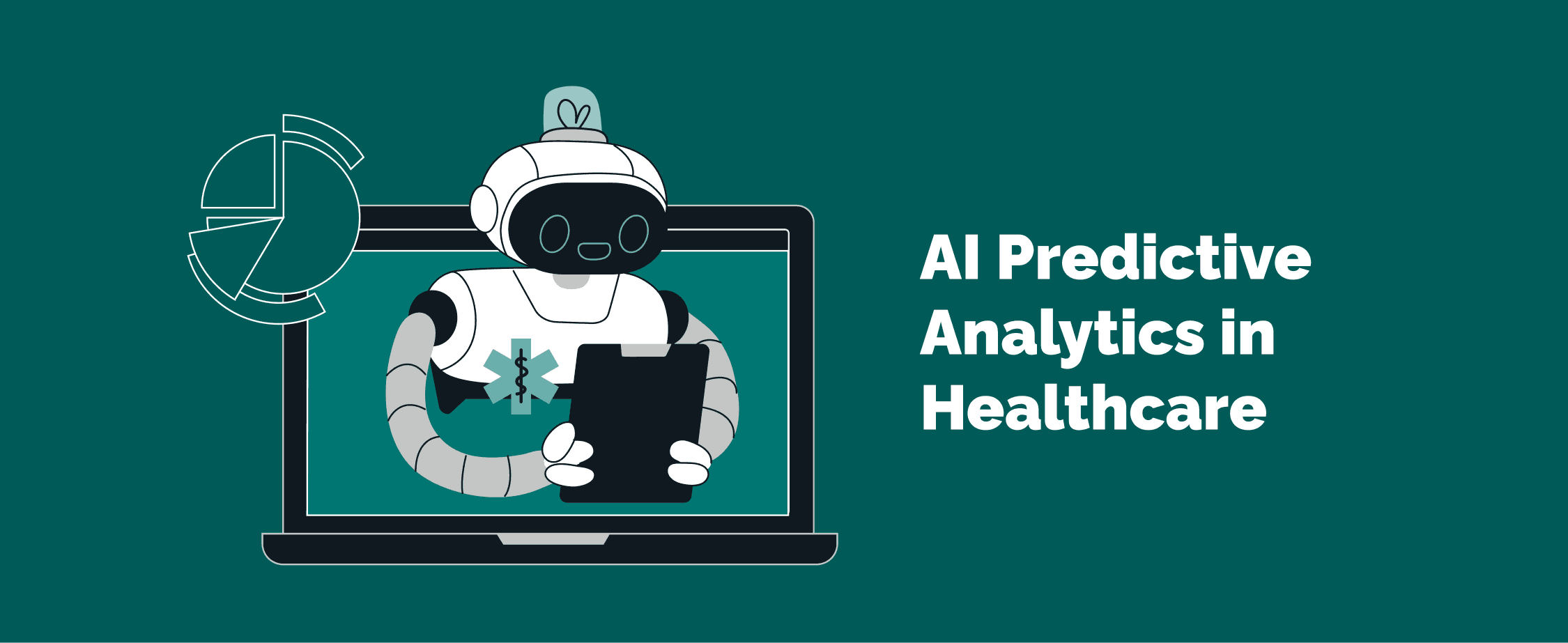
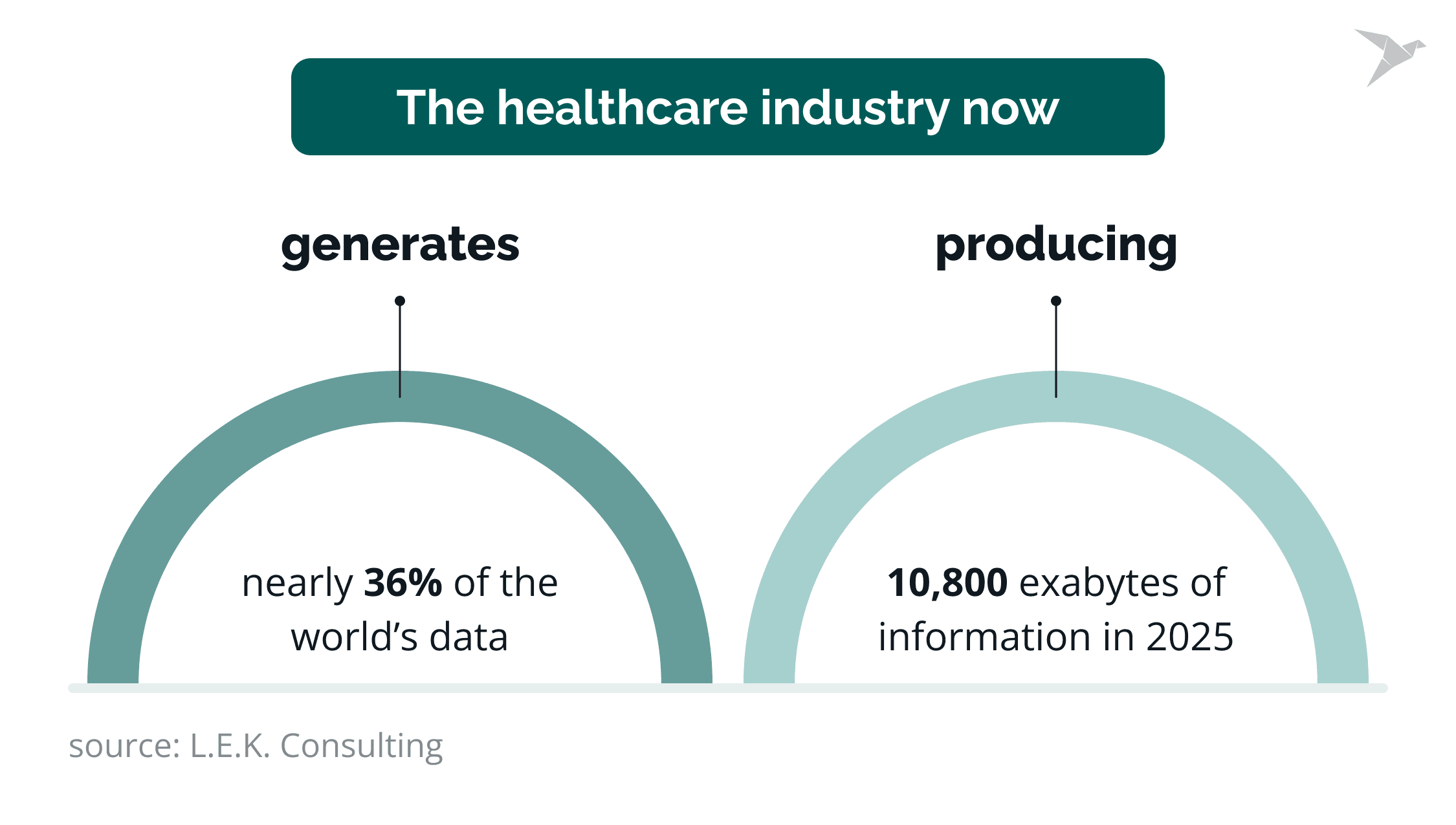
Healthcare is drowning in data. The industry now generates nearly 36% of the world's data, producing 10,800 exabytes of information every year.
Most of it never gets used. It sits in silos, in formats nothing else reads, or in free text that no query can reach. Roughly 80% of healthcare data is unstructured, which is why rule-based systems have never managed much of it. AI-powered predictive analytics is the part of the stack built for that problem.
The gap is one of pace. Data arrives every second, and a clinician reviewing a chart reads a fraction of what exists about that patient. Predictive analytics works through the whole record, finds patterns that do not announce themselves, and puts a warning in front of someone while there is still time to act on it.
Most health systems still run reactively, responding once a problem is visible. This article covers what changes when they stop.
Key Takeaways
- Healthcare produces 10,800 exabytes of data a year and uses a fraction of it. Around 80% is unstructured, which is precisely the part rule-based systems cannot read.
- The value is in earlier signals. A slight rise in heart rate plus a small drop in oxygen saturation means little separately and can indicate developing sepsis together.
- Adoption is past the pilot stage: 65% of U.S. hospitals report using predictive models, and 79% of those use whatever their EHR vendor supplies.
- The healthcare predictive analytics market reached $16.75 billion in 2024 and is projected at $184.58 billion by 2032, a 35% CAGR.
- The pipeline matters more than the algorithm. Records, labs, and notes merge into a data lake, features feed models such as LSTMs, and those models get validated, deployed, and watched for drift.
- Eight applications are working now, from early acute kidney injury alerts to bed forecasting to predictive maintenance on imaging equipment.
- The hard parts are patient privacy under HIPAA and GDPR, data quality and interoperability, explainability to clinicians, FDA and EMA uncertainty, legacy integration, and bias auditing.
- What gets projects through: privacy-first architecture, real ETL pipelines, dashboards designed with the clinicians who will use them, and bias monitoring that continues after go-live.
What Is AI Predictive Analytics in Healthcare
AI predictive analytics uses machine learning (ML), deep learning, and statistical modeling to find trends and make predictions from healthcare data, both historical and live.
Predictive analytics is like giving your data a voice and a sense of foresight.
– Alexandr Pihtovnicov, Delivery Director at TechMagic
The inputs are wider than most people assume. Electronic health records, lab results, wearable sensor streams, genomics, and socioeconomic indicators all feed in, and the output is a warning sign, a forecast of clinical outcomes, or a recommended next action.
Why predictive AI in healthcare matters
Traditional healthcare analytics runs on rules. If X happens, do Y. That works when conditions behave predictably, and patients frequently do not.
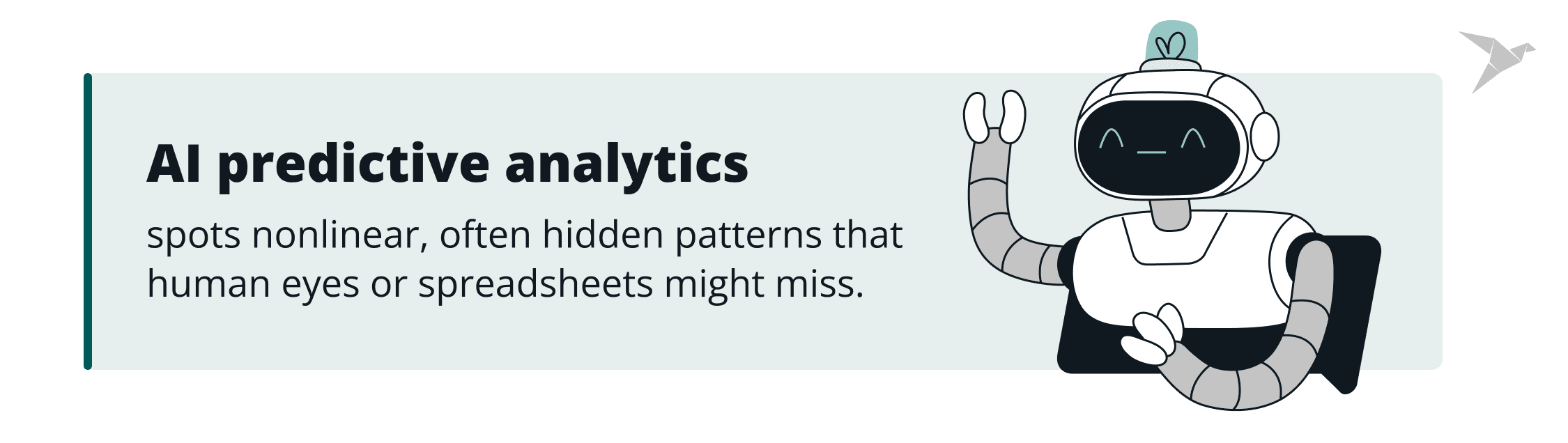
Predictive models find nonlinear relationships that a rule or a spreadsheet will never surface. Two illustrations of what that means in practice:
- A drop in blood pressure on its own is unremarkable. Combined with a temperature shift and specific lab markers, it can indicate early sepsis.
- A patient's genome can show a high likelihood of an adverse drug reaction before any symptom appears.
By the Way: Some Quick Stats
The adoption numbers have moved. As of 2024, 65% of U.S. hospitals report using predictive models, and 79% of those rely on solutions their EHR vendor provides.
That last figure is worth pausing on. Most hospitals are not building anything; they are switching on what came with the platform, which sets a fairly low ceiling on how well the model fits their population.
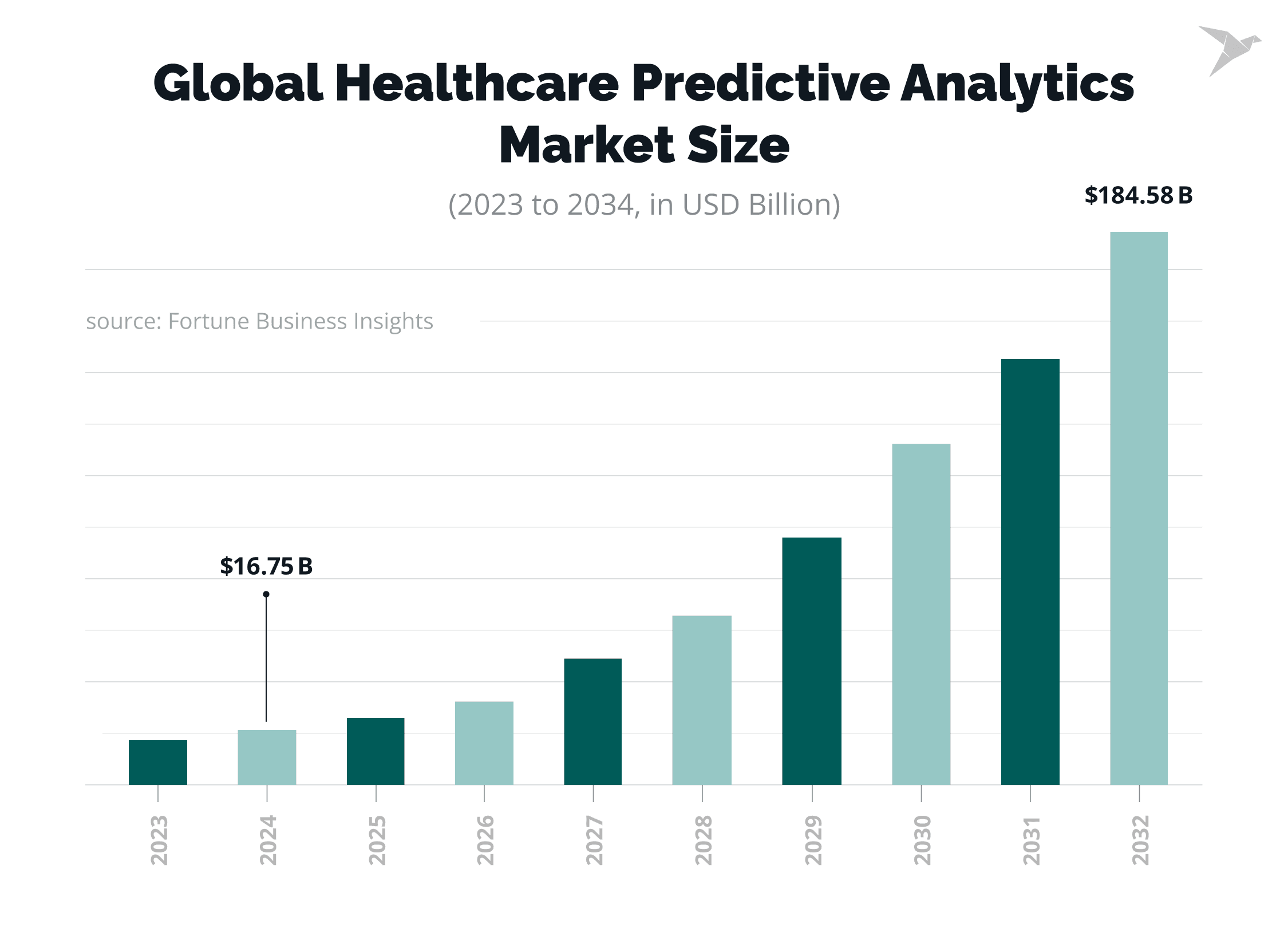
The global healthcare predictive analytics market was valued at $16.75 billion in 2024 and is projected to reach $184.58 billion by 2032, a CAGR of 35.0%, according to Fortune Business Insights.
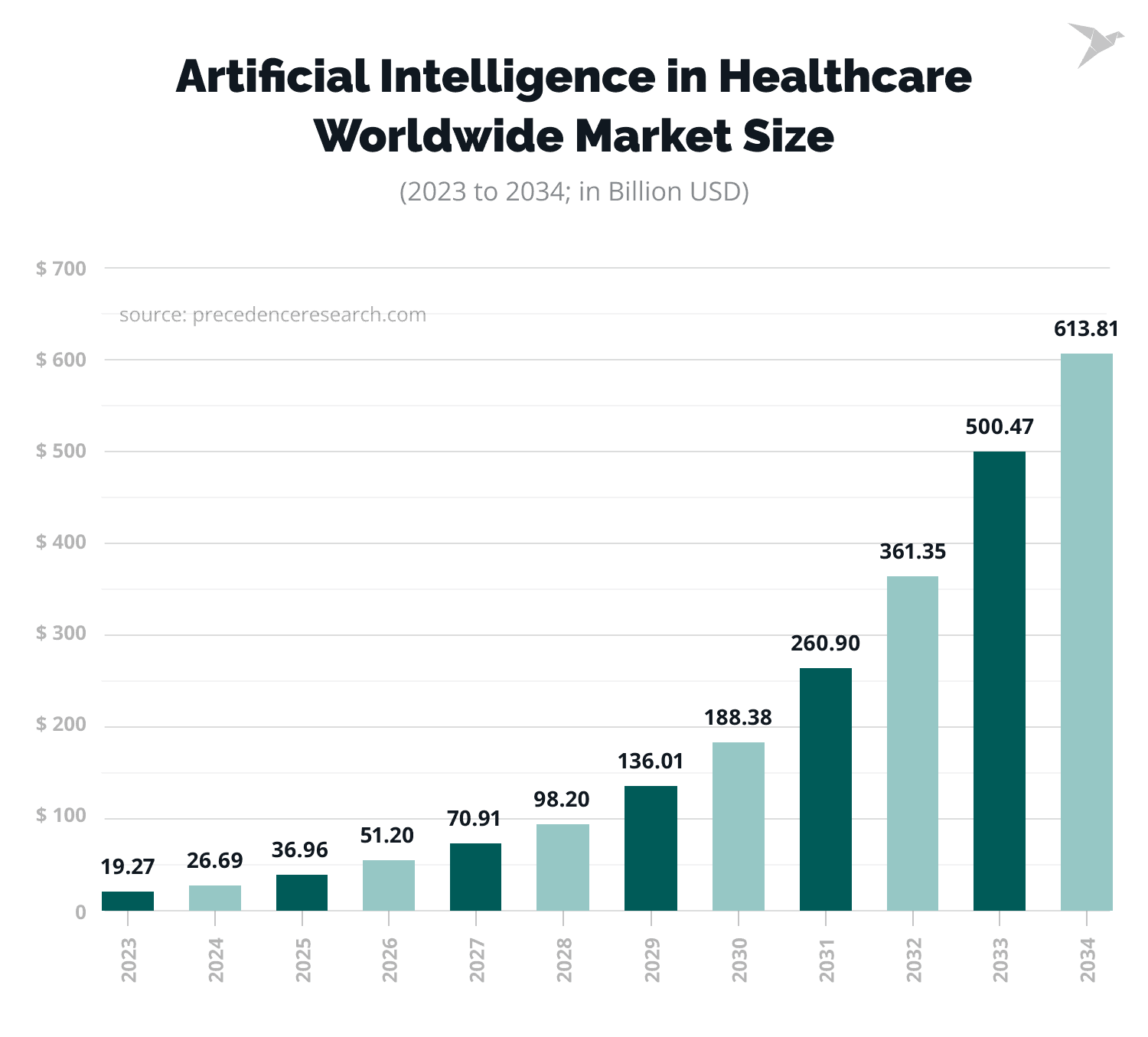
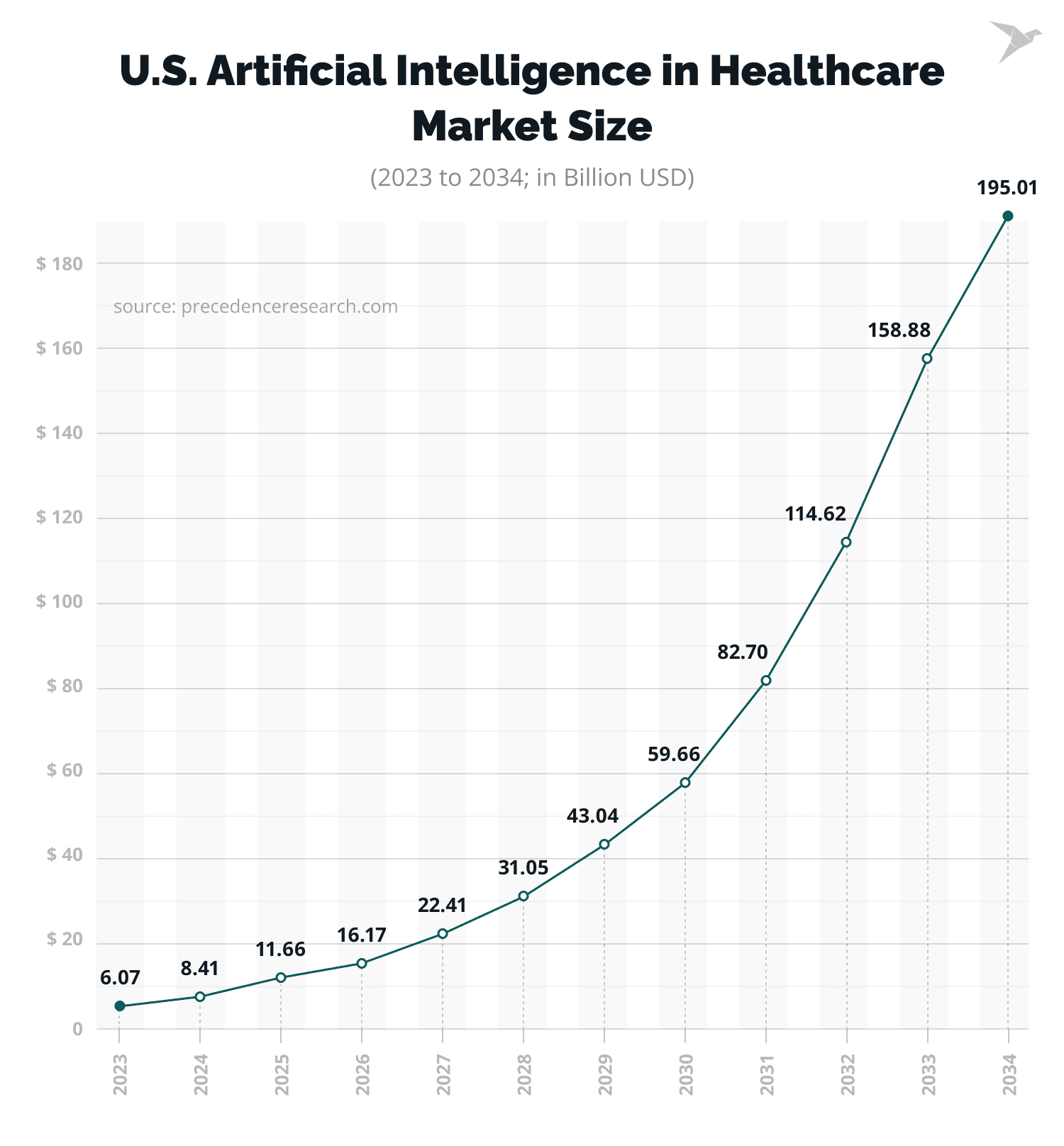
The wider picture is similar. Artificial intelligence in healthcare is projected to expand from $26.69 billion in 2024 to roughly $613.81 billion by 2034. In the United States alone the market stood at $8.41 billion in 2024 and is expected to reach around $195.01 billion by 2034, a compound annual growth rate of 37% across the decade.

How AI Contributes to Predictive Analytics in Healthcare
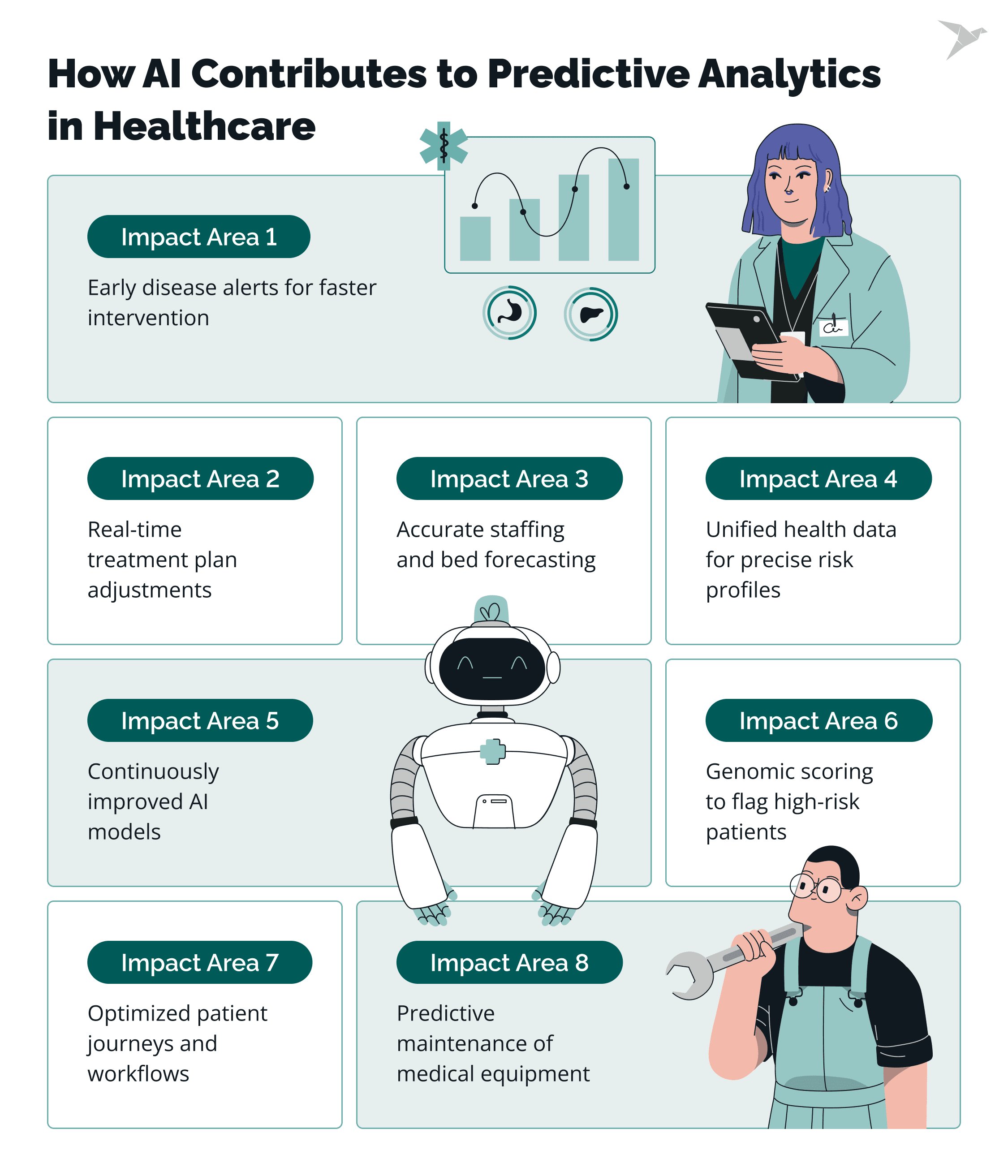
AI changes how the healthcare sector plans and delivers care, moving it from reacting to anticipating. Early intervention becomes possible, scarce resources go further, and treatment matches the individual instead of the average. Eight places where that is already happening.
1. Hospitals receive early AI-powered disease alerts
Models watch vitals, lab results, and clinician notes as they arrive, looking for the indicators that precede a deterioration nobody has noticed yet.
Acute kidney injury is a good example. An AI tool built for AKI can flag risk up to 48 hours before clinical signs appear, picking up rising creatinine alongside blood pressure changes. Reported results include fewer severe AKI cases and an average reduction of 1.2 ICU days per patient.
Earlier alerts mean better patient health outcomes, lower treatment costs, and less pressure on critical care. Improving patient outcomes and controlling cost are the same action here.
2. Clinicians adapt treatment plans with real-time insights
Static protocols are giving way to something that adjusts. Artificial intelligence reads patient-specific data streams and suggests changes as the picture changes.
Type 1 diabetes shows this clearly. AI reads continuous glucose monitor trends against EHR data and lifestyle factors to personalize insulin dosing, with reported reductions in hypoglycemic episodes of nearly 40% and better time-in-range.
The difference is that decisions run on the patient's current state rather than an average built from historical data.
3. Health systems unify genomics, imaging, labs, and social data
AI-driven predictive analytics gets stronger as the inputs connect. Genomic data, radiology results, lab values, and social determinants of health combine into one risk profile instead of five disconnected views.
One lung cancer screening model combined polygenic risk scores with CT scan image patterns and ZIP-code-level air quality data, and identified individuals at three times the baseline risk. Screening capacity went where it would find something.
4. Operations teams forecast staffing and bed needs accurately
Some of the clearest returns are nowhere near a patient. Models read seasonal trends, infection rates, scheduled procedures, and weather to project staffing, healthcare facilities requirements, and bed occupancy.
A large U.S. health system used artificial intelligence to forecast weekend bed demand, cutting last-minute staffing gaps by around 15% and saving $2.3 million a year that had been going to agency staff.
Forecasting also reduces the scramble that burns out the people doing it.
5. Healthcare providers identify high risk patients with genomic scoring
AI reads genetic data at scale and flags patients carrying higher-than-average health risks for chronic diseases, including cardiovascular conditions, cancers, and diabetes.
One health system generated polygenic risk scores for heart disease and gave the top 10% proactive coaching and monitoring. Adverse events dropped 25% over three years.
6. Data scientists refine models continuously from new outcomes
A model that stops learning starts decaying. Federated learning lets institutions retrain together without moving raw patient data anywhere, which keeps privacy law satisfied while widening the data the model has seen.
A hospital network used it on a sepsis prediction model and improved performance across age groups, ethnicities, and care settings. No raw EHR data changed hands.
7. Care managers map and optimize every patient journey
Journey mapping shows how patients actually move through a system, admission to discharge and after.
One health system found imaging turnaround was quietly extending stays. Rescheduling around that cut average length of stay and brought 30-day readmissions down. Smoother journeys show up in treatment outcomes and in how patients rate the stay.
8. Biomedical teams predict equipment failures before downtime
The same approach works on hardware. Maintenance algorithms watch equipment telemetry for early signs of wear.
Biomed teams analyzing MRI telemetry, including temperature trends and usage frequency, can predict component failure up to 72 hours out. That converts an emergency callout into a scheduled repair, which costs a fraction as much.

Core Components of AI Predictive Analytics in Healthcare
Five things have to work for predictive analysis to hold up in a hospital.
Data ingestion & integration
Getting the data out of its silos is the first and usually the longest job. Structured sources like lab values and billing codes are the easy half. Clinicians' notes and radiology reports are the other half, and they arrive as free text. Everything lands in a central repository, often a data lake, so there is one patient view rather than nine.
Feature engineering
Raw data becomes variables a model can use. Heart rate variability trended across 48 hours, or texture patterns extracted from CT scans using computer vision. This is where domain knowledge earns its money, because a badly chosen feature produces a confident, useless model.
Model development
The technique follows the question. For time-based predictions such as ICU deterioration, Long Short-Term Memory (LSTM) networks, a type of recurrent neural network, work well because they hold earlier data points in view and track how a condition develops.
Validation & calibration
A model that scores well in a notebook has proved very little. Validate on unseen data using AUC, recall, and precision, then test in the live environment, where the data is messier and the population is not the one you trained on.
Deployment & monitoring
Models get embedded where clinicians already work: alerts inside the EHR, mobile dashboards, nurse station monitors. Then the monitoring starts, because populations and care practices shift and model performance drifts with them. A model nobody is watching a year after launch is a liability.
What Are the Benefits of AI Predictive Analytics in the Healthcare Industry
Eight benefits, with what drives each one and where it shows up in practice.
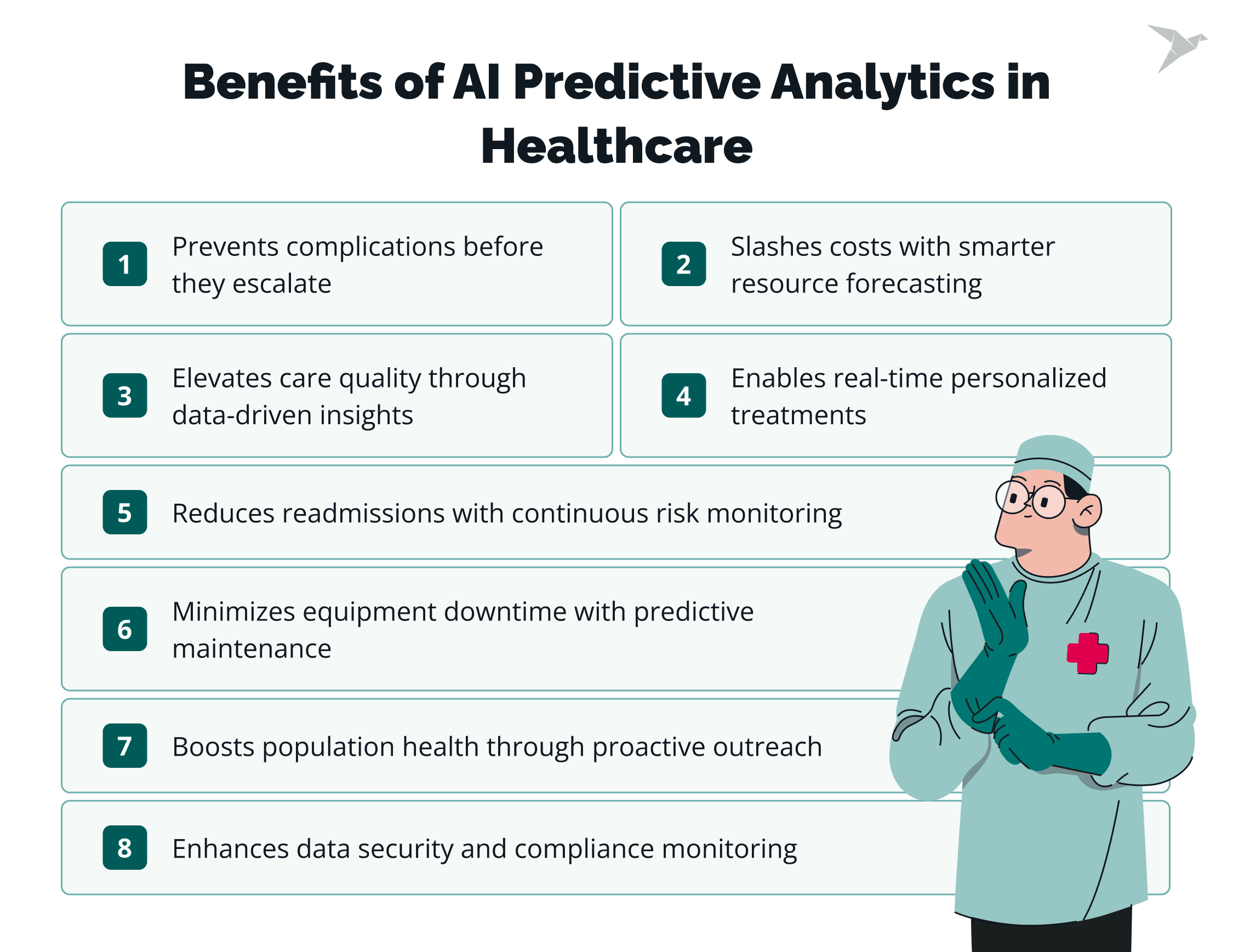
Hospitals can prevent complications before they escalate
Most complications start with something easy to miss: a small change in vitals, a lab trend, a shift in how a patient is behaving. Models analyzing patient data in real time catch early signs of patient deterioration while there is still room to act.
This works because the model is trained on far more history than any clinician sees, analyzing data at a scale no chart review reaches, and it weighs combinations rather than single readings. Slightly elevated heart rate, a marginal drop in oxygen saturation, a mild fever. Individually unremarkable, together a developing sepsis case.
At one U.S. hospital, an AI sepsis early detection system alerted clinicians hours ahead of when conventional monitoring would have flagged it. Early disease detection is what makes timely interventions possible at all.
Where it lands: in the ER, triage by severity before symptoms are obvious. In the ICU, continuous monitoring that catches instability around the clock. On general wards, wearables feeding data to a system that notices what an hourly round does not.
Hospitals can slash costs with smarter resource forecasting
Labor and beds are the two biggest cost lines in most hospitals, and both are usually managed on last year's assumptions. Predictive models read admissions patterns, seasonal outbreaks, and local event data to project need days or weeks ahead.
Providers report substantial savings from cutting agency staff use, which is the most expensive way to cover a gap. Bed occupancy forecasting stops one ward sitting half empty while another runs over, and supply planning follows the same forecast. Having the numbers a week ahead is what lets staffing teams optimize resource allocation instead of reacting on the morning.
Clinicians can elevate care quality through data-driven insights
Prioritizing high risk patients is difficult when every chart looks urgent. AI processes lab values, medical imaging, and clinical notes continuously, surfacing treatment gaps and adverse drug interaction risks that would otherwise need someone to go looking. That supports faster and better informed decisions at the bedside.
Oncology clinics using these tools have improved time-to-treatment, which in oncology is the variable that matters most, and faster treatment shows up as improved health outcomes. Algorithms can also flag treatments that have fallen behind current guidance and surface trends in chronic disease progression across a caseload.
Providers can tailor treatments to each patient instantly
Predictive analytics is what makes personalized medicine operational. Data from EHRs, wearables, labs, and genomics builds personalized treatment plans that update as the patient changes.
Diabetes care is the clearest case: glucose monitor data, activity levels, and past insulin responses combine into real-time dosing recommendations. AI-assisted insulin dosing systems have cut hypoglycemic events meaningfully, which is a direct patient safety gain. The same approach supports chemotherapy dose personalization, and mental health plans that adjust against mood and sleep data.
Check our custom software development services

Care teams can cut readmissions with real-time risk monitoring
The month after discharge is the most dangerous part of a hospital stay. Models identify patients likely to come back, and what would prevent it.
The inputs are broader than clinical history alone. Medication adherence, recent vitals, and social factors such as living alone all carry weight, and the last of those often carries the most. Providers using AI-assisted discharge planning report meaningful reductions in 30-day readmissions.
High-risk patients get a call, a telehealth check-in, or a home visit. The point is that finite follow-up capacity goes to the people most likely to need it.
Operations managers can minimize equipment downtime
Devices show early signs of failure much as patients do: heat spikes, degrading performance, error codes that repeat. AI reads telemetry from MRIs and ventilators for the patterns that usually come before a breakdown, so maintenance happens on a schedule.
Health systems can boost population health with proactive outreach
Predictive analytics identifies which patient groups are heading toward chronic disease and would benefit from getting to them first.
Clustering and classification separate a population into meaningful groups and expose risk factors a manual review misses, such as overlapping conditions or a pattern of missed follow-ups. Regional health systems using AI for population health management have seen emergency visits fall among their highest-risk patients.
IT teams can safeguard compliance and protect patient data
Patient records are among the most valuable data on any criminal market, and most breaches involve credentials that were supposed to be there. AI monitors EHR access patterns and flags what does not fit, such as an account pulling hundreds of records or logging in at 4am.
Hospitals running anomaly detection have caught insider threats and stopped breaches that a quarterly manual audit would have found months later. Privacy-preserving techniques like federated learning reduce the exposure further by keeping data where it lives.
What Are the Use Cases of AI Predictive Analytics in Healthcare
Eight scenarios in detail, covering patient care, healthcare delivery, management, and security.
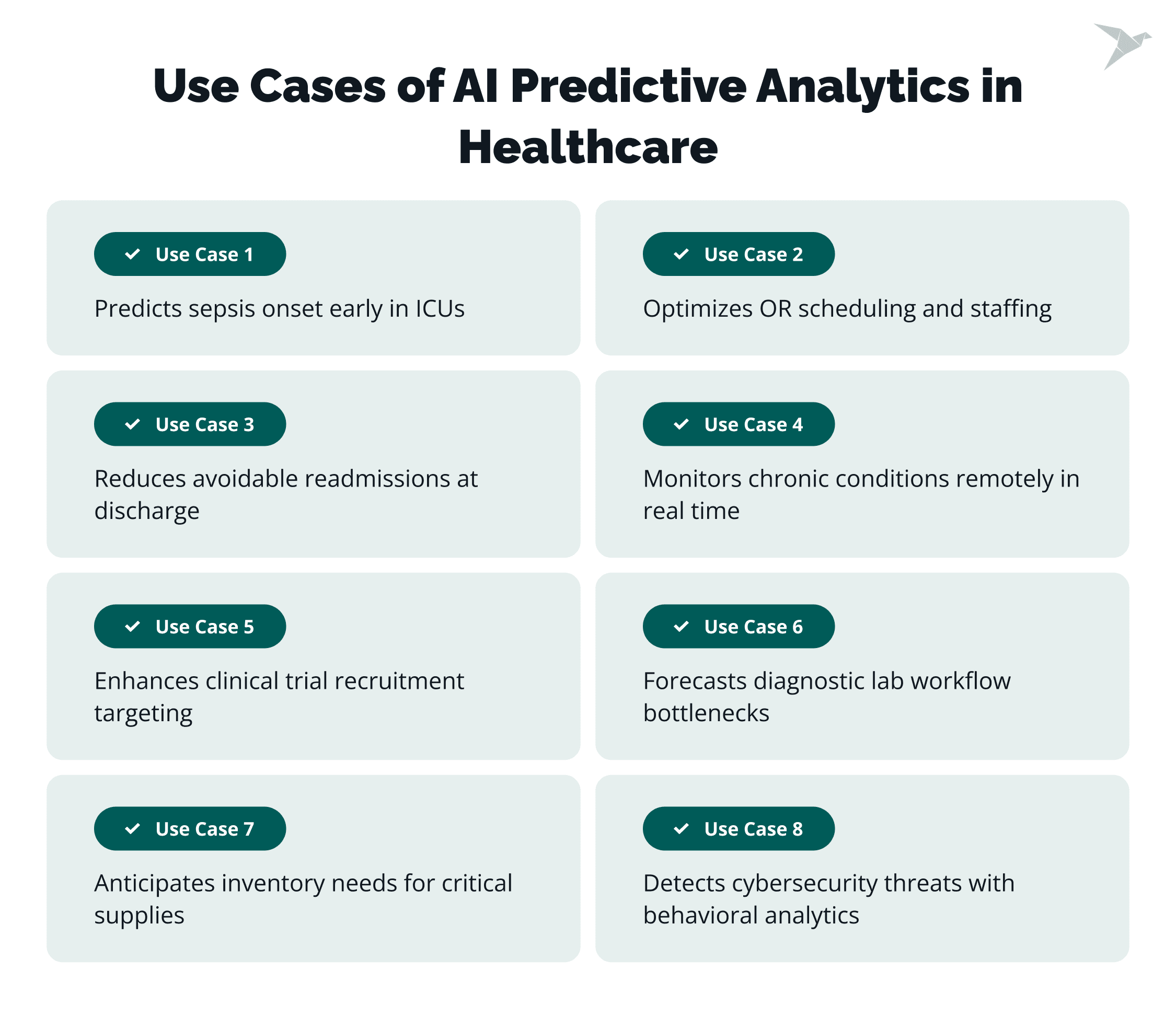
Hospitals predict sepsis onset in the ICU
Sepsis moves fast and its early presentation varies between patients, which is exactly why manual monitoring struggles with it. Models trained on large ICU datasets read time-stamped vitals, labs, and notes to detect early signs, catching a small heart rate increase or a falling blood pressure well before either crosses a clinical threshold.
Academic hospitals running these models report alerts arriving substantially earlier than conventional diagnosis, which is the whole game with sepsis.
Health systems reduce avoidable readmissions at discharge
A 30-day readmission is expensive and frequently avoidable. Models read structured clinical data alongside unstructured notes, and factor in housing and transportation, because a patient who cannot get to a follow-up appointment will not attend one.
One large health system built accurate 30-day readmission prediction and cut its rate materially through targeted calls and home visits.
Clinics optimize operating room scheduling and staffing
Operating rooms are the most expensive real estate in a hospital, and idle theatre time is unrecoverable. Models forecast case length from historical surgery durations, staff schedules, and patient risk factors, then allocate resources against that forecast.
An academic medical center improved on-time starts and increased throughput without cutting corners on safety. Predictive scheduling absorbs the variability that fixed-slot booking cannot.
Providers monitor chronic conditions remotely in real time
Wearables produce a continuous stream, and heart failure is where reading it matters most. AI tracks heart rate, respiratory rate, and weight for the fluid retention and rhythm changes that precede a decompensation. Catching those lets healthcare professionals step in before symptoms worsen.
Providers using AI-powered remote monitoring for heart failure patients have seen hospitalization rates fall, which cuts healthcare costs and spares patients an admission.
Pharma teams enhance clinical trial recruitment with precision targeting
Recruitment is the usual bottleneck in clinical trials. Artificial intelligence scans millions of de-identified EHRs and genomic profiles against eligibility criteria, and predicts which sites and candidates will actually enroll rather than merely qualify.
Pharmaceutical companies using this approach report substantially shorter enrollment periods, and enrollment time is where trial budgets go.
Labs forecast diagnostic workflow bottlenecks
Diagnostic labs get hit hard in flu season. Models predict test order volumes and turnaround times from historical trends, staffing levels, and patient flow, so a surge is staffed for rather than absorbed.
One lab system improved turnaround during peak demand. Faster results enhance patient care everywhere downstream, because every treatment decision is waiting on a test.
Supply chain managers anticipate inventory needs for critical supplies
A missing supply delays care. Forecasts combine historical usage, outbreak projections, and admission trends to hold stock at the right level, avoiding both shortages and the waste that comes from over-ordering against a guess. Providers report fewer stock-outs and less expiry.
IT leaders detect cybersecurity threats with behavioral analytics
Healthcare is a preferred target, and static rules only catch attacks someone has already seen. AI learns what normal looks like in an EHR system, including login times and access volumes, and flags deviation in real time. That is what makes insider risk detectable, since an insider is using legitimate access.
Learn about our expertise in the industry and what we have to offer
What Are the Key Challenges of Using AI Predictive Analytics in Healthcare
This is the honest half of the article. Personalized medicine predictive analytics runs into six recurring problems, and most failed projects failed on one of them rather than on the modeling.
Healthcare organizations struggle with data privacy and security
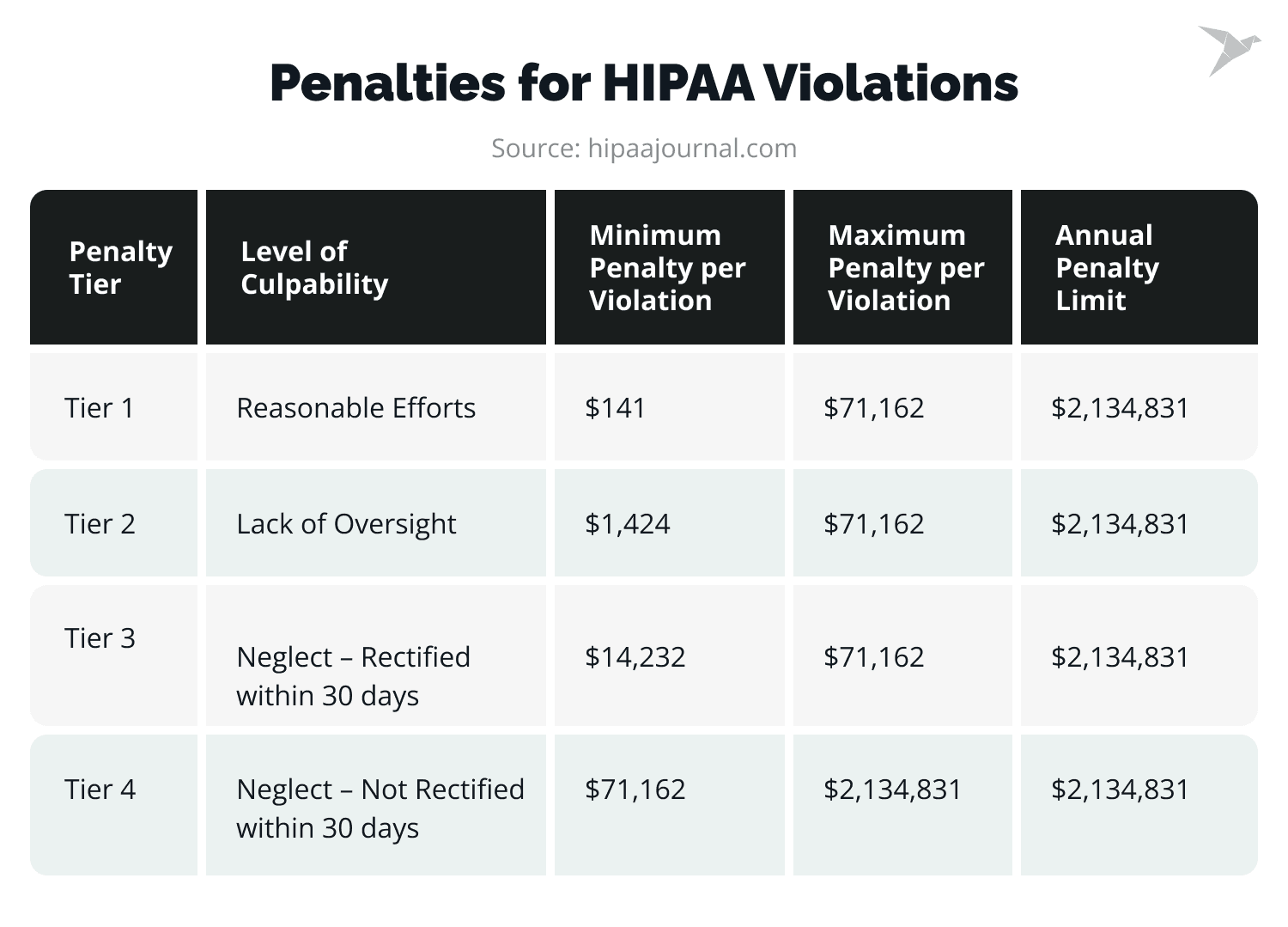
Healthcare data is about as sensitive as data gets. EHRs, genomic sequences, and wearable streams each carry their own obligations, and pulling them together multiplies the compliance surface under HIPAA in the U.S. and GDPR in Europe. One breach costs patient trust that does not come back, plus the fines.
The architecture has to assume this from the start. Federated learning trains models across institutions without raw data leaving any of them. Encryption at rest and in transit, real access controls, and audit trails are the baseline underneath that, with security assessments and an incident response plan that someone has actually rehearsed.
Teams grapple with data quality and interoperability issues
Healthcare data is messy in ways that surprise people coming from other industries. Coding standards differ between departments, fields are half-completed, and a large share of the useful content, including medical professionals' notes, is prose. Models trained on that produce confident nonsense.
Standardization is the way out. Common data models such as OMOP (Observational Medical Outcomes Partnership) and FHIR (Fast Healthcare Interoperability Resources) align structure and meaning across systems. Real ETL pipelines clean and prepare the data, and Natural Language Processing pulls valuable insights out of the notes. Budget for this properly, because data preparation is routinely most of the project.
Clinicians demand transparency and explainability from AI models
A model that cannot explain itself will not get used. Clinicians are accountable for the decision, so a recommendation with no visible reasoning is a risk they have no reason to take.
Explainable AI methods address this directly. SHAP values quantify which features drove a prediction, and counterfactual explanations show what would have changed the output. Design the dashboards with the clinicians who will use them, not for them, because the presentation determines whether any of this reaches a decision.
Providers navigate complex regulatory and compliance hurdles
The rules are still being written. The FDA and the European Medicines Agency are both defining what validation, risk management, and post-market surveillance mean for AI and ML in medical devices, and the answer keeps moving.
Bring regulatory expertise in early rather than at submission. Document the full model lifecycle from data collection through training and deployment, because that documentation is what an audit asks for. Plan post-market surveillance from the start, since a model in production is a product under continuing obligation.
IT departments wrestle with integrating AI into legacy systems
Plenty of providers run EHR platforms and on-premises infrastructure built long before real-time AI was a consideration. Modern APIs are missing, and streaming data out of them ranges from awkward to impossible.
A microservices architecture decouples the AI from the legacy estate, so integration is modular rather than a rebuild. HL7 and FHIR bridges handle translation. Where migration is viable, cloud-native platforms supply the compute these workloads need without a capital project.
Stakeholders face challenges in mitigating model bias and fairness
Training data underrepresents minority and marginalized populations, so models trained on it perform worse for those groups. Deployed at scale, that widens the disparities the technology was supposed to help close.
Bias audits should measure performance separately across demographic groups, since aggregate accuracy hides exactly this. Reweighting samples and augmenting datasets improve representation. Fairness metrics need monitoring as new data arrives, and involving clinical and community stakeholders during development catches problems that a metric will not.
Ready to Transform Your Care with AI Predictive Analytics?
Predictive analytics projects rarely fail at the model. They fail at the data pipeline, the integration with a system nobody wants to touch, or a security review that arrives too late to design for.
That is the work we do. We combine healthcare domain experience with AI development, and we build to HIPAA requirements from the architecture up rather than adding controls at the end.
What we offer:
- Custom predictive analytics built around your patient population and care goals, since a model tuned elsewhere rarely transfers cleanly
- Integration with your existing EHR, imaging, and medical device systems, scoped against what you actually run
- Full lifecycle support, from validation through deployment to the monitoring that catches drift
Next steps to get started:
- A discovery session to look at your data environment as it is
- A clear view of which use case is realistic first, and which should wait
- A scoped first project with measurable outcomes
We will also tell you when the answer is that your data is not ready yet, because starting there wastes less money than finding out later.

Wrapping Up
AI predictive analytics changes what a healthcare system can see coming. Complications get caught while they are still preventable, treatment fits the individual, and operations run against a forecast rather than a guess. It is an important part of AI automation in healthcare, where Artificial Intelligence can deal with huge amount of data and repetetive tasks.
The obstacles are real and they are mostly not technical. Data privacy, data quality, and moving regulation account for more stalled projects than model accuracy ever has. The organizations getting value are the ones that treated those as the project rather than as prerequisites to it.
The next few years point toward cloud-native platforms built on interoperability standards like FHIR and OMOP, federated learning as a default rather than a differentiator, and explainable AI as a requirement instead of a feature. What that demands from health systems is unglamorous: data governance that someone owns, continuous bias monitoring, and regulatory work that starts early.
If you are working out where to begin, that conversation is one we have often.
FAQ
AI-powered predictive analytics in healthcare organization uses machine learning and statistical models to read diverse patient data and estimate what is likely to happen next. Healthcare AI predictive analytics identifies risk early and forecasts health outcomes, which is what makes proactive care possible rather than aspirational.
AI predictive analytics in medicine analyzes patient data, historical and real-time, to anticipate future events such as disease onset or readmission. The value is the window it opens: a clinician who knows something is coming can act before it arrives.
AI handles the scale and the mess. It processes complex healthcare data, including the unstructured majority, and finds patterns that rule-based analysis cannot reach. Those become insights that improve clinical decisions, operational efficiency, and patient outcomes, provided someone acts on them.