
 Software Development
 Security Services
 Cloud Services
 AI Services
 Other Services















 TechMagic Academy


How Should FinTech CTOs Choose a Cloud Services Provider?
Last updated:7 August 2026


Time is money in FinTech–and your cloud choice can quietly drain both. A single hour of downtime can cost millions. A poor compliance setup can delay market entry by months. Yet many CTOs still approach cloud selection as a technical checkbox, not a strategic risk decision.
FinTech choosing a cloud services provider is a risk decision that happens to involve infrastructure. Compute power and pricing tiers are the easy part to compare.
What decides the outcome is whether the platform holds up under regulatory pressure, absorbs transaction spikes, protects sensitive data, and lets you leave if you need to. Get it wrong and it surfaces two years later as audit friction, a bill nobody can explain, or a system your team works around instead of with.
What follows is how leading FinTech companies handle FinTech choosing a cloud provider in practice: where AWS, Azure, Google Cloud, IBM Cloud, and Oracle OCI actually diverge for financial platforms, plus how TechMagic's FinTech leadership weighs risk, scalability, and long-term dependency before signing anything.
Key takeaways
- Your cloud choice sets your regulatory readiness, your uptime exposure, and how fast you can open in a new market.
- Hyperscalers and enterprise clouds solve different problems. AWS, Azure and GCP suit cloud-native growth; IBM and Oracle suit regulated, legacy-heavy estates.
- Security, data residency, and audit controls differ between providers far more than most teams assume before they look closely.
- Lock-in is the cost nobody prices at signing. It shows up later in your negotiating position and in every architecture decision after it.
- Market share is a weak proxy for fit. The right answer follows from your product model.
Why Is Cloud Provider Choice Critical for FinTech Companies?
FinTech platforms run under constraints most digital products never meet. Regulatory oversight, data risk, and uptime expectations all land directly on revenue and on customer trust. That is why picking among the best platforms for FinTech cloud is a different exercise from picking a cloud in general.
Regulatory and compliance pressure in financial services
Financial services carry hard requirements on data residency, auditability, and operational controls. Those rules differ by region and they move, so infrastructure has to be configured and monitored against a target that shifts under you.
What you need from a provider is certified services, logging detailed enough to satisfy an auditor, and an unambiguous line showing where their responsibility ends and yours begins. Service level agreements and shared ownership models are critical factors here, and vague ones cost you during an audit. Gaps raise audit risk and slow entry into new markets.
Financial impact of downtime and service disruptions
Downtime in FinTech bills immediately. Failed transactions, delayed settlements, and customer accounts nobody can reach turn into lost revenue the same day and regulatory attention shortly after.
Providers differ on availability guarantees, regional redundancy options, and how openly they report incidents. That last one matters more than teams expect, because you will be explaining someone else's outage to your own regulator. These differences count when uptime expectations approach continuous operation, and when you have to scale without compromising performance.
Data sensitivity and risk management
FinTech systems hold payment data, identity records, and transaction histories. Losing any of it is a legal problem, a financial problem, and a reputational one at the same time.
Provider-level encryption, access management, and monitoring set the baseline of your risk profile. Robust security features take work off your own team and make controls consistent across environments. Weak defaults or thin visibility push that work back to you, and you absorb it whether you planned to or not.
Long-term strategic dependency on cloud
Cloud choices compound. Data services, managed databases, and security tooling get difficult to replace once they are woven through a product.
For FinTech companies that dependency shapes pricing flexibility, geographic expansion, and how fast you can answer a regulator. Weigh exit options, interoperability, and the operating model you will live with in five years alongside how quickly you can ship next quarter. These critical factors influence future architecture more than the initial migration does.
AWS: The Leader in Cloud Computing Services
Amazon Web Services (AWS) is a leading public cloud provider with a large global footprint and an extensive service portfolio. As of 2025, the AWS Cloud spans 38 geographic regions and 120 availability zones, with additional regions and zones announced for future expansion.AWS's market dominance is seen in its widespread adoption among various industries.
AWS remains a dominant player in the cloud market. In 2025, AWS held approximately 30 % of the global cloud infrastructure market, followed by Microsoft Azure at around 20 % and Google Cloud at about 12 %. It also delivers broad product coverage, with over 200 fully featured services across computing, storage, databases, networking, analytics, machine learning, and more
In its 2024 financial results, AWS generated approximately $107.6 billion in annual revenue, which tells you how much of enterprise cloud adoption currently runs through a single provider.
Strengths of AWS as a cloud provider
Where AWS is genuinely strong:
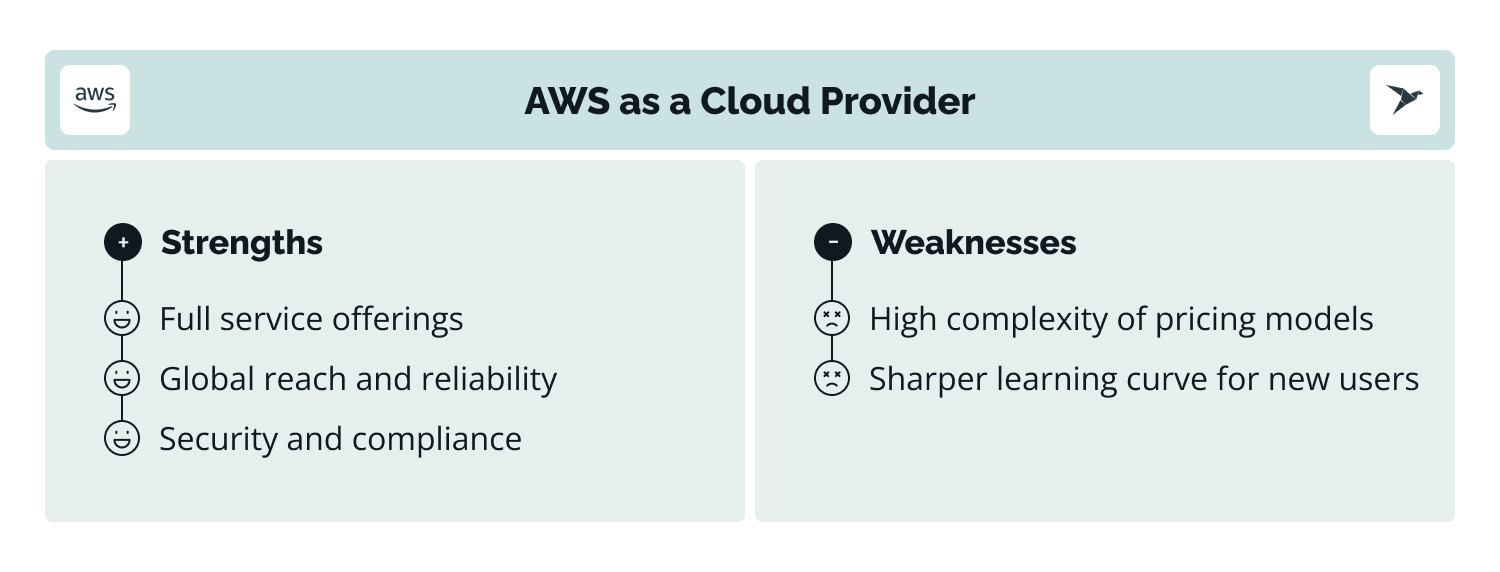
- Service breadth. Compute (EC2), storage (S3), database services (RDS), advanced analytics (Redshift), and roughly two hundred more. For most FinTech requirements a managed service already exists, which is the main reason teams default here.
- Global reach and reliability. 38 geographic regions and 120 availability zones put your application near your users and give you real failover options. Low latency, high availability, and fault tolerance carry more weight in FinTech than in most sectors, and AWS keeps hardening its access controls and data centers against both physical and digital risk.
- Security and compliance. PCI-DSS, GDPR and HIPAA among a long list of certifications, with data encryption and DDoS protection built in rather than bolted on.
Weaknesses of AWS as a cloud provider
The trade-offs:
- Pricing that is genuinely hard to predict. Pay-as-you-go, reserved instances, savings plans, and tiered rates interact in ways that surprise people. Without active monitoring the bill drifts upward and nobody can say exactly why.
- A steep learning curve. Two hundred services is a strength and a problem. Teams new to cloud computing need real training before making architecture decisions they will have to live with for years.
Stripe: a FinTech company using AWS
Stripe processes payments for millions of businesses, and its core cloud infrastructure runs on AWS. Volume is the binding constraint. Stripe handles millions of transactions a day, which needs a platform that scales without a procurement conversation. Compute runs on Amazon EC2, data storage on S3, and databases through Amazon RDS.
Security carries the same weight as scale given what moves through the system. AWS's compliance certifications cover a large part of what Stripe would otherwise have to evidence itself, which protects customer data and shortens audits.
Stripe also leans on AWS machine learning to read enormous transaction datasets for fraud detection, and on AWS's global infrastructure to keep service continuous in every market it operates in.
Azure: Smooth Integration with the Microsoft Environment
Microsoft Azure is another leader among top cloud service providers. Microsoft Azure is widely chosen by enterprises that already use Microsoft technologies, such as Microsoft Entra ID, Windows Server, SQL Server, and .NET, because these integrations reduce friction across identity, governance, and management layers.
Azure’s cloud business has continued to grow strongly through 2025. In Microsoft’s fiscal year 2025 results, Azure and other cloud services drove growth in the Intelligent Cloud segment, with cloud revenue increasing notably year over year and Azure exceeding $75 billion in annual revenue, up around 34 % from the previous year. This reflects ongoing enterprise adoption and demand for cloud and AI-driven workloads.
On market share, industry analyses show Azure holding around 20 % of the global cloud infrastructure market in 2025, behind AWS but ahead of most competitors, with continued expansion in enterprise deployments and AI-related services.
Strengths of Azure as a cloud provider
What Azure does well:
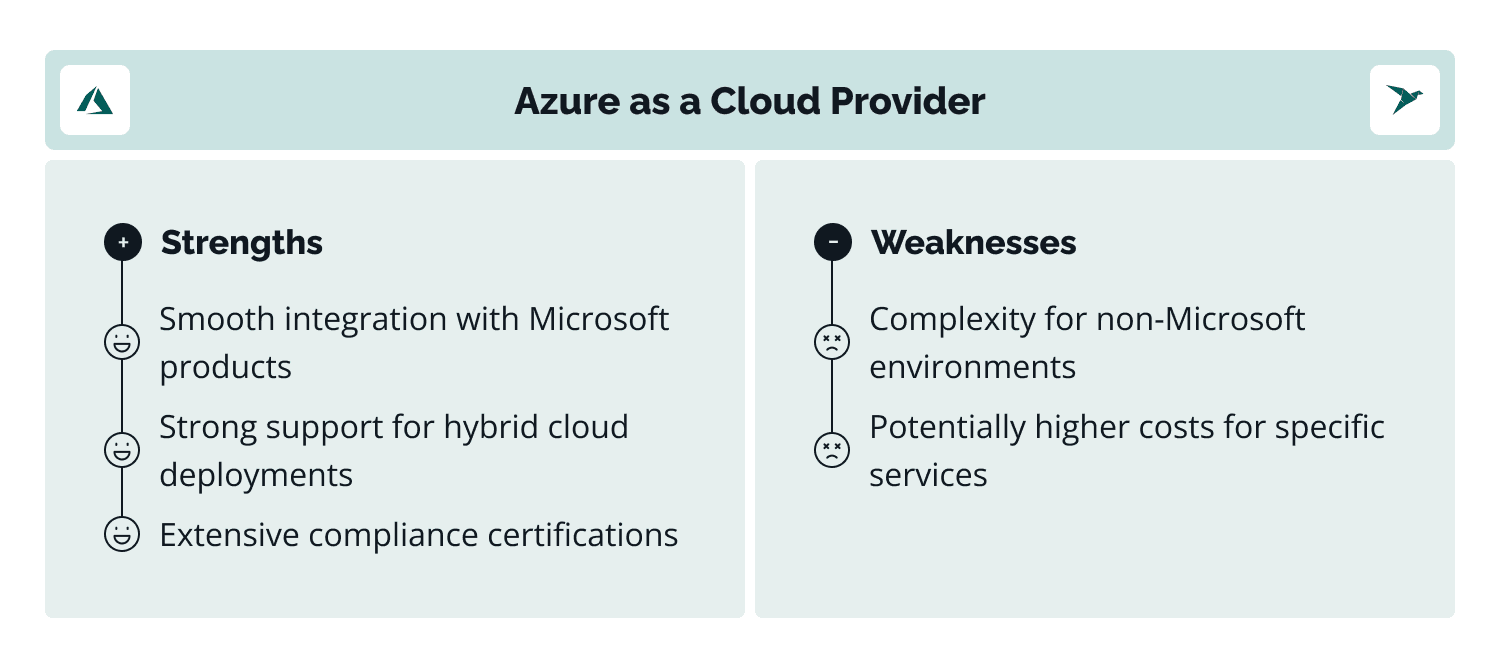
- Microsoft integration. Office 365, Dynamics 365, and Active Directory connect without an integration project. If your organization already runs on Microsoft, identity and governance come close to free.
- Hybrid cloud solutions. Azure handles a mixed estate better than most. FinTech companies with on premises infrastructure they cannot retire can move in stages instead of all at once.
- Compliance coverage. GDPR, ISO/IEC 27001, SOC 2 and a long list beyond, which matters in an industry where the certification list is procurement's first question.
Weaknesses of Azure as a cloud provider
Where it gets harder:
- Less intuitive outside the Microsoft world. Teams without Microsoft tooling find the environment harder to navigate and harder to connect to their existing systems.
- Specialized services can cost more. Certain Azure services price above their equivalents elsewhere, so the total needs modelling rather than an assumption of parity.
JPMorgan Chase: a FinTech company using Azure
JPMorgan Chase runs Microsoft Azure across trade handling, risk modeling, client relationship management, and compliance operations.
Azure's advanced analytics and AI capabilities feed the bank's modelling work, and its security controls cover data that regulators examine closely. The global footprint matters for a bank operating in most markets on earth.
It has not been friction-free. Data transfer, cost control, security, and integration with legacy systems all took significant time and money to resolve, which is the honest picture for any institution of that age moving to cloud.
The bank's work with the Quorum blockchain platform alongside Azure points to an institution testing distributed ledger technology rather than waiting for it to settle, with enhanced security requirements attached from the start.
Learn about our expertise in the industry and what we have to offer
Google Cloud Platform: Advanced Technology and Data Analytics
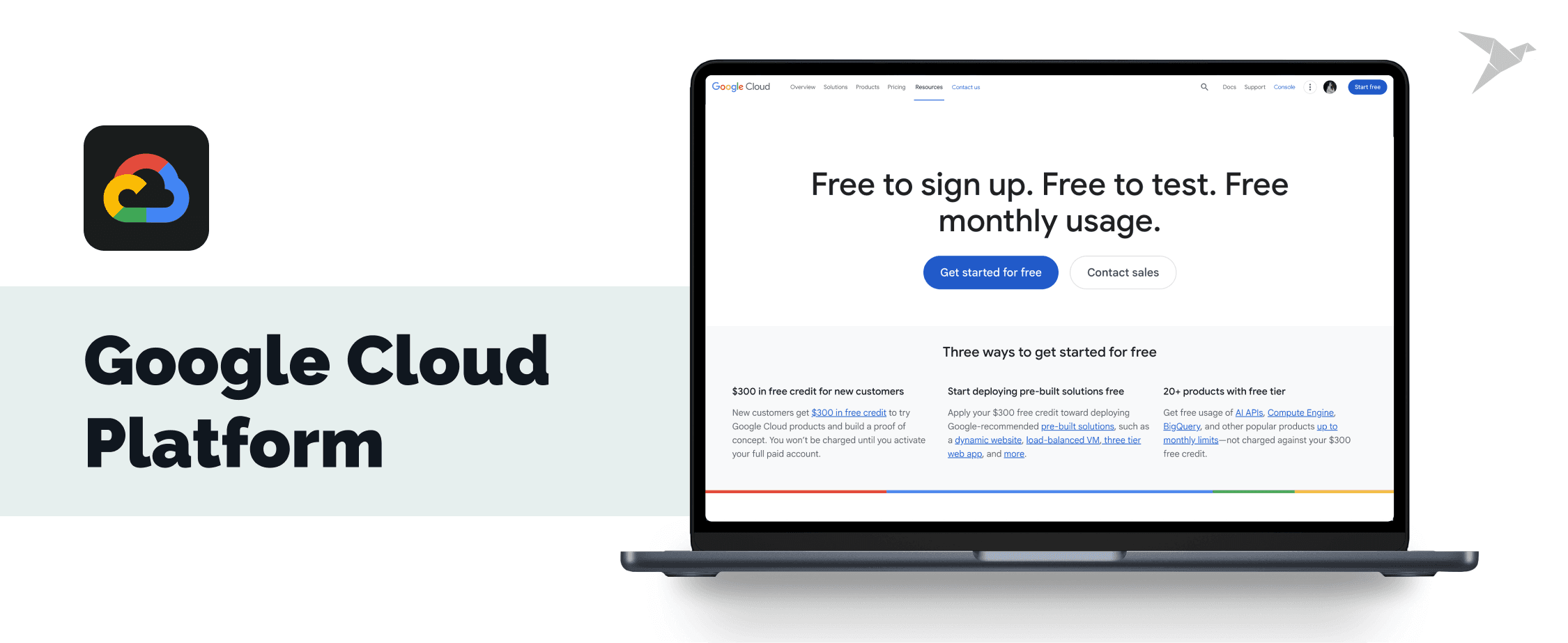
Google Cloud Platform (GCP) competes on a narrower front and wins on it. Its cloud technology is strongest in data analytics and machine learning, which is where a growing share of FinTech value now sits. About 960,000 businesses use Google Cloud Platform cloud computing solutions.
Strengths of GCP as a cloud provider
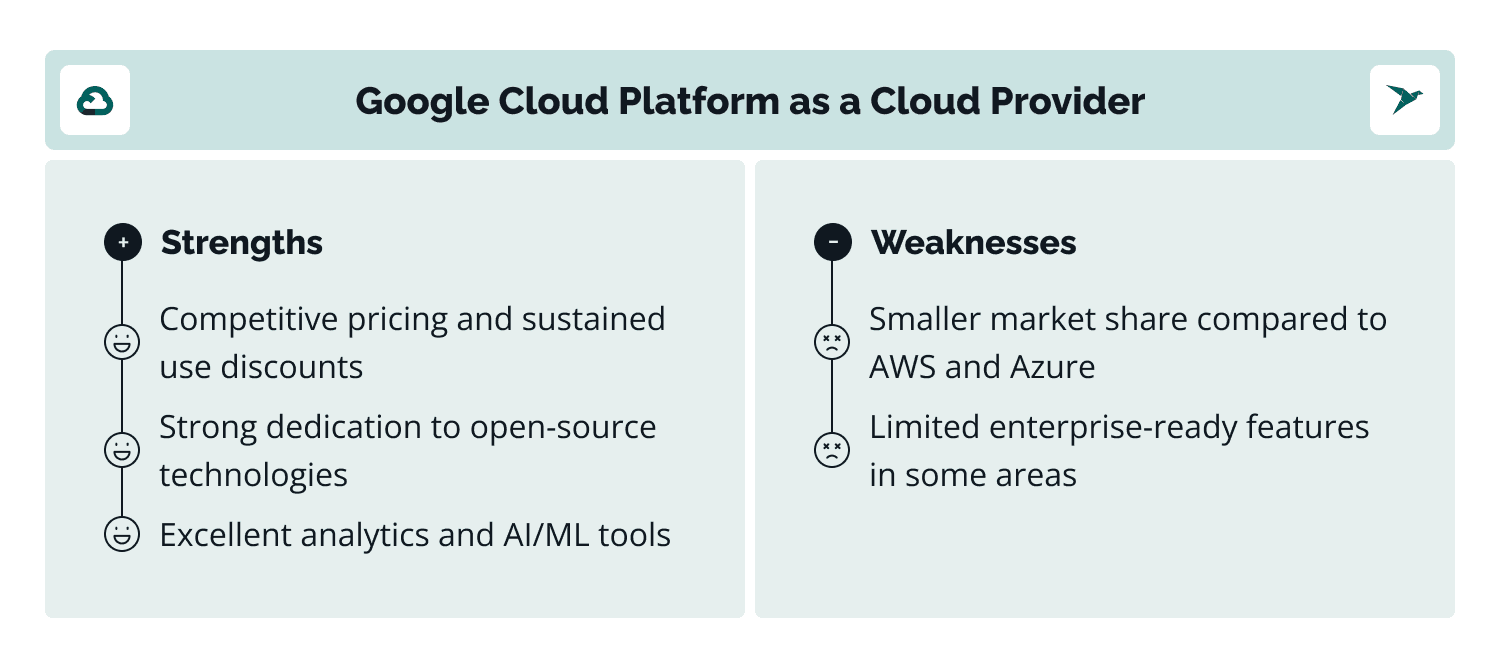
- Analytics and AI/ML tooling. BigQuery, Dataflow, and TensorFlow are the reason most FinTech teams end up on Google Cloud at all. Processing large datasets and training machine learning models is less work here than on the alternatives.
- Pricing. Competitive rates plus sustained use discounts that apply automatically, so cost efficiency improves without anyone managing reservations.
- Open-source commitment. Broad support for open technologies, which appeals to engineering teams who would rather not be tied to one vendor's runtime.
Weaknesses of GCP as a cloud provider
- Smaller market share. Third place behind AWS and Azure raises reasonable questions about ecosystem maturity and long-term commitment, fairly or not.
- Enterprise gaps. Some enterprise-ready features lag AWS and Azure, and you fill the difference with third-party integrations.
PayPal: a FinTech company using GCP
PayPal runs parts of its platform on Google Cloud Platform, serving millions of customers and processing billions of transactions.
Scale and reliability are the baseline. On top of that, GCP's analytics let PayPal pull valuable insights out of transaction data, which feeds decision-making, fraud prevention, and personalized customer experiences.
The AI and machine learning tooling supports PayPal's fraud detection models directly, and that is where the return shows clearest: better risk management and cleaner payment processing at the same time.
Google's global network keeps latency low for users wherever they are. That combination is a large part of how PayPal moved from an online payment platform to a broader financial technology company.
IBM Cloud: Enterprise Focus and Regulated Workloads
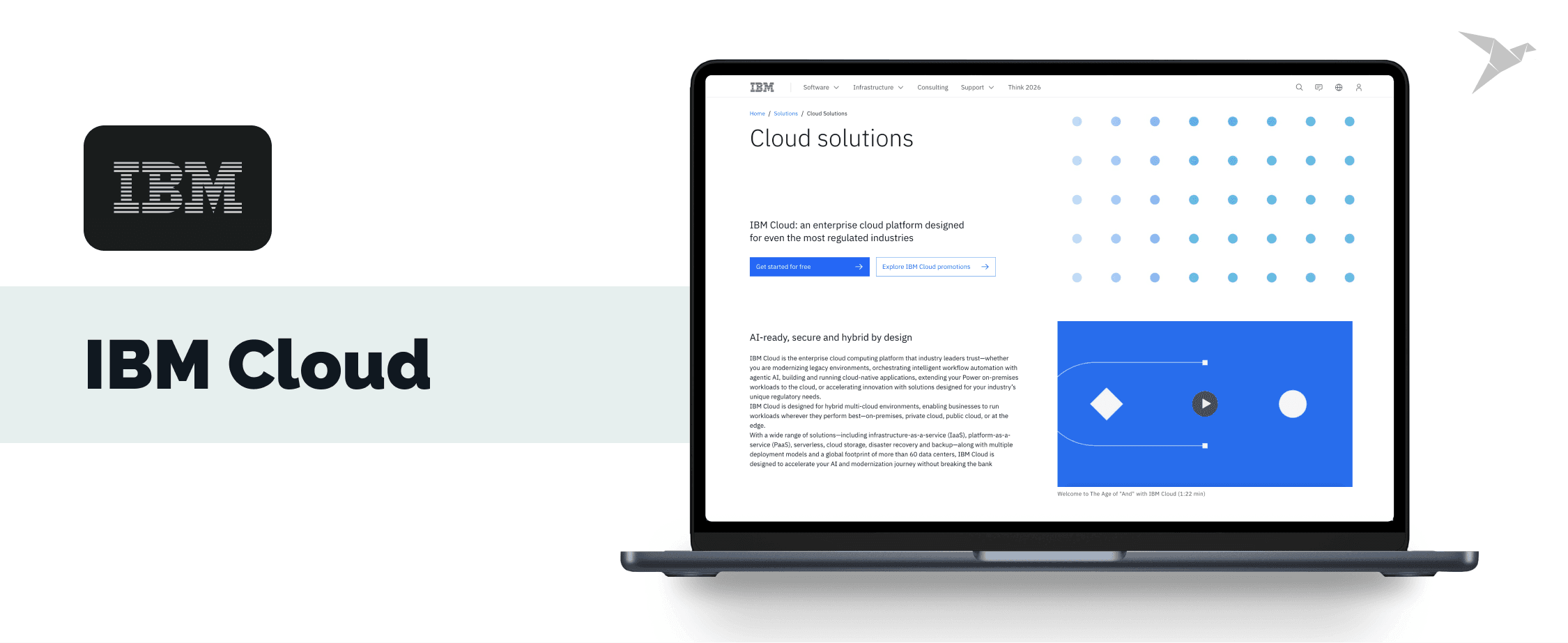
IBM Cloud sells to a different buyer. It is built around hybrid cloud solutions, enterprise workloads, and integration with legacy systems, combining IaaS and PaaS for mission-critical applications that need security and compliance controls spanning public and private environments. IBM Cloud operates through more than 60 data centers in 19 countries and multiple multizone regions.
IBM does not break out cloud revenue the way the hyperscalers do, so market share estimates are rougher. Industry data puts IBM at a small share of global IaaS/PaaS, around 2% in 2025, with hybrid-oriented offerings and enterprise integration services accounting for most of that presence. The wider business is growing. IBM reported 17% growth in its infrastructure segment year over year in Q3 2025, attributing the momentum to hybrid cloud and AI demand.
It is also buying. IBM announced an $11 billion acquisition of Confluent in late 2025, a real-time data streaming platform aimed at strengthening its data and AI infrastructure, which should widen its appeal in complex enterprise environments.
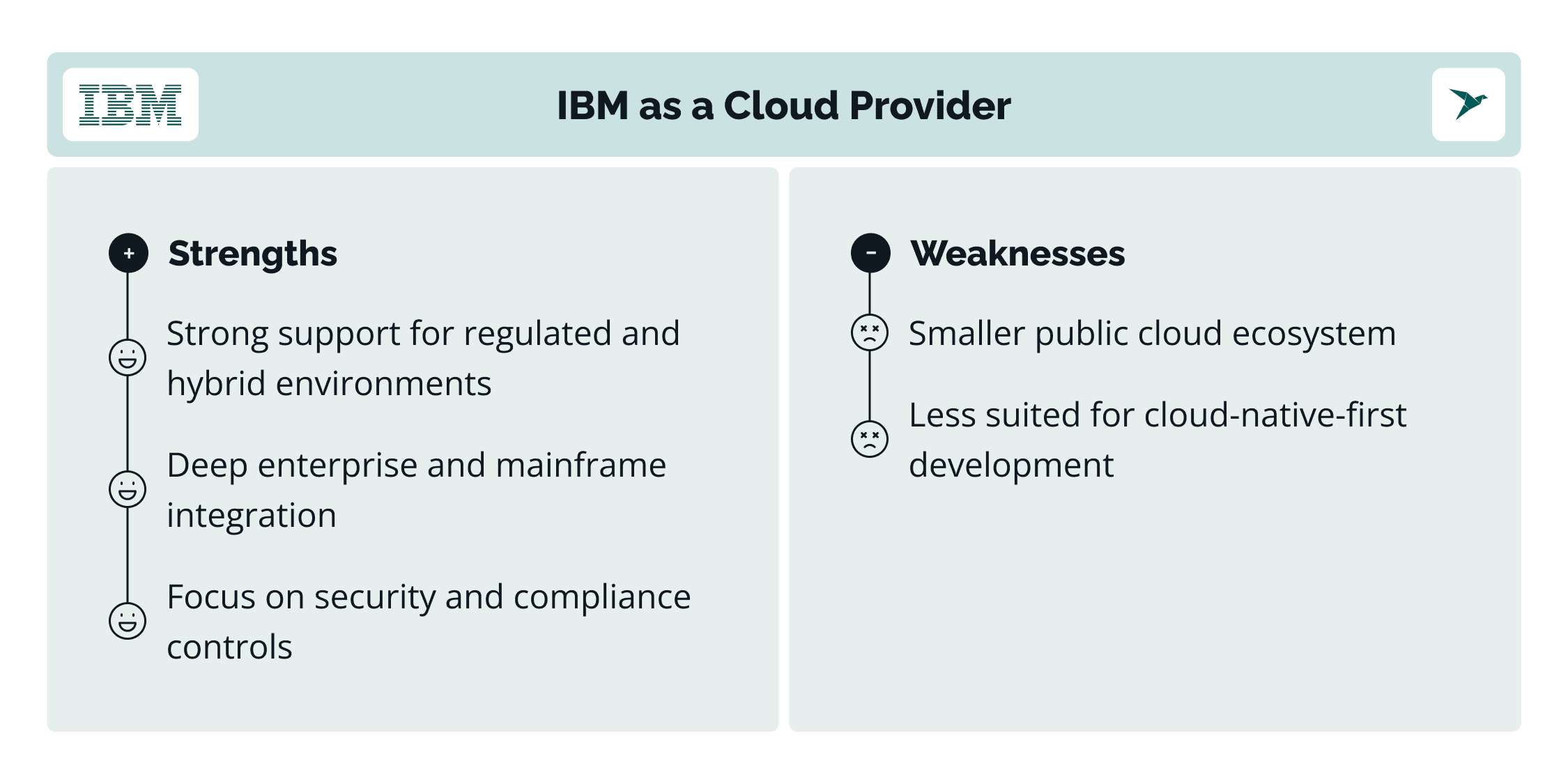
Strengths of IBM as a cloud provider
- Regulated and hybrid environments. IBM Cloud assumes part of your workload stays on-premises or in a private cloud, which fits FinTech organizations running across legacy systems, private infrastructure, and public cloud simultaneously.
- Mainframe and core banking integration. Decades of experience with core banking and mainframe workloads, and genuine integration with IBM Z and existing enterprise middleware. For financial institutions that lowers migration risk in a way no marketing claim can.
- Built-in security and compliance controls. Encryption, key management, identity access control, and audit logging, aimed at the data residency and access traceability requirements financial services actually face.
Weaknesses of IBM as a cloud provider
- Smaller public cloud ecosystem. Fewer third-party services and marketplace integrations than AWS, Azure, or Google Cloud, which slows adoption of newer cloud-native tooling.
- Not built for cloud-native-first teams. Building something new from scratch, you will find fewer managed services and less flexibility than on a hyperscaler platform.
FinTech example using IBM Cloud
BNY Mellon, one of the world's largest custodial banks, uses IBM Cloud for parts of its digital asset and financial services infrastructure, modernizing selected workloads while staying inside its regulatory obligations.
The model is hybrid. Existing core systems keep running and connect to cloud services, which preserves security controls, auditability, and operational resilience without a wholesale migration nobody wanted to attempt.
That is generally what IBM Cloud does in this sector: bridge traditional systems and modern cloud operations, rather than replace either one.
Oracle Cloud Infrastructure (OCI)
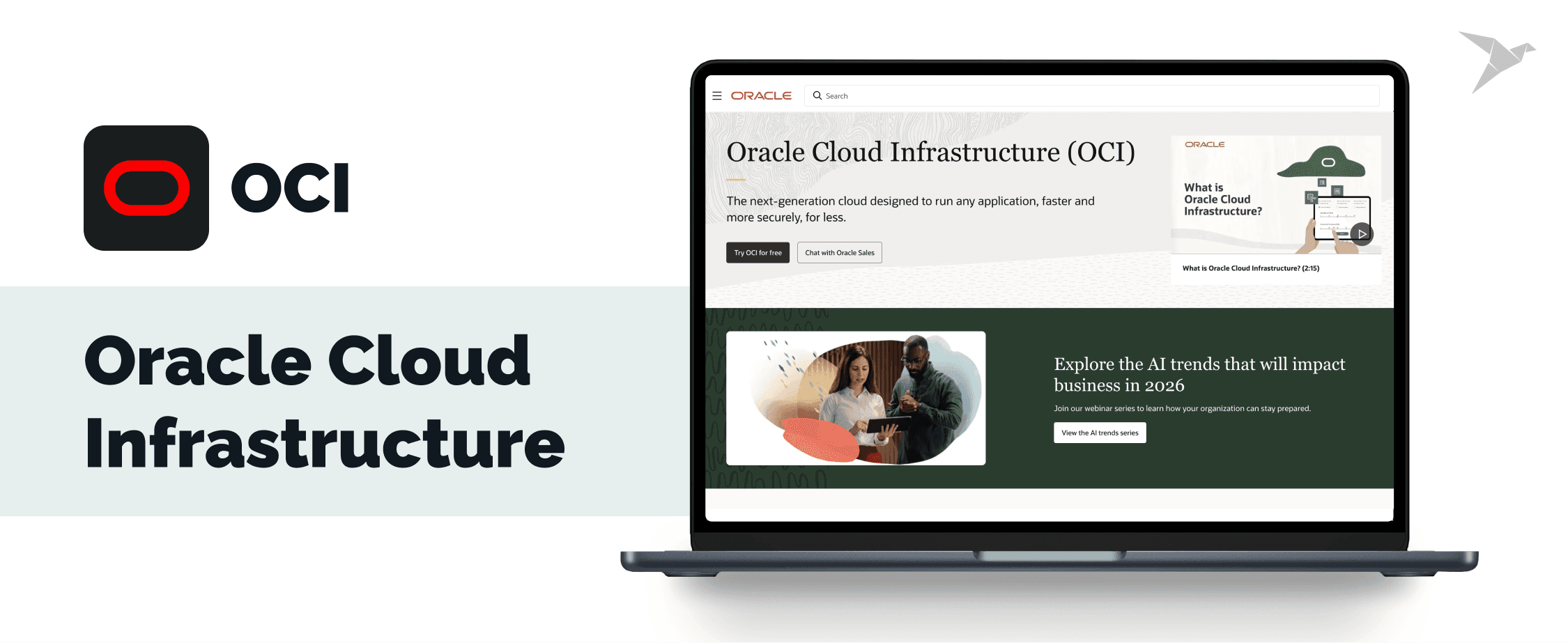
Oracle Cloud Infrastructure gets chosen by financial organizations running data-intensive, transaction-heavy systems. OCI is built around performance consistency, database tuning, and predictable cost models, which changes how to choose cloud provider for FinTech workloads sitting on core financial operations.
Oracle is a smaller player than AWS, Azure, or Google Cloud. Industry estimates place its share of the global IaaS/PaaS market at around 3–4% in 2025. The strategy targets enterprise workloads over broad cloud coverage, and the numbers reflect that choice rather than a failure to compete.
The cloud business is growing regardless. Oracle reported over $19 billion in cloud services revenue in FY2025, driven largely by Oracle Cloud Infrastructure and cloud database services, with demand concentrated among customers moving mission-critical and database-centric workloads.
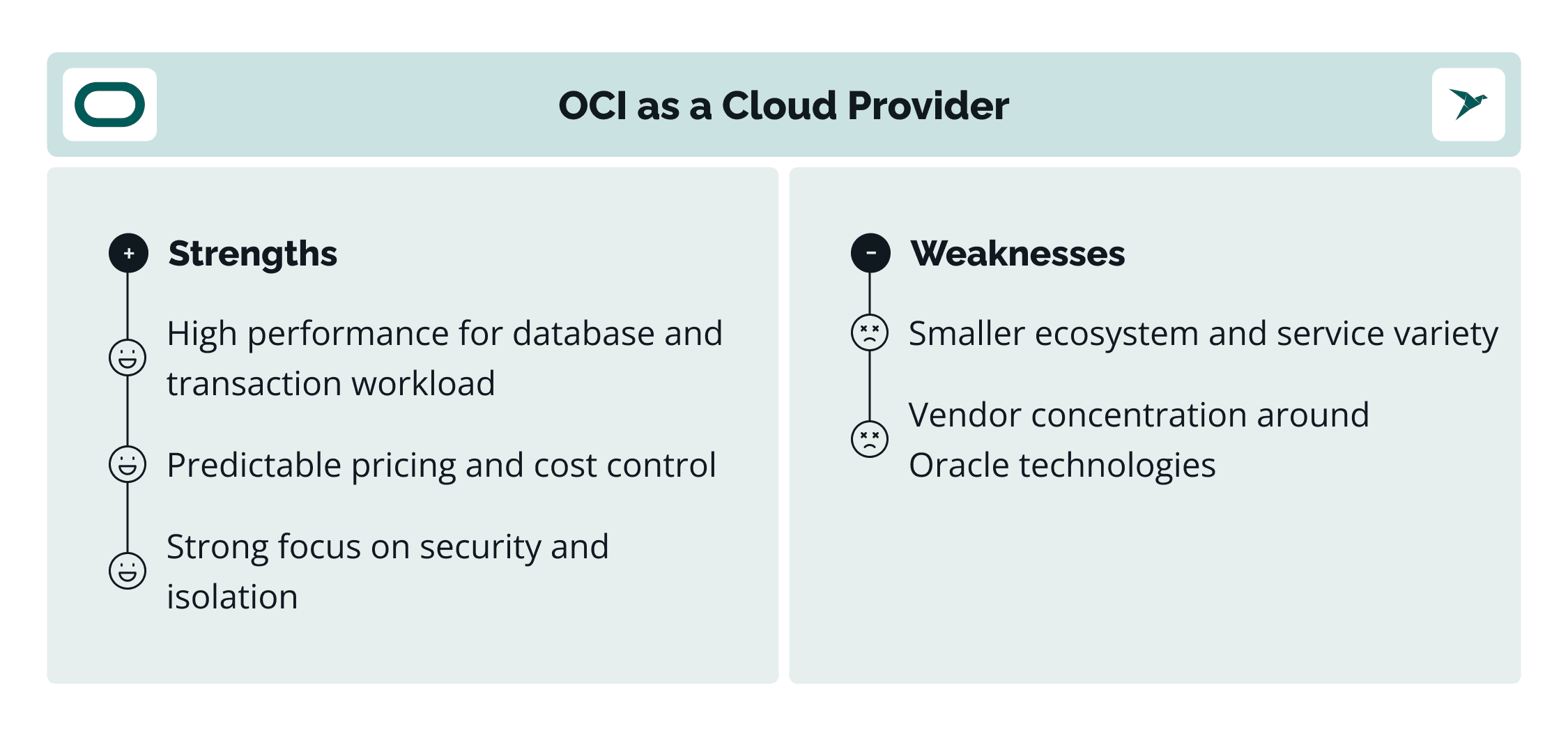
Strengths of OCI as a cloud provider
- Database and transaction performance. Tuned for Oracle Database and high-throughput transaction processing, which suits FinTech systems depending on low latency, high I/O, and response times that do not wander.
- Predictable pricing and cost control. Fewer variable charges than the hyperscalers use, so finance teams can forecast infrastructure cost and avoid an ambush during a busy quarter.
- Isolation and security. Network isolation, dedicated infrastructure options, and built-in encryption, aimed squarely at sensitive financial data and regulated workloads.
Weaknesses of OCI as a cloud provider
- Smaller ecosystem and service variety. Fewer managed services and third-party integrations than AWS, Azure, or Google Cloud, so analytics, AI, or specialized cloud-native functions need tooling from elsewhere.
- Vendor concentration around Oracle technologies. If you are not already on Oracle databases or middleware, adoption costs more, and migrating non-Oracle workloads takes planning and often refactoring.
FinTech example using OCI
PayPal also runs parts of its payment processing and core transaction systems on Oracle Cloud Infrastructure, where OCI's performance profile handles large transaction volumes at consistent latency.
Availability, data security, and predictable infrastructure behaviour are the requirements. OCI's database-focused architecture matches transaction-heavy work, where performance stability translates directly into financial operations that hold up.
Which Cloud Provider Best Supports FinTech Scalability and Global Growth?
FinTech growth means scaling across regions while staying inside regulatory and performance requirements at the same time. Comparing providers at the infrastructure level is what clarifies how to choose provider for FinTech cloud services as a platform expands internationally.
Elastic infrastructure and managed cloud services
AWS, Azure, and GCP all offer mature elastic infrastructure with deep managed services and cutting edge tools. Auto-scaling, managed databases, and serverless options absorb workload growth, adapt to shifting usage patterns, and let FinTech teams accelerate growth without growing operations headcount in proportion.
IBM Cloud and Oracle Cloud Infrastructure scale too, on a narrower front. IBM leans into hybrid and enterprise-managed environments that work with legacy infrastructure and regulated systems; Oracle into performance consistency for database-driven workloads. These hybrid solutions fit particular growth patterns rather than general cloud-native expansion, and they help organizations avoid vendor lock in when older systems are staying put.
Global coverage and data residency options
AWS and Azure have the widest regional coverage and the strongest global presence, which matters when entering regulated or emerging markets. Their regional spread supports data residency, redundancy requirements, and scaling against regional usage patterns.
GCP runs fewer regions but holds a solid global presence in the major financial hubs. IBM Cloud and Oracle cover less ground, which constrains expansion but works fine for organizations operating in defined regions, supporting hybrid solutions or running under strict residency rules tied to legacy infrastructure.
Performance for high-volume financial transactions
AWS and Azure handle high transaction volumes through varied compute options, advanced networking, and managed data services. Both hold up for payment processing, trading platforms, and real-time financial systems as usage patterns shift.
GCP's global private network suits low-latency distributed workloads, and its data processing stack is among the more cutting edge tools available. Oracle Cloud Infrastructure performs strongly on transaction-heavy and database-centric systems. IBM Cloud fits workloads that value stability and integration with existing enterprise platforms, particularly where legacy infrastructure is still central.
Service limits, quotas, and scaling constraints
Every provider enforces service limits to protect the platform. AWS, Azure, and GCP have formal quota-increase processes that support long-term scaling plans and let teams accelerate growth without hitting an unexpected ceiling.
IBM and Oracle apply limits too, usually tied to enterprise contracts and reserved capacity models. That requires planning up front and returns more predictable capacity for regulated or steady-state workloads, especially in hybrid solutions designed to avoid vendor lock in while balancing modern cloud services against existing systems.
How Do Cloud Ecosystems and Native Services Impact FinTech Development?
Cloud ecosystems decide how fast a FinTech team can build, integrate, and change a product. Native services, partner tooling, and industry-specific support all feed into development speed and into how much flexibility you keep. This is where evaluating the top cloud service providers for FinTech gets concrete, because ecosystem depth is far harder to change later than instance types are.
Financial services and industry-specific offerings
The majors build for financial workloads specifically. AWS and Azure both offer financial services frameworks, compliance tooling, and reference architectures aimed at banking and payments.
GCP concentrates on data-driven financial use cases. IBM Cloud serves the regulated and hybrid environments common in older financial institutions, and Oracle Cloud Infrastructure lines up with database-centric, transaction-heavy systems. Industry tooling that already exists is development work you do not have to do.
Data, analytics, and AI capabilities
Fraud detection, risk scoring, and personalization all run on data pipelines. AWS and GCP have the most mature analytics platforms and AI services for large-scale pipelines and machine learning workflows.
Azure ties analytics and AI tightly to enterprise data platforms. Oracle prioritizes performance and reliability for transactional data. IBM emphasizes governance, data control, and enterprise analytics. How deep these services go determines how quickly a team ships a data-driven feature.
Integration with enterprise and banking systems
FinTech products lean on core banking platforms, identity systems, and payment networks. Azure integrates cleanly with enterprise identity and directory services. IBM Cloud handles legacy middleware and mainframe integration, which almost nobody else does properly.
AWS and GCP give you broad API support and integration services, though older systems usually need extra configuration. Oracle Cloud simplifies the work for organizations already running Oracle databases or ERP platforms.
Partner network and marketplace maturity
Provider marketplaces extend what a platform can do through third-party tools. AWS and Azure run the largest ecosystems, with deep coverage across security, compliance, payments, and monitoring.
Let's Compare Cloud Providers in the Table
Choosing Cloud Computing Services: Tips from Techmagic’s Director of FinTech
Choosing the optimal private cloud and service provider can be challenging, especially within the FinTech sector. The goal of this article is to guide you through this process.
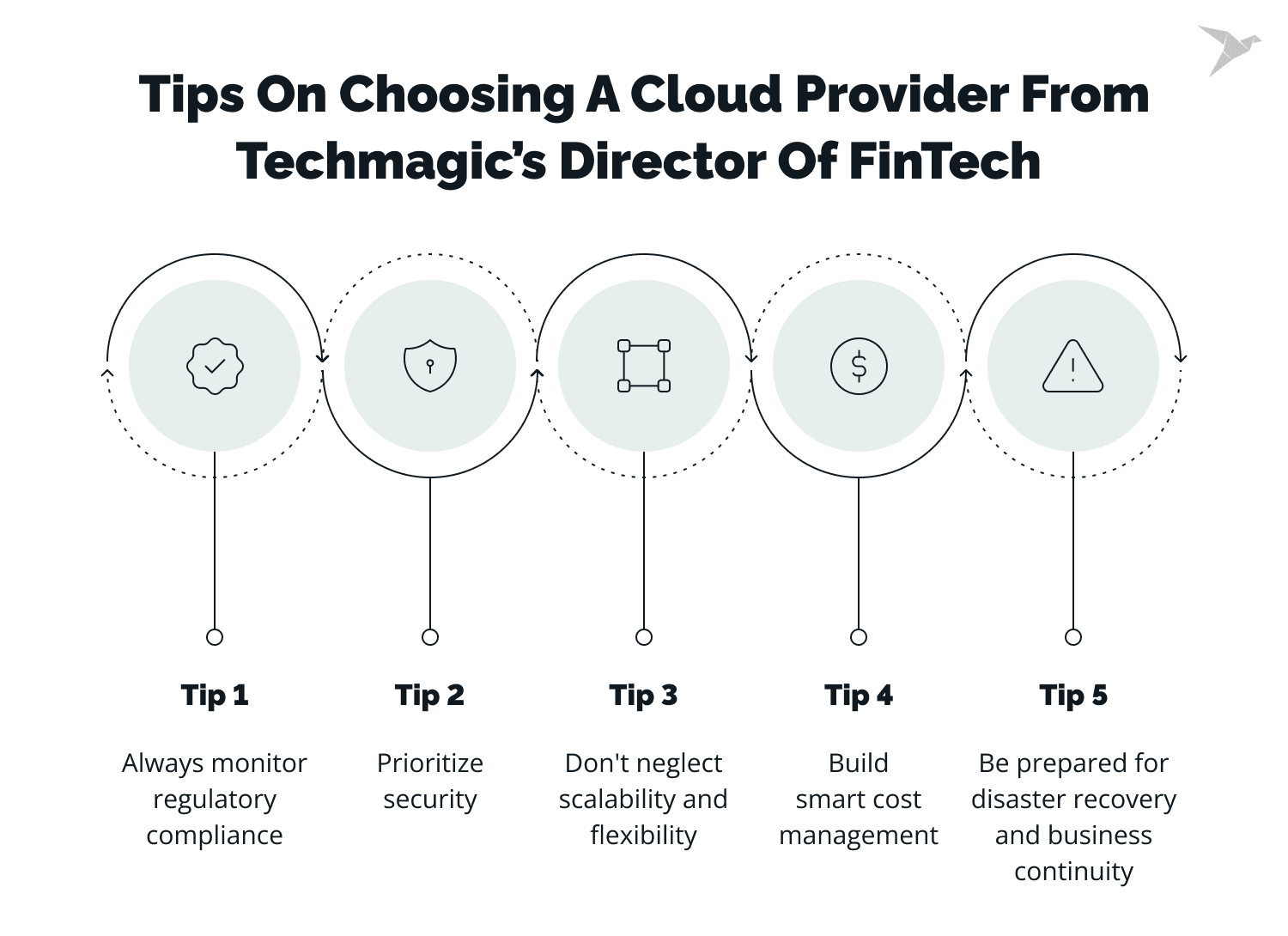
So, here are my recommendations as a director of FinTech at TechMagic on choosing a cloud services provider:
Tip 1: Always monitor regulatory compliance
Check that your provider actually holds the certifications your regulator expects. GDPR, PCI-DSS, and local financial rules are non-negotiable in FinTech, and the provider's posture shapes whether your own data storage and handling practices survive inspection. Getting this wrong costs fines first and reputation for much longer.
Tip 2: Prioritize security
Pick FinTech cloud service providers with strong encryption, data protection, and identity management. This is what stands between your sensitive data and a very bad week. Look specifically for multi-factor authentication, encryption both at rest and in transit, and monitoring tools that tell you what happened rather than just that something did.
Tip 3: Don't neglect scalability and flexibility
Choose a provider that scales resources without a procurement conversation. Flexible allocation is how you control cost and performance together, and it matters most for FinTech companies in rapid growth or with seasonal demand peaks. Check for automated scaling and a range of instance types wide enough to match your actual workloads.
Tip 4: Build smart cost management
Watch usage, use the cost tooling, and revisit pricing models regularly. AWS Cost Explorer, Azure Cost Management, and GCP's cost calculators all show where the money goes and where you can optimize costs.
CTOs at leading top financial app development companies will tell you cost discipline separates the projects that survive their second year from the ones that quietly do not. Ask your provider about credits too. Most teams never do.
Tip 5: Be prepared for disaster recovery and business continuity
Confirm your chosen cloud provider's disaster recovery is real. Downtime in FinTech is expensive enough that business continuity belongs on the board agenda, so assess multi-region backups, failover mechanisms, and automated recovery before you commit.
Then test it, on a schedule. An untested disaster recovery plan is a document. It becomes a capability the first time someone proves it works.
Summing Up
Your cloud provider shapes how a FinTech platform scales, how it meets regulatory demands, and how much operational risk it carries. The right answer depends on your product roadmap, your compliance scope, and the systems you have to run and integrate, infrastructure management included. Provider strengths differ enough that comparing them against your real constraints beats hunting for a universal best cloud provider.
AWS gives you the broadest service portfolio and the widest reach, and charges for it in complexity. Pricing is hard to model and the learning curve is real. Without governance in place early, cloud spending climbs faster than anyone forecast, which is why teams that focus on cost savings and ways to optimize costs from the start end up ahead of the ones that retrofit it.
At TechMagic, we offer cloud implementation services to assist you in making the right choice and guide you throughout the whole process. We can help you make the right provider choice and turn it into a working foundation. Talk to us for details!

FAQ

Start with regulatory fit, because it eliminates options fastest. Then robust security features and data protection, since cloud provider security sets the floor for your own. After that: cost efficiency, consistent performance, scalable solutions that grow with transaction volume, strong data management, and seamless integration with your existing systems. If you are building on AI, check the maturity of their predictive analytics and ML services before you commit rather than after.
AWS is generally competitive, with pay-per-use and reserved instances giving you levers over operational costs. Azure's pricing models include Azure Hybrid Benefit, which is worth real money if you already hold Microsoft licences. GCP is the most transparent of the three, and its sustained-use discounts apply automatically, which helps long-term cost efficiency without anyone managing reservations.
Both handle regulated workloads and both deliver secure and scalable solutions. AWS goes deeper on services and gives you finer-grained controls. Azure tends to fit enterprises already committed to Microsoft identity and governance, and it is stronger on hybrid cloud capabilities and on enterprise grade seamless integration with the tooling those organizations already run.
PCI DSS, ISO 27001, SOC 1/2, GDPR, and whatever your local financial regulator requires. Beyond the certificate list, check data residency options, data encryption, audit logs, and a shared responsibility model written clearly enough to argue from. Strong cloud provider security backed by robust security features is what you are actually buying.
Any major public cloud provider is highly available, and that is not the same thing as your platform being reliable. Architecture decides it. Multi-zone or multi-region design, failover that has been tested, monitoring tools that alert before your customers do, and scalable solutions sized for your real peaks are what determine uptime.
Yes, and it costs more than teams expect if you have leaned hard on provider-specific services or bet everything on a single right cloud provider. Portability comes from modular design, standard runtimes, clear data export paths, and planning for multiple cloud providers before you need them rather than during the migration.
Yes, usually for resilience, compliance, or vendor risk control. Running multiple cloud providers adds real operational complexity, so it needs strong governance, consistent security controls, and careful management of operational costs. Done casually it gives you the downsides of both platforms and the benefits of neither.
AWS offers SageMaker for machine learning and predictive analytics, plus Rekognition and a wide AI service range. Azure has Azure Machine Learning and Cognitive Services, with the tightest enterprise integration of the three. GCP has the strongest reputation in artificial intelligence and ML, including Cloud AI Platform and Cloud Vision API, with solid generative AI support and advanced data management.