
 Software Development
 Security Services
 Cloud Services
 AI Services
 Other Services















 TechMagic Academy


How To Choose a HIPAA-Compliant Telehealth Platform for Your Healthcare Practice
Last updated:9 August 2026


Choosing the right telehealth platform isn’t easy. You’re balancing patient care, compliance, and technology while trying to keep your team confident and your data secure. Every click, every video call, and every shared file carries risk when protected health information is involved.
You already know HIPAA matters. What you need is clarity: what exactly makes a telehealth platform HIPAA compliant, which platforms truly meet those standards, and how to choose one that fits your practice without adding unnecessary complexity or cost.
In this guide, you’ll find clear answers. We’ll explain what HIPAA compliance means for telehealth, why it matters for your organization, what to look for in secure platforms, and how to set one up the right way. You’ll also see examples of trusted HIPAA-compliant telehealth platforms and learn how TechMagic can help you build or integrate a custom, compliant solution that fits your workflow.
Key Takeaways
- A platform gives you safeguards and signs a business associate agreement; the legal obligation never leaves your organization, and vendors who blur that line are telling you something about themselves.
- Get HIPAA compliance wrong and three things break at once: patient privacy, your federal exposure, and your reputation.
- Most failures we see aren't platform failures. They're setup failures. Nobody signed the BAA, encryption was left on defaults, twelve people share one login.
- Trained staff and written administrative policies beat a better feature list. Every time.
- Patients notice when you explain plainly how you store and protect patient data. That does more for engagement in virtual care than any feature you could buy.
- A secure system your clinicians avoid isn't secure. Weigh usability alongside integration with electronic health records and practice management tools.
- When nothing off the shelf fits, custom builds or Medplum-based development are the alternative.
How We Selected HIPAA-Compliant Telehealth Platform Examples in This Post
Further down we name specific HIPAA-compliant telehealth platforms. Here's how they got on the list.
The first filter was blunt: signed business associate agreement, end to end encryption, access controls, audit logging, EHR integration. Miss one and you're off. Then usability and total cost of ownership, because we've watched a genuinely secure platform get abandoned inside a month because the login flow annoyed a busy clinic.
Five sources fed the list:
- Verified user reviews on Capterra, G2, and Software Advice, weighted by recency and volume
- Public case studies from vendors and from the health systems actually running them
- Our own testing of security features and clinical workflows
- Industry research on telehealth adoption and compliance trends
- Clinician discussions in professional forums, which is where the complaints live
One thing shapes how we read vendor claims. We build this software. TechMagic delivers telemedicine products for clinics, startups, and enterprise health systems under HIPAA, HITECH, FHIR and HL7, so we know which safeguards survive contact with a live clinic and which ones only look good on a feature page.
What HIPAA Compliance Means for Telehealth
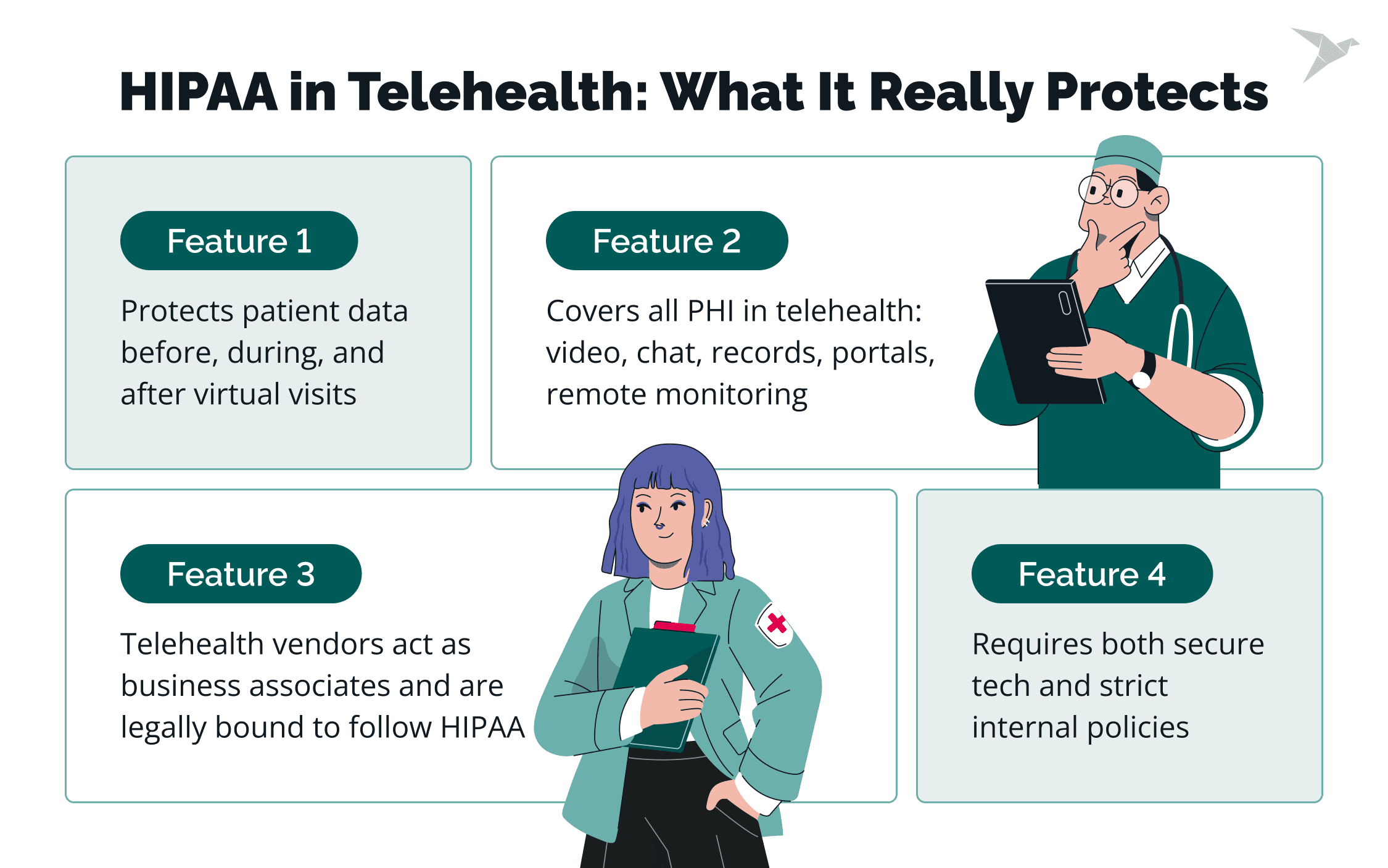
HIPAA compliance in telehealth means protecting patient information before, during, and after a virtual visit. Technology and habits both.
One distinction first, because the whole article rests on it. Compliance belongs to your organization, never to a product. HIPAA applies to covered entities: health plans, health care clearinghouses, and covered health care providers whose claims and clinical data are transmitted electronically.
So when people say HIPAA compliant telehealth platforms, what they mean is software built to support that obligation, backed by a vendor willing to sign a business associate agreement. The obligation stays with you. It cannot be bought.
What is HIPAA, and its role in digital healthcare
The Health Insurance Portability and Accountability Act (HIPAA) was written to protect patients' medical information and give them a say in who sees it. It was designed for filing cabinets. It now governs telemedicine, remote monitoring, and patient portals.
Telehealth vendors usually land in the business associate category, which binds them to the same rules you follow. Three sets matter: the Privacy Rule, the Security Rule, and the breach notification rules.
If you want a plain-English starting point, the Health Resources and Services Administration publishes guidance for health care providers at telehealth.hhs.gov, and it's better than almost anything a vendor will hand you.
How HIPAA applies to telehealth platforms
A telehealth tool touches PHI every time a patient's name, diagnosis, or lab result crosses it. Chats. Video sessions. Screen sharing. That file someone dragged into the window at 4pm.
A compliant setup covers all of it with encryption, access control, and audit trails, so data stays protected end to end. Vendors sign a business associate agreement with healthcare providers, and that signature is the point. Marketing copy saying a product is "aligned with HIPAA rules" isn't a BAA and doesn't transfer any liability.
Key Privacy Rule requirements for telehealth providers
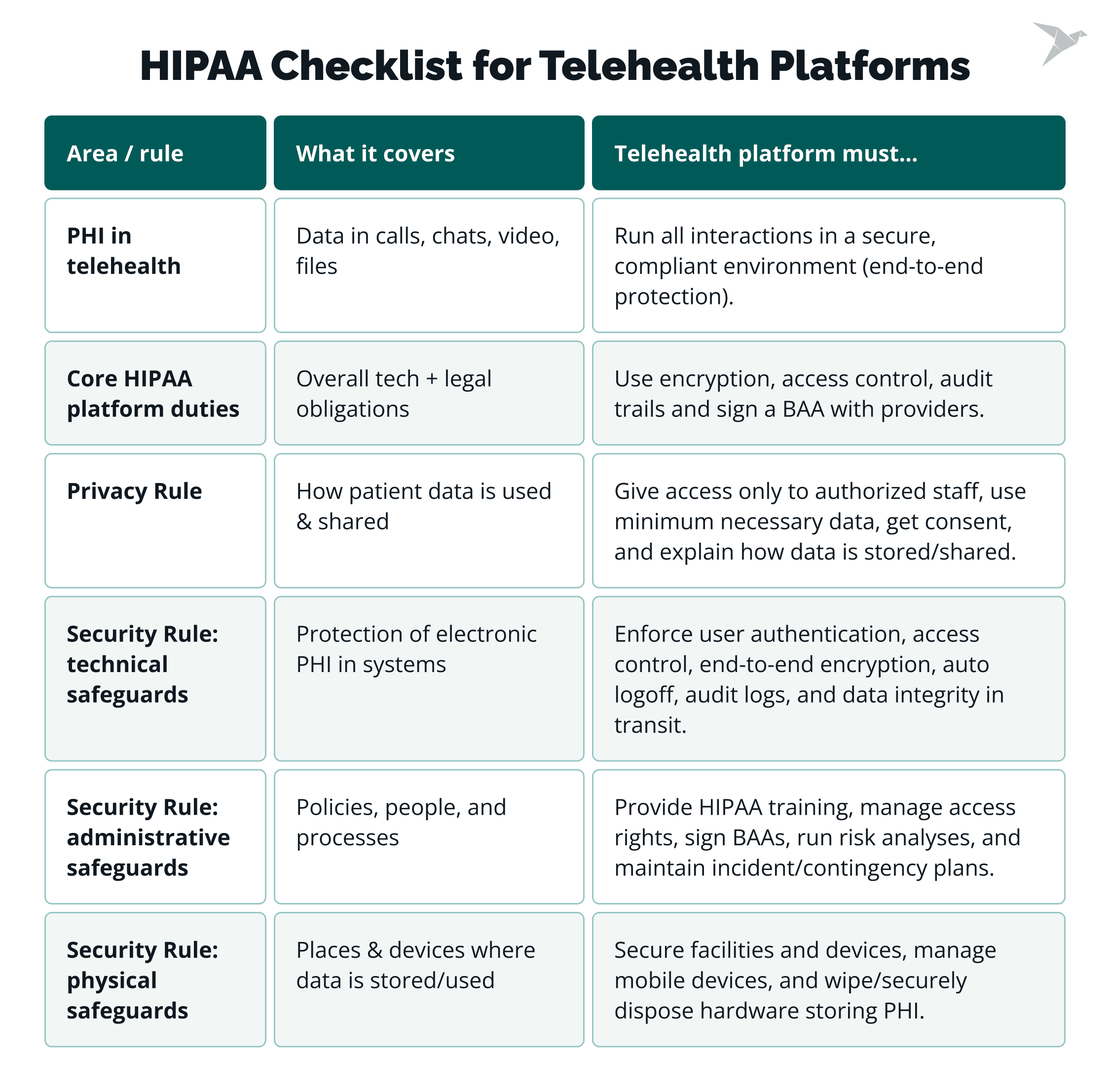
The HIPAA Privacy Rule sets the limits on how patient data gets used and shared. In telehealth: minimum necessary access, authorized staff only, consent before disclosure. And you have to tell patients plainly how their information is stored and shared, virtual visits included. Most privacy notices fail that last part by being technically complete and completely unreadable.
Key Security Rule safeguards for telehealth platforms
The Security Rule handles electronic PHI. It sorts security measures into three groups, and all three are required.
Technical safeguards: core requirements for secure telehealth systems
- Access controls and user authentication, so only verified users reach patient data
- End to end encryption, in transit and at rest
- Automatic logoff. Shared workstations are where this earns its keep
- Audit controls tracking who opened what, and when
- Data integrity and transmission security
Administrative safeguards: policy and process compliance
- Workforce training and access management
- Business associate agreements, one per vendor, no exceptions
- Risk analysis and ongoing security review
- Contingency and incident response plans, tested rather than filed
- Written administrative policies short enough that staff actually read them
Physical safeguards: protecting data storage and access points
- Secure facility and device access
- Mobile device management, and proper disposal. A wiped laptop still isn't a donated laptop
- Environmental protection for hardware
Why HIPAA Compliance Matters in Telehealth
In telehealth the entire clinical relationship runs through technology, so compliance is doing work that walls and locked filing cabinets used to do. No other corner of the healthcare industry pushes this much regulated data through consumer devices on domestic wifi.
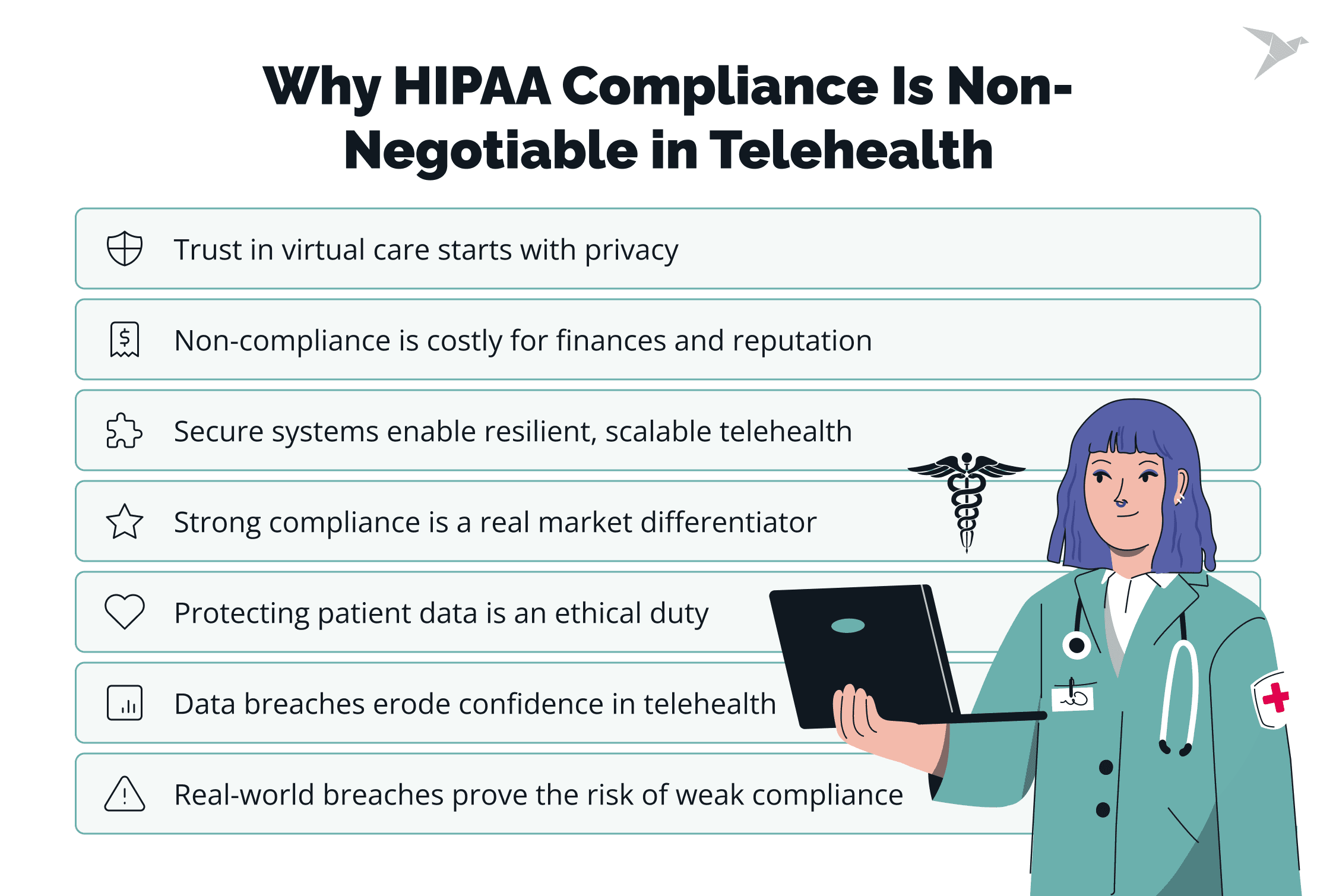
Here are the key “whys”:
Patient trust depends on privacy and transparency
Patients want to know a video call is as private as a consulting room. Tell them plainly how data is used, stored, and shared, and they talk more openly. That's not a soft benefit. A patient who withholds a symptom because they're unsure who's listening is a clinical problem.
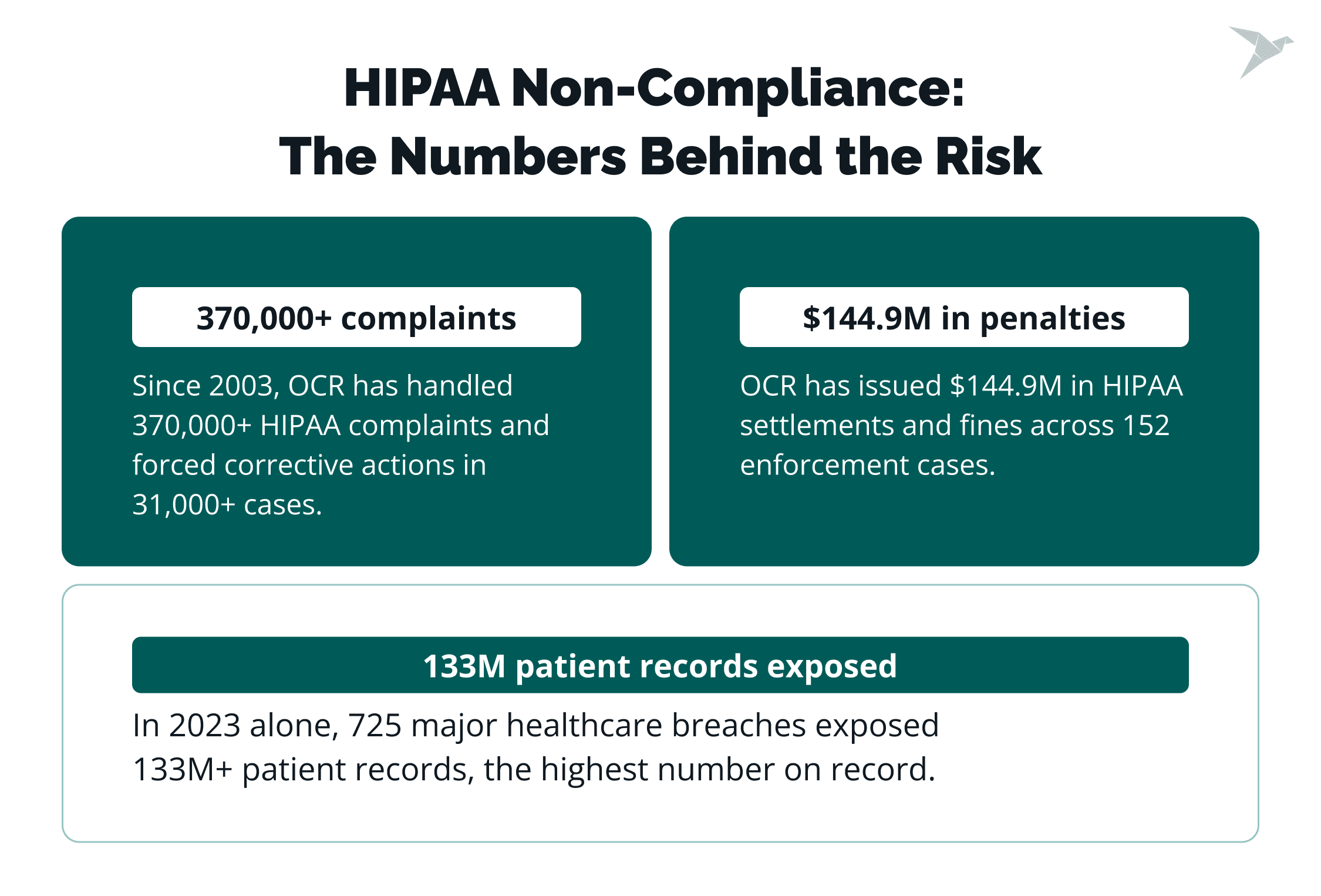
In 2023 the U.S. healthcare sector reported 725 large-scale data breaches, exposing more than 133 million patient records. Highest on record. Your patients may not know that number, but they've read the headlines it produced.
Non-compliance leads to costly penalties and reputational loss
Fines run from thousands into the millions depending on how negligent you were. The fine is the part you can budget for. What you can't budget for is the local news segment, and non compliance has a habit of surfacing at the worst imaginable moment. The Office for Civil Rights (OCR) has already imposed $144.9 million in HIPAA violation settlements and penalties across 152 cases since enforcement began.
Data breaches undermine confidence in virtual care
A single security lapse, an unencrypted call, an exposed file, or an unsecured device can erode public trust. Once confidence in digital healthcare falters, adoption slows and patient engagement suffers. A telehealth HIPAA compliant platform helps prevent this as it secures every data exchange, every time.
Strong compliance differentiates providers in a competitive market
Telehealth adoption has accelerated, and patients now have options. Demonstrating strong compliance gives your organization an edge. It shows you take security seriously, which appeals not only to patients but also to partners, insurers, and enterprise clients evaluating which telehealth platforms are HIPAA compliant and reliable.
Secure systems ensure sustainable and resilient telehealth operations
To ensure HIPAA compliance means to be ready for tomorrow’s risks. When you build security into your telehealth infrastructure, you’re also investing in stability, scalability, and business continuity. Systems that are secure by design stay adaptable in a dynamic digital healthcare industry.
Protecting patient data is an ethical and professional obligation
Beyond policy, compliance reflects a core value of healthcare: do no harm. Protecting data is part of that promise. Upholding patient privacy in virtual care honors the same ethical commitment healthcare professionals make in person.
Real-world violations show the consequences of neglecting compliance
The Office for Civil Rights (OCR) regularly investigates breaches caused by unsecured video platforms, missing BAAs, or misconfigured cloud storage. These cases serve as reminders: even small oversights can lead to major fallout. Staying compliant means learning from these examples and building proactive safeguards.
Since 2003, OCR has resolved over 370,000 HIPAA-related complaints and required corrective action in more than 31,000 cases.
Key Factors to Consider When Choosing a Telehealth Platform
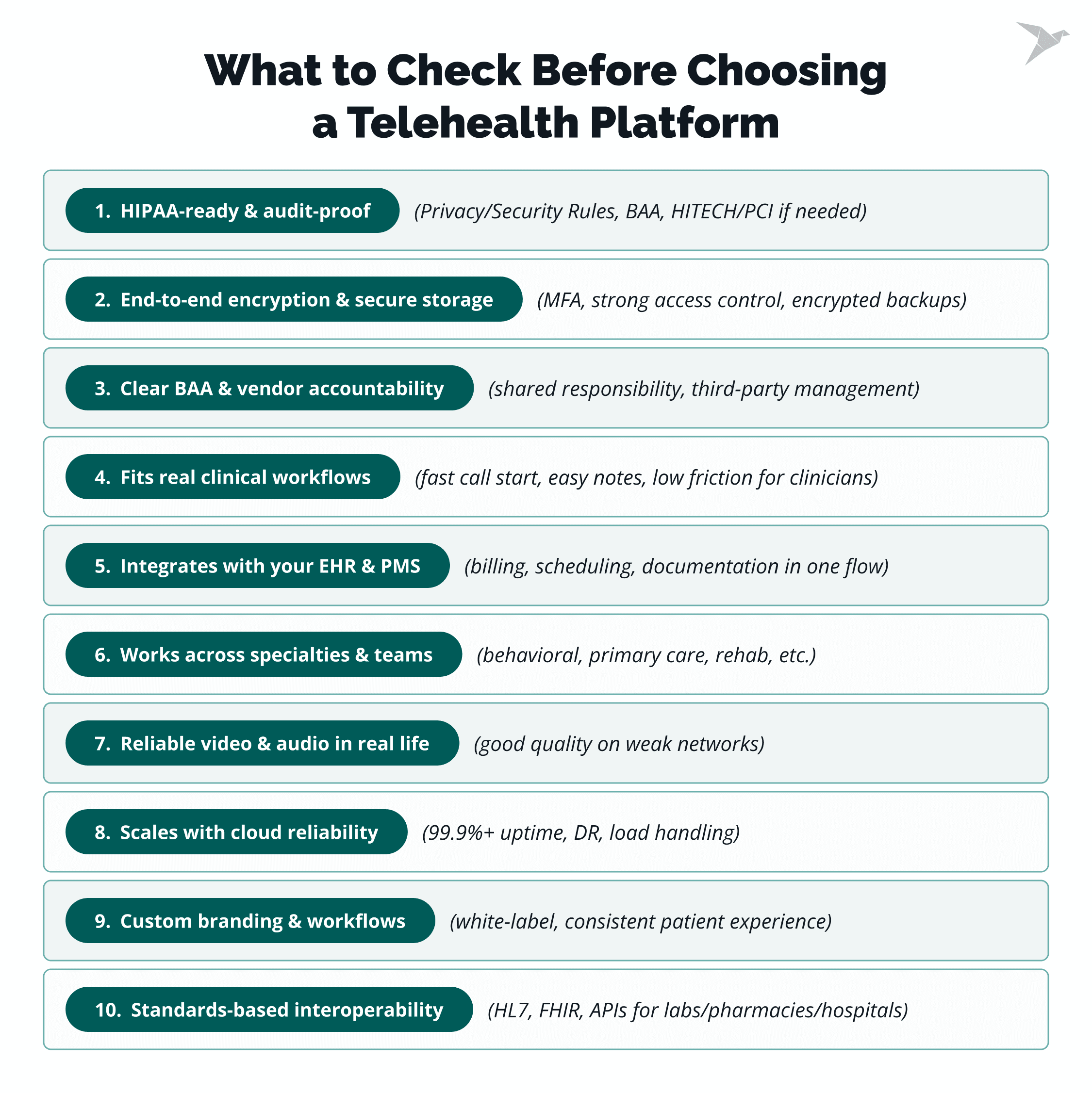
You're picking something you'll live with for years, so it's worth doing properly. The best HIPAA compliant telehealth platforms hold security and usability together instead of trading one for the other. Eight things decide which one you end up with, and they matter roughly in this order.
HIPAA readiness and the business associate agreement
Start here. It kills most of the shortlist in an afternoon. Confirm the vendor supports the Privacy and Security Rules, hands over compliance documentation without a sales call, and will sign a detailed, current business associate agreement. No BAA, no deal. Your organization carries the full liability for a breach otherwise. Ask about subcontractors too. Their third parties become your exposure, and vendors rarely volunteer that list. If you're billing insurance, check HITECH and PCI DSS readiness while you have their attention.
Data encryption, access control, and secure storage
Encryption tells you how a vendor thinks. Look for end to end encryption, real password policy, multifactor authentication.
Then ask the awkward questions. Where does PHI physically live, cloud or on-premises? How is it encrypted at rest? Are backups protected the same way, or did nobody get around to that? The answer to the backup question is revealing more often than it should be.
Business associate agreement and vendor accountability
A signed BAA is a HIPAA requirement. It defines the vendor’s legal obligation to safeguard patient data. Without it, your organization bears full liability for breaches. Ensure the vendor offers a detailed, up-to-date BAA and is transparent about how it manages third-party partners and subcontractors.
Clinical workflow compatibility and ease of use
Bring your care team to the demo. Not the IT lead, the people who'll use it forty times a week. Many clinicians will quietly stop using anything that takes more than a few clicks to start a call or file a note, and they won't tell you they've stopped. They'll just go back to what they had. The same goes for patients: no downloads, no hurdles, works on a phone as easily as a laptop. Check WCAG accessibility standards, closed captioning, screen reader support. Care that excludes people isn't care.
EHR integration and interoperability (HL7, FHIR, APIs)
Integration is what makes a telehealth platform part of the record instead of a system running beside it.
Look for native or API-based connections to your electronic health records, billing, and scheduling, and confirm HL7 and FHIR support so labs, pharmacies, and other healthcare providers can exchange data with you. Every manual re-entry is two problems: a transcription error waiting to happen, and PHI sitting in a clipboard.
Support for multi-specialty use and call quality
Behavioral health, primary care and rehabilitation want different session types, templates and patient engagement tools. Group sessions too, depending on the specialty. One platform should cover all of it.
Then test the video where your patients actually are. The office fiber connection tells you nothing. A secure platform that freezes mid-consultation has failed at the only job that matters. Check it degrades gracefully on poor bandwidth, and keep phone calls available for patients whose internet isn't reliable. Plenty of them exist.
Scalability, reliability, and support
Uptime guarantees, with 99.9% a fair benchmark. Disaster recovery. Load handling. Hosting certified for healthcare data.
Then read the SLA properly, including the boring parts: response times, 24/7 availability, escalation paths. Support quality only shows itself on your worst day, which is exactly when you can't shop around.
Customization and white-labeling capabilities
White-label options keep your logo, colors and templates on top of a compliant backend. Worth it for multi-location networks, and for anyone whose patient experience is part of the brand rather than an afterthought. Larger systems should check hardware support too, including mobile telehealth carts if care moves between wards.
Certifications, total cost of ownership, and product roadmap
Ask for evidence. Assurances are free and worth about that much. SOC 2, ISO 27001 or HITRUST certification. Recent audit results. Penetration test findings, including what they found and fixed.
Upfront pricing hides most of the real cost, so add setup, training, BAA coverage, integration and upgrades before you compare anything. And ask what's on the roadmap. Telehealth technology and health information technology both move quickly, and a vendor drifting without direction becomes your constraint in about three years.
Work through those and you'll land on HIPAA compliant platforms that protect patient data, keep clinicians onside, and grow with you.

Top Examples of HIPAA-Compliant Telehealth Platforms
There's a wide field of secure video conferencing tools out there, built for very different practices. Which of the telehealth options suits you comes down to size, specialty, workflow, and how much you need to bend the software to fit.
Doxy.me – Simplicity and accessibility for small practices
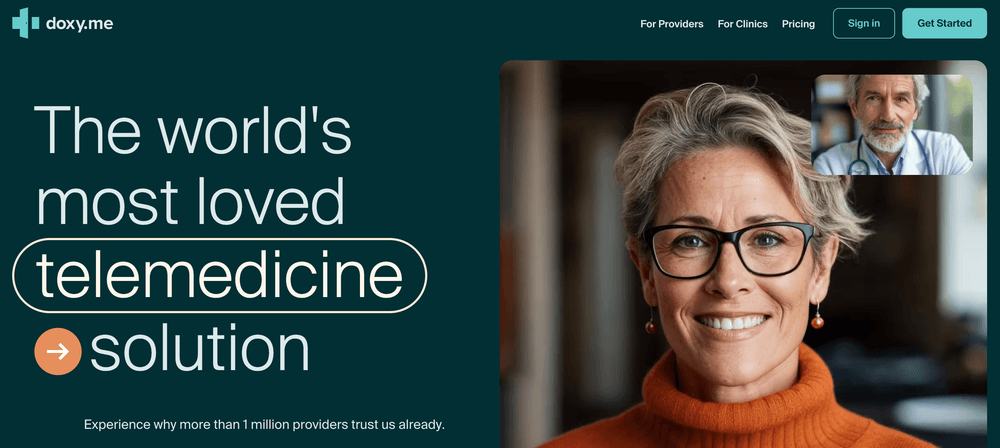
Doxy.me runs in ordinary web browsers and does almost nothing else, deliberately. Patients click a link and they're in. The free tier covers encrypted video; paid tiers add branding and a virtual waiting room. For a solo clinician who wants to start seeing patients remotely next Tuesday, it's hard to beat.
Best for: solo practitioners and small clinics wanting affordable, low-friction video visits.
Key strengths: ease of use, nothing to install, quick setup, end to end encryption.
Weaknesses: thin integrations, basic analytics, and a free tier that runs out of road quickly beyond simple video calls.
Zoom for Healthcare – Enterprise-level video with HIPAA compliance
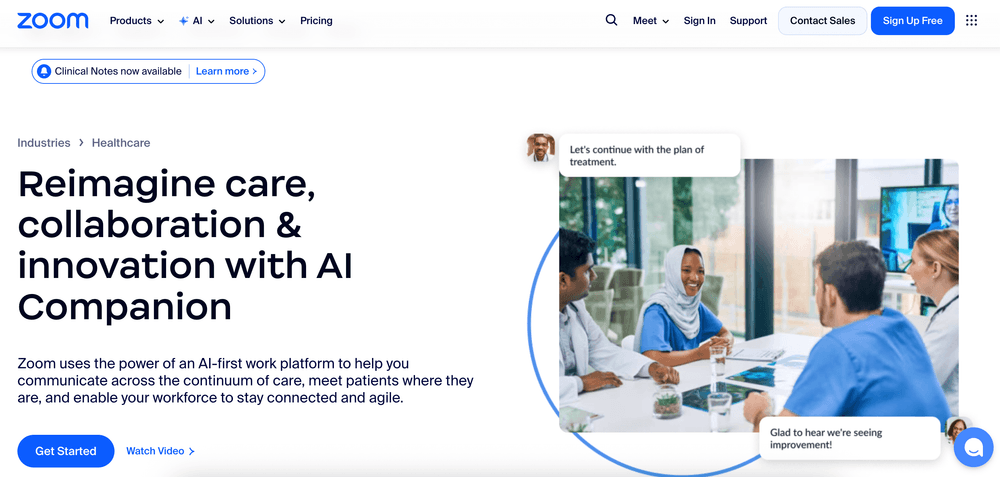
Zoom for Healthcare wraps compliance features around an interface your staff already know, which removes a training problem most vendors hand you. BAAs, AES 256-bit encryption, integration with EHRs including Epic and Cerner, and it holds together when hundreds of sessions run at once.
Best for: hospitals, enterprise healthcare networks, and academic medical centers.
Key strengths: video quality, compliance documentation, enterprise integration, customizable workflows.
Weaknesses: the healthcare tier costs considerably more than standard Zoom, and buying the licence doesn't make you compliant, the configuration does.
VSee – Flexible Platform for Startups and Specialty Clinics
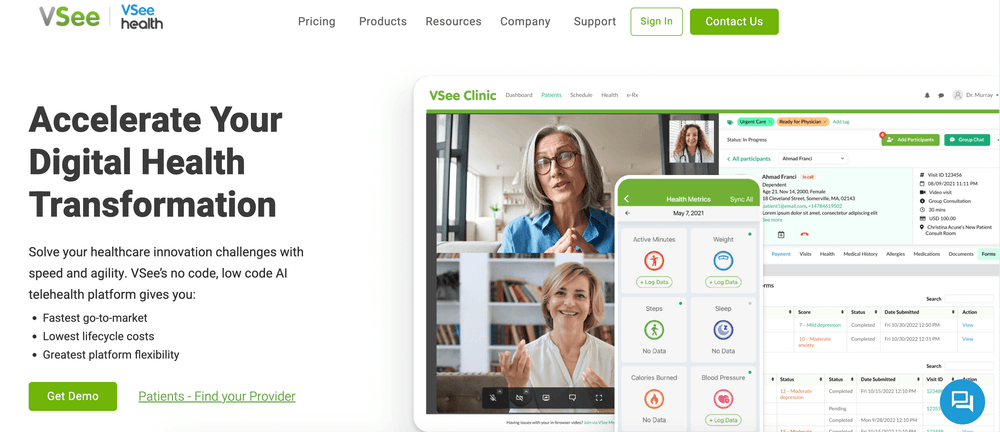
VSee sells HIPAA compliant telehealth tools as modules: video visits, remote monitoring, patient triage. You assemble what you need. That's the appeal and the catch.
Best for: niche healthcare startups or specialty practices (like behavioral health or dermatology) that value agility and customization.
Key strengths: modular design, medical device integration, API flexibility, and HIPAA-ready infrastructure.
Weaknesses: assembly takes technical input an all-in-one product doesn't ask for, and the interface shows its age next to newer competitors.
Mend – All-in-one telehealth and patient engagement solution
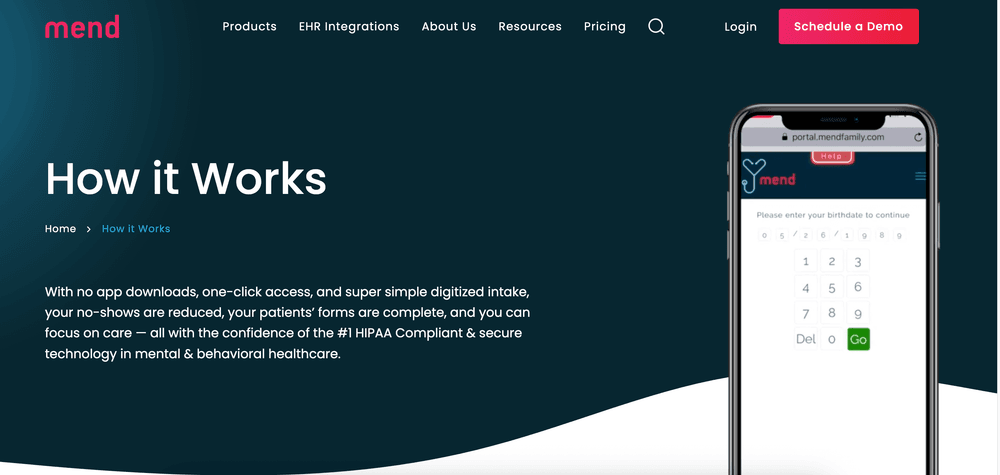
Mend is aimed squarely at the no-show rate. Automated appointment reminders, digital intake forms, real-time analytics.
Best for: multi-provider practices wanting an integrated patient communication suite.
Key strengths: engagement tooling, clean design, EHR integrations, operational analytics.
Weaknesses: more features means longer onboarding, and a small practice pays for capability it never touches.
SimplePractice – Integrated practice management for therapists and counselors
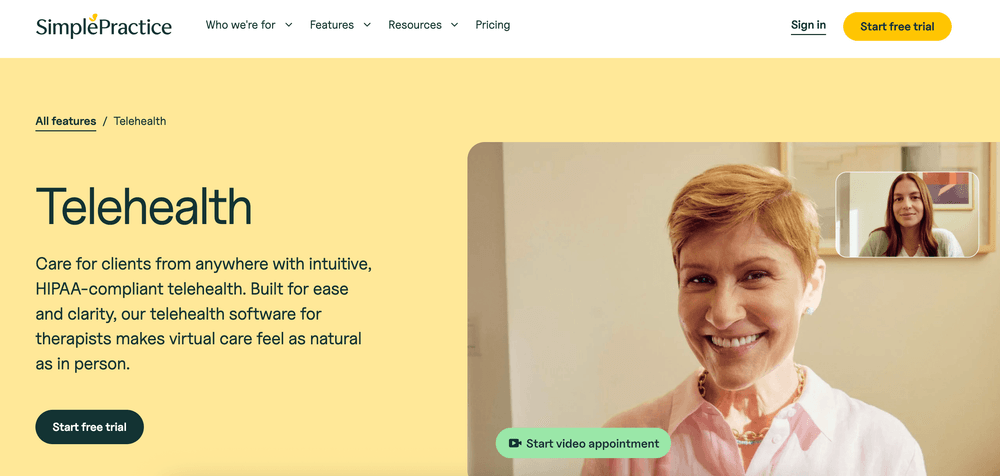
Scheduling, billing, documentation and telehealth in one place. Mental health professionals are the core audience and it shows in the details, from note templates to how the patient portal handles intake.
Best for: therapists, psychologists, and counselors in private practice or small groups.
Key strengths: scheduling, note templates, secure video, straightforward client onboarding.
Weaknesses: built for solo and small-group work, so it doesn't scale to enterprise, and integrations outside its own ecosystem are limited.
Teladoc Health – Scalable virtual care network for large organizations

One of the most established virtual care networks anywhere: end-to-end infrastructure, clinical staffing, AI-driven triage, all at a scale most organizations will never need. It's sold as HIPAA compliant telehealth software and runs inside major health systems.
Best for: large health systems, insurers, and organizations needing global reach and telehealth analytics.
Key strengths: scalability, global infrastructure, deep analytics, extensive compliance support.
Weaknesses: enterprise pricing and long implementations put it out of reach for smaller practices, and that scale leaves little room to customize.
Amwell – Robust platform for hospitals and health systems
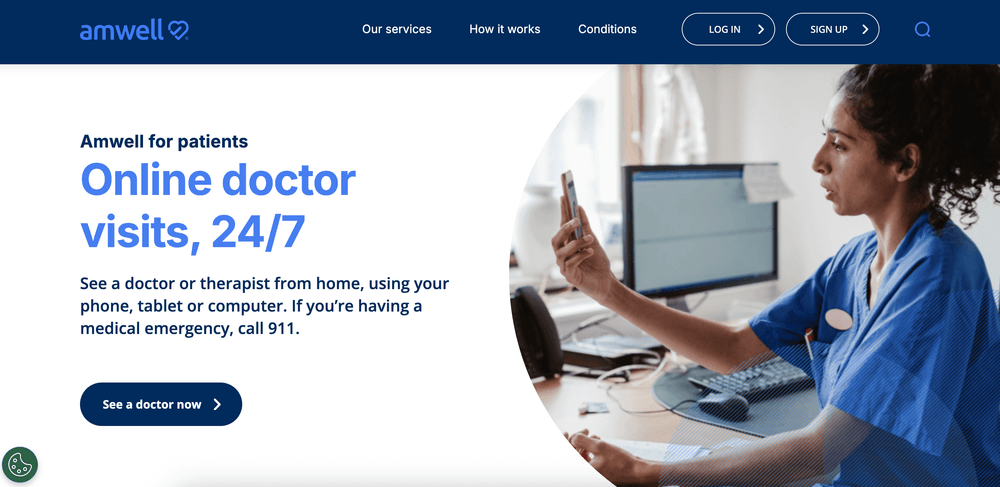
A full virtual care ecosystem covering EHR integration, white-label options and secure messaging, used by major U.S. hospital systems to connect patients, clinicians and specialists across one estate.
Best for: hospitals and integrated delivery networks needing enterprise reliability.
Key strengths: EHR integration, customizable modules, patient triage, documented HIPAA compliance support.
Weaknesses: complexity and cost make sense only at scale, and configuration usually needs the vendor in the room.
Custom telehealth solutions and integrations with TechMagic
Off-the-shelf stops working at a fairly predictable point: when workflows get strange, when more than one system has to talk to another, or when the patient experience needs to be yours rather than a vendor's.
That's the work we do. We also build on Medplum development, an open-source foundation that removes months of groundwork. If you're still deciding between building and buying, our guide to HIPAA compliant app development walks through it.
Best for: organizations with unusual workflows, multi-system integration needs, or requirements no product covers.
Key strengths: built to your workflows, integrates with existing systems, Medplum-based cost efficiency, HealthTech-specific engineering.
Weaknesses: custom costs more up front and launches later than a subscription. If your needs are standard, buy one of the platforms above, we'll tell you that on the first call.
Learn about our expertise in the industry and what we have to offer
Best Practices for Setting Up a HIPAA-Compliant Telehealth System
Once you’ve chosen a platform, compliance doesn’t stop there. How you configure, monitor, and maintain your system determines if it truly stays HIPAA compliant. The goal is to create a telehealth environment that is secure by design. Here’s how to achieve it.
Conduct a comprehensive risk assessment before deployment
Map how protected health information moves through your system before you launch, then go looking for the weak points: unsecured devices, cloud misconfigurations, that one integration somebody set up years ago and nobody owns now. A formal risk assessment satisfies hipaa guidelines. More usefully, it tells you what to fix first.
Configure secure access controls and user authentication
Give each person what their role needs and nothing else. Unique credentials, strong passwords, multi-factor authentication for administrators as well as staff.
And kill the shared accounts. "Reception" logging in as one user is still one of the most common routes to unauthorized access in healthcare, and it makes your audit log worthless.
Enable end-to-end encryption and secure data storage
Encrypt video, chat and file transfers in transit, and data at rest in databases and cloud storage. If the platform keeps session recordings or attachments, check they're encrypted and access-restricted by default. Not available on request. By default.
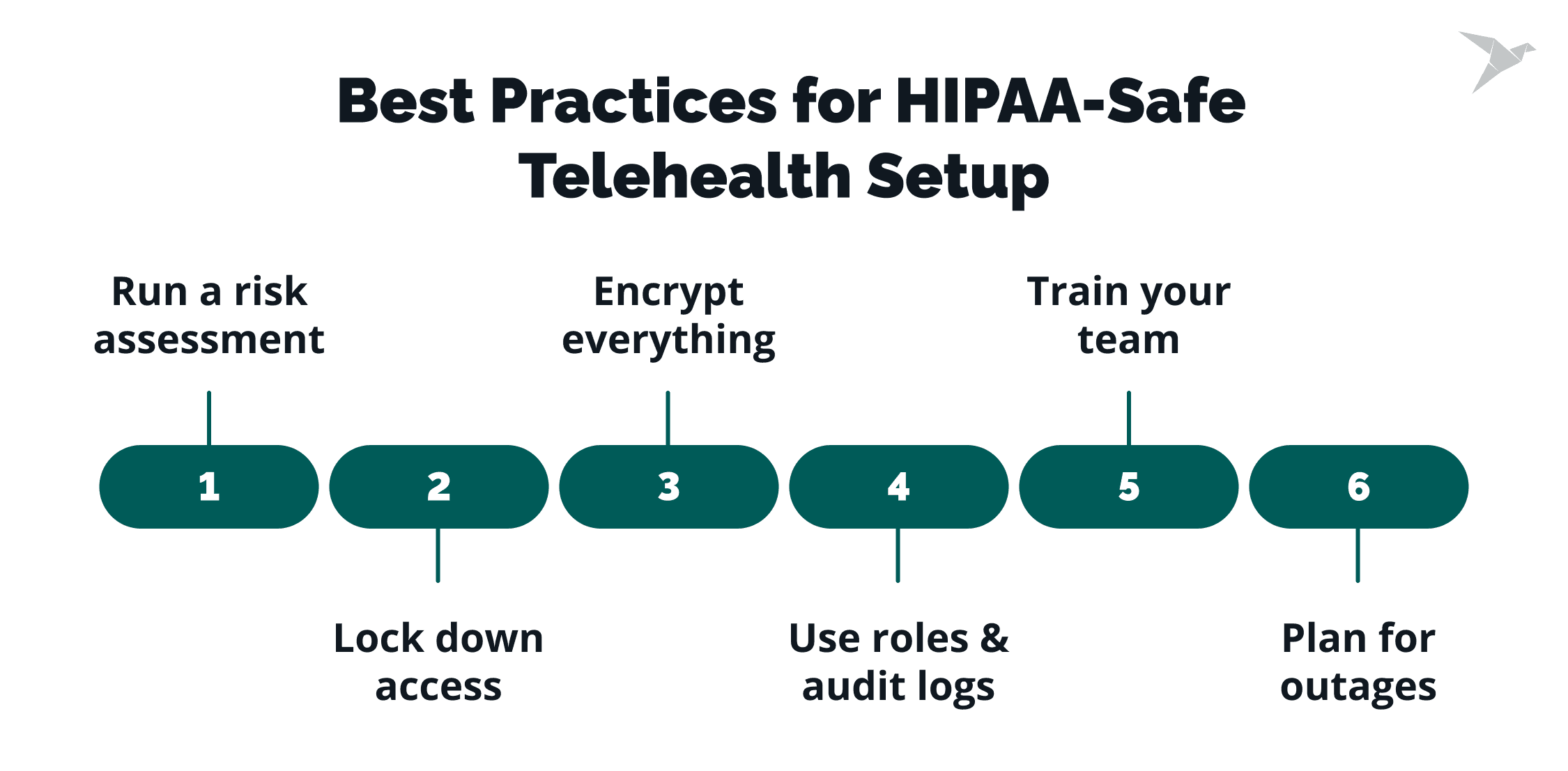
Implement role-based permissions and activity auditing
Every touch of patient data should be traceable. Logs need to capture logins, downloads and configuration changes, and somebody has to read them regularly to catch anomalies early and ensure compliance is demonstrable. A log nobody reviews is a log that proves nothing when an auditor asks.
Train staff on HIPAA policies and secure virtual communication
Technology is only ever as secure as the healthcare professionals using it. Train on phishing, PHI handling, and what responsible use of telehealth tools actually looks like, and refresh it whenever the system changes.
One thing matters more than the content: make reporting a mistake easy and consequence-free. Staff who fear the conversation will hide the incident, and a hidden incident is the expensive kind.
Establish data backup, retention, and disaster recovery procedures
Automated encrypted backups in HIPAA-compliant environments, and a recovery plan somebody has actually run. Set retention periods that satisfy both HIPAA and your state's medical record laws, which are often stricter than the federal floor and get overlooked for exactly that reason.
Common Mistakes to Avoid When Choosing Telehealth Platforms
A well-chosen platform won't stay compliant if it's used carelessly. Three mistakes account for most of what goes wrong.
Choosing a non-HIPAA-compliant platform or consumer app
FaceTime and WhatsApp are already on everyone's phone, which is exactly why they get used. Neither offers a business associate agreement, adequate encryption, or access controls. One unprotected session is enough to be a violation.
How to prevent it: verify a signed BAA, appropriate encryption and data-handling documentation before the first appointment. A platform feeling secure proves nothing.
Ignoring security configuration after platform setup
Organizations buy a secure platform and then never open the settings. Open ports, default passwords, accounts belonging to people who left in 2023. All of it survives the purchase order.
How to prevent it: run a configuration audit after setup. Disable what you don't use, enforce multi-factor authentication, apply role-based permissions, and re-check after every major update, because updates have a habit of resetting things quietly.
Neglecting integration with EHR and existing clinical workflows
When a telehealth platform runs on its own, staff copy and paste between systems. It's slower, and it scatters PHI into places nobody is auditing.
How to prevent it: integrate straight into your EHR or practice management system over FHIR or HL7 APIs, which keeps patient data inside systems you control.
Get Your Reliable Partner in HIPAA-Compliant Telehealth Solutions
Reliable telehealth takes more than software. It takes someone who understands the technology and how a clinic actually runs on a Tuesday morning.
We help healthcare organizations design, build and integrate telehealth platforms that meet current security standards and bend when those standards change. Work starts with your workflows, your compliance scope and your patient experience goals, whether you're building from nothing or extending what you already run, and it aligns to HIPAA, HITECH, FHIR and HL7.
For teams that need to move faster we develop on Medplum, an open-source, API-first healthcare foundation that cuts time-to-market and infrastructure cost while giving you the technical safeguards HIPAA expects. Your compliance programme stays yours. We build so it holds up when someone audits it.
We deliver:
- Telehealth platforms for secure, scalable remote care
- Custom healthcare software solutions shaped around your workflows
- EHR/EMR systems built for interoperability and daily usability
- HIPAA compliance consulting services supporting you end to end as you ensure HIPAA compliance across the organization

Wrapping Up: Building a Secure and Future-Ready Telehealth Practice
HIPAA compliance is what separates telehealth that's credible from telehealth that's merely convenient. You've got the shape of it now: what these platforms do, what to check before you sign, how to set one up, and the places teams usually come unstuck.
If your current system feels fragmented or half-finished, that's worth acting on rather than tolerating for another year. Telehealth is heading toward AI-driven triage, wearable data feeding into care plans, deeper EHR interoperability. Regulators will follow it there. Build on something flexible and secure now and you'll adapt without starting over. Your patients will stay connected to care that's compliant and, more to the point, worth having.
FAQ

Strictly speaking, nothing. A platform can't be compliant on its own. Your organization is. What a good vendor does is support that: encryption, access controls, audit logs, secure data storage, and a signed business associate agreement. Those five are what you check.
No, and plenty of them say otherwise. General-purpose video apps and telehealth remote communications tools routinely offer neither the safeguards nor a BAA. Confirm it's a hipaa compliant telemedicine platform before you send patient information through it.
It protects patient data, keeps you clear of penalties that reach into the millions, and preserves trust you can't easily rebuild. Patient care suffers when people withhold information from a system they don't trust. It also lets you provide telehealth services at scale without carrying a privacy risk nobody's managing.
End to end encryption, secure authentication, audit logs, EHR integration. A credible vendor signs a BAA and shows documentation of their security measures without being chased for it.
Virtual care tools built to HIPAA standards, using encryption, restricted access and data management controls so consultations and records stay confidential. It's industry shorthand, and worth remembering that the obligation still sits with the covered entity using the tool.
Platforms like Doxyme, Zoom for Healthcare, VSee, Mend, SimplePractice, Teladoc Health, and Amwell are recognized as telehealth platforms HIPAA compliant for different practice sizes and needs. You can also build a custom HIPAA compliant platform for telehealth with TechMagic for full flexibility and control.