
 Software Development
 Security Services
 Cloud Services
 AI Services
 Other Services















 TechMagic Academy




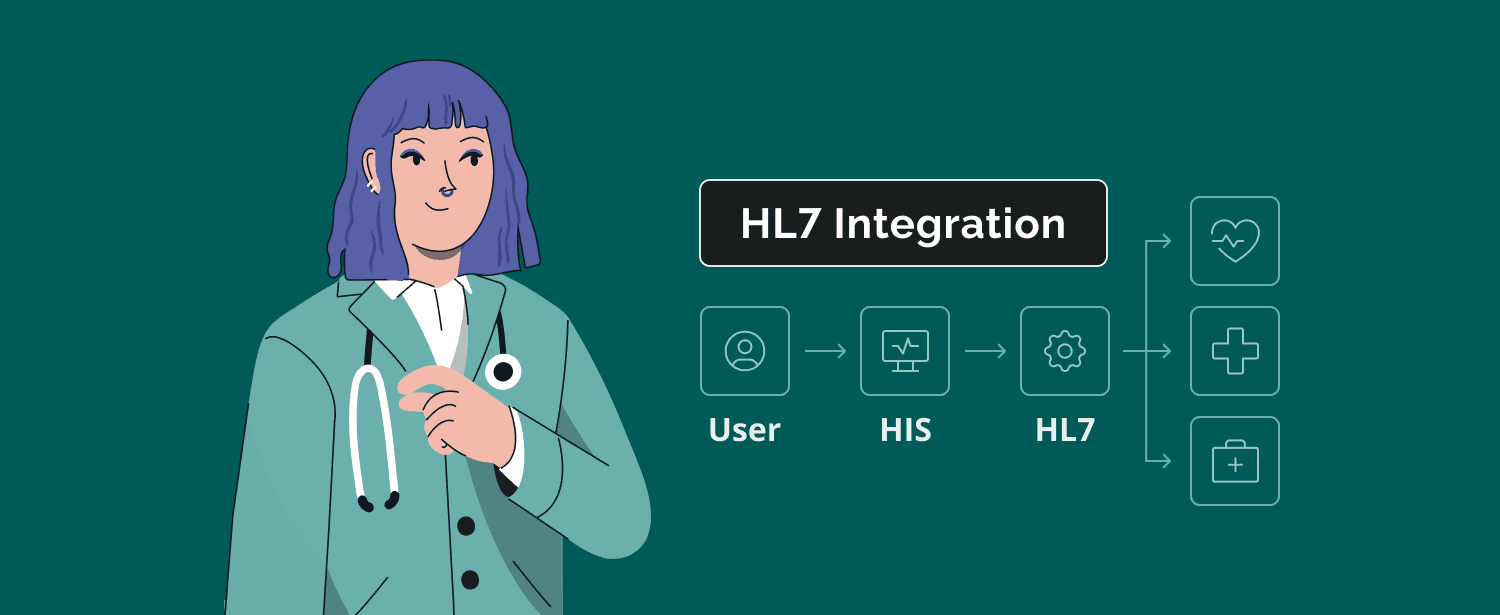
The worst version of a broken health record system looks like this: an emergency clinician treating a patient from whatever that patient can remember about their own medications and history. The records exist. They sit in a system this hospital cannot query.
This is rarer than it used to be, though far from solved. According to recent ONC data, 70% of U.S. hospitals now report interoperable data exchange capabilities, which means nearly 30% still struggle with data sharing and system compatibility.
HL7 exists to close that gap. The standards define how medical data is structured, so gathering, interpreting, and sharing clinical data between healthcare professionals stops depending on whether two vendors happened to pick the same format.
Vendors and health systems are spending on the fix. The healthcare data interoperability market is projected to reach $19.28 billion by 2028, growing at a CAGR of 18.3%, according to Frost & Sullivan. This article covers what HL7 integration is, which HL7 standards are used in practice, and how HL7 compares with APIs. Then the mechanics: how the integration process works, what planning and implementation actually take, and the challenges teams run into on the way.
Key Takeaways
- HL7 gives healthcare systems a shared format for moving data, which is what stops a lab result arriving as something the receiving EHR cannot read.
- V2 still carries most of the traffic. Over 90% of Health Information Exchanges use it routinely, and that will not change quickly.
- FHIR is where new work goes: API-based data exchange over REST and JSON, suited to cloud and mobile in a way V2 never was.
- Most organizations end up running both. Hybrid beats rip-and-replace whenever the legacy system still does its job.
- Projects slip on three things. Legacy compatibility, inconsistent data, and nobody in-house who has done HL7 before.
- Deciding scope and integration approach before build starts is what separates a six-month project from an eighteen-month one.
What Is HL7 and HL7 Integration
Health Level Seven (HL7) is a set of standards defining how healthcare organizations collect, process, and share healthcare data. Think of it as the common IT language of the sector, adopted across most countries.
The name comes from Health Level Seven International, the non-profit that develops these standards. Its remit covers exchanging, integrating, and retrieving electronic health information, and improving global health data interoperability.
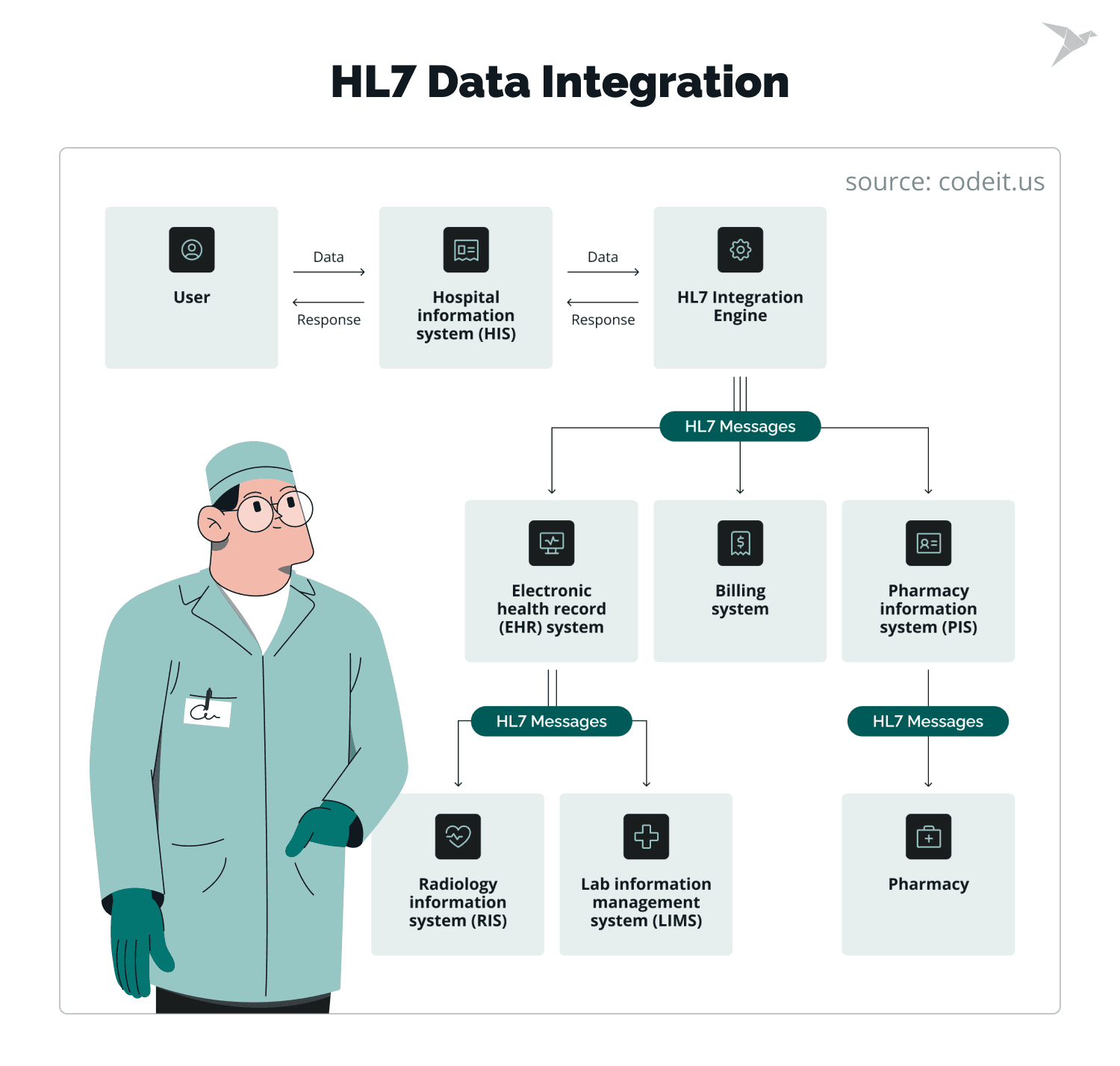
HL7 integration is the process of implementing HL7 standards and connecting various healthcare applications and systems to enable smooth, secure, and accurate data exchange. You can read more about this in our HL7 EMR Integration Checklist.
HL7 is still one of the core standards behind healthcare interoperability. It remains especially important as more organizations adopt hybrid architectures that combine legacy systems with modern APIs.
HL7 Standards: Common Language for Healthcare
HL7 standards offer a structured framework that, if followed, makes data exchanged between disparate healthcare systems consistent, precise, and meaningful. HL7 integration creates a unified language for patient data and decreases the risk of mistakes that can occur when systems interpret data differently.
Simply put, HL7 integration results in effective data exchange and interpretation across diverse systems. Below is an overview of the key HL7 standards:
HL7 V2
HL7 Version 2 (V2) is the workhorse. It is the most widely adopted messaging standard in the healthcare industry, and a 2023 national survey found over 90% of Health Information Exchanges (HIEs) routinely implemented HL7 V2 messages.
The format splits each message into segments: patient details, clinical observations, administrative data, and so on. That structure is what lets a receiving system pull out the one field it needs without parsing everything else.
You will find V2 running between EHRs (Electronic Health Records), laboratory information systems (LIS), and radiology information systems (RIS), moving patient data in real time between platforms that have nothing else in common.
For those readers interested in the technical side, here is how the HL7 V2 message looks from the code perspective:
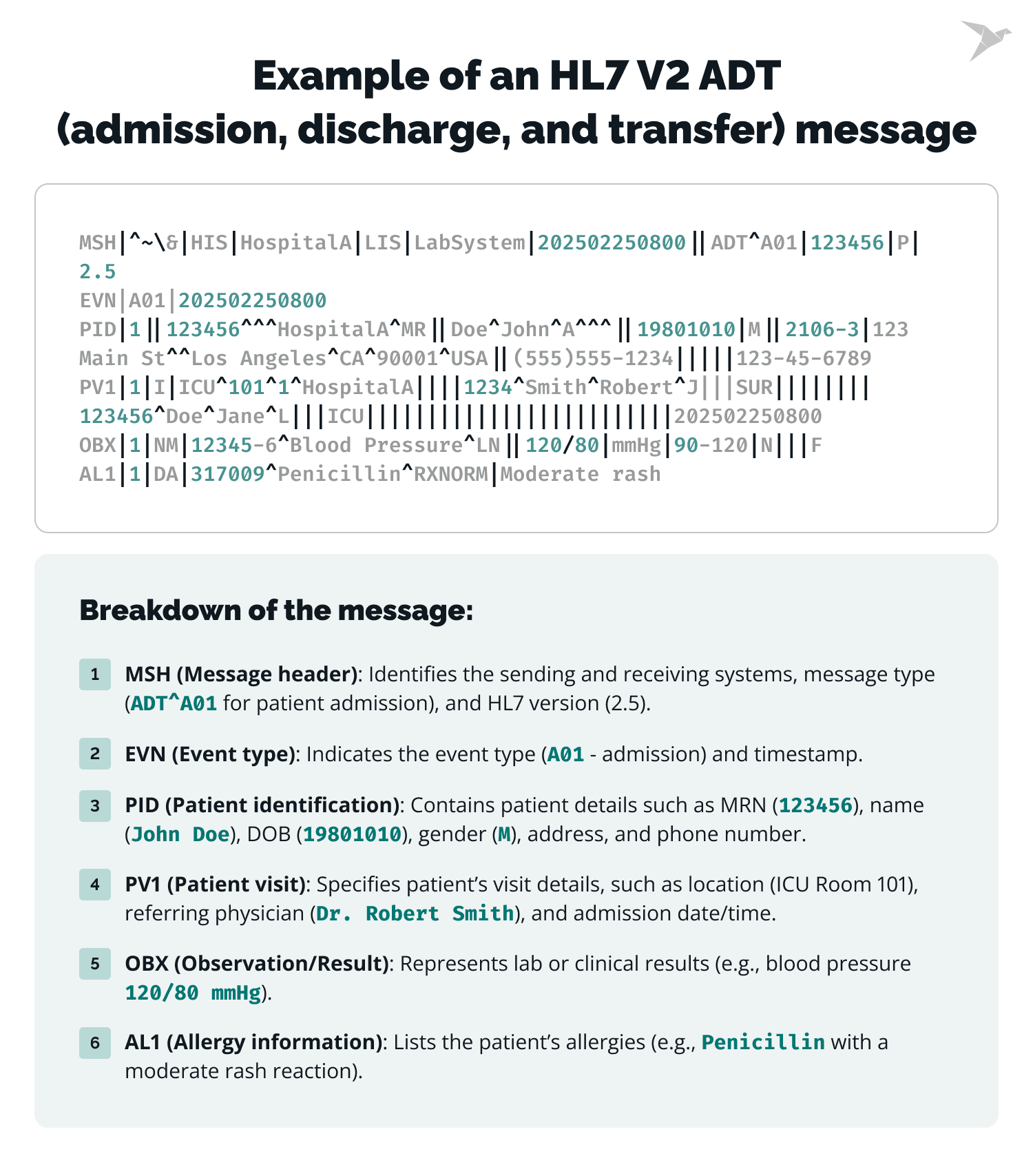
Note:
For doctors and healthcare providers, HL7 messages are not directly visible in raw code format. Instead, they are processed and displayed in EHR systems or other clinical applications in a user-friendly format.
A typical EHR system takes the structured HL7 message and presents it in a clean, readable format. Here is how the information from an HL7 ADT (Admission) message might appear in a doctor's interface:
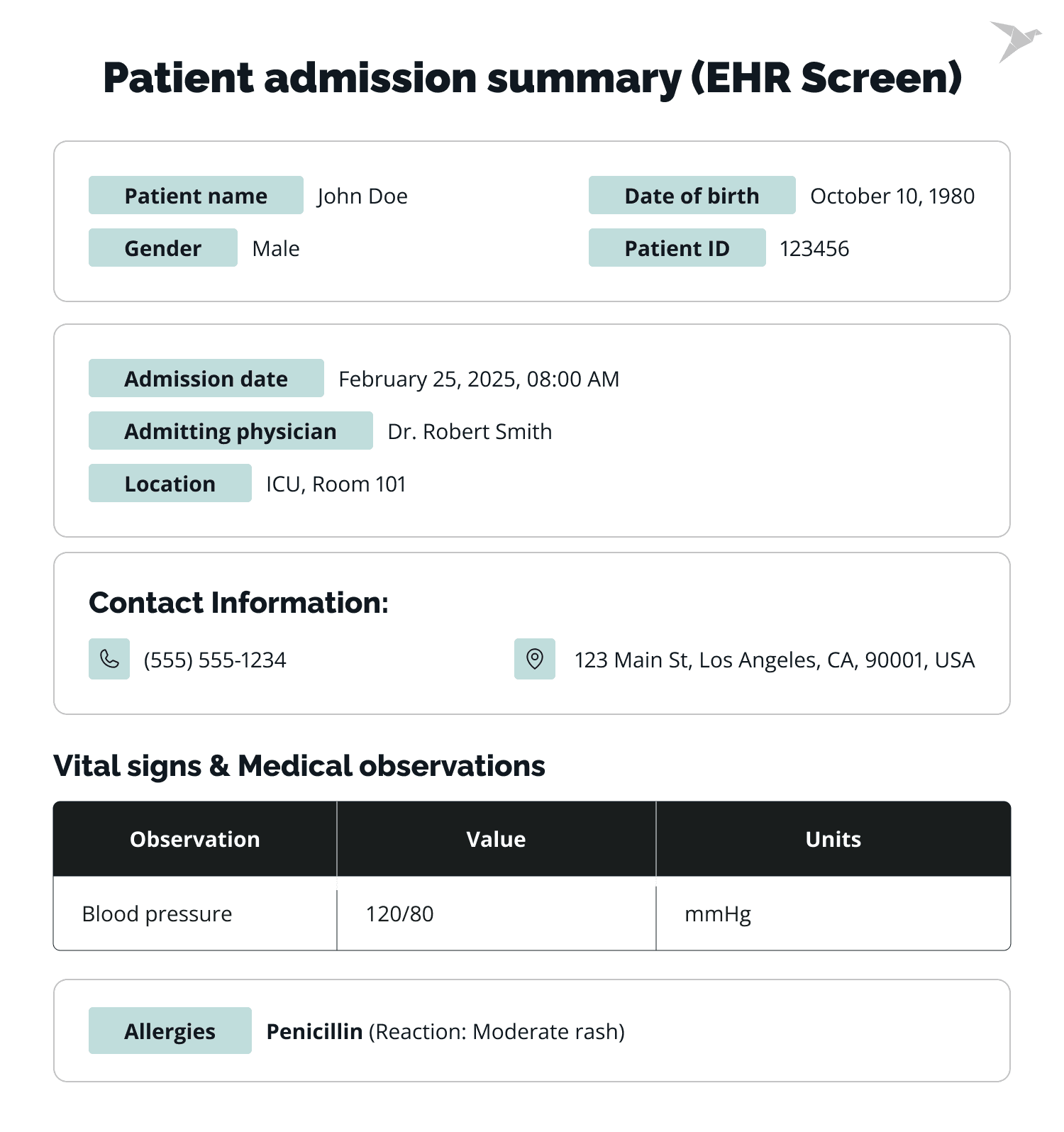
This user-friendly format is generated automatically from HL7 messages. The underlying HL7 message is parsed by the hospital system, and the data is displayed in an interface that doctors, nurses, and other healthcare staff can easily understand.
Learn about our expertise in the industry and what we have to offer
HL7 V3
HL7 Version 3 (V3) was the attempt to fix what V2 left loose. It uses a model-based approach built for semantic interoperability, so a message means the same thing to every system that reads it instead of depending on local convention.
The cost was complexity. V3 never came close to V2's adoption, and it now lives in specialized applications where data accuracy and fidelity justify the extra work.
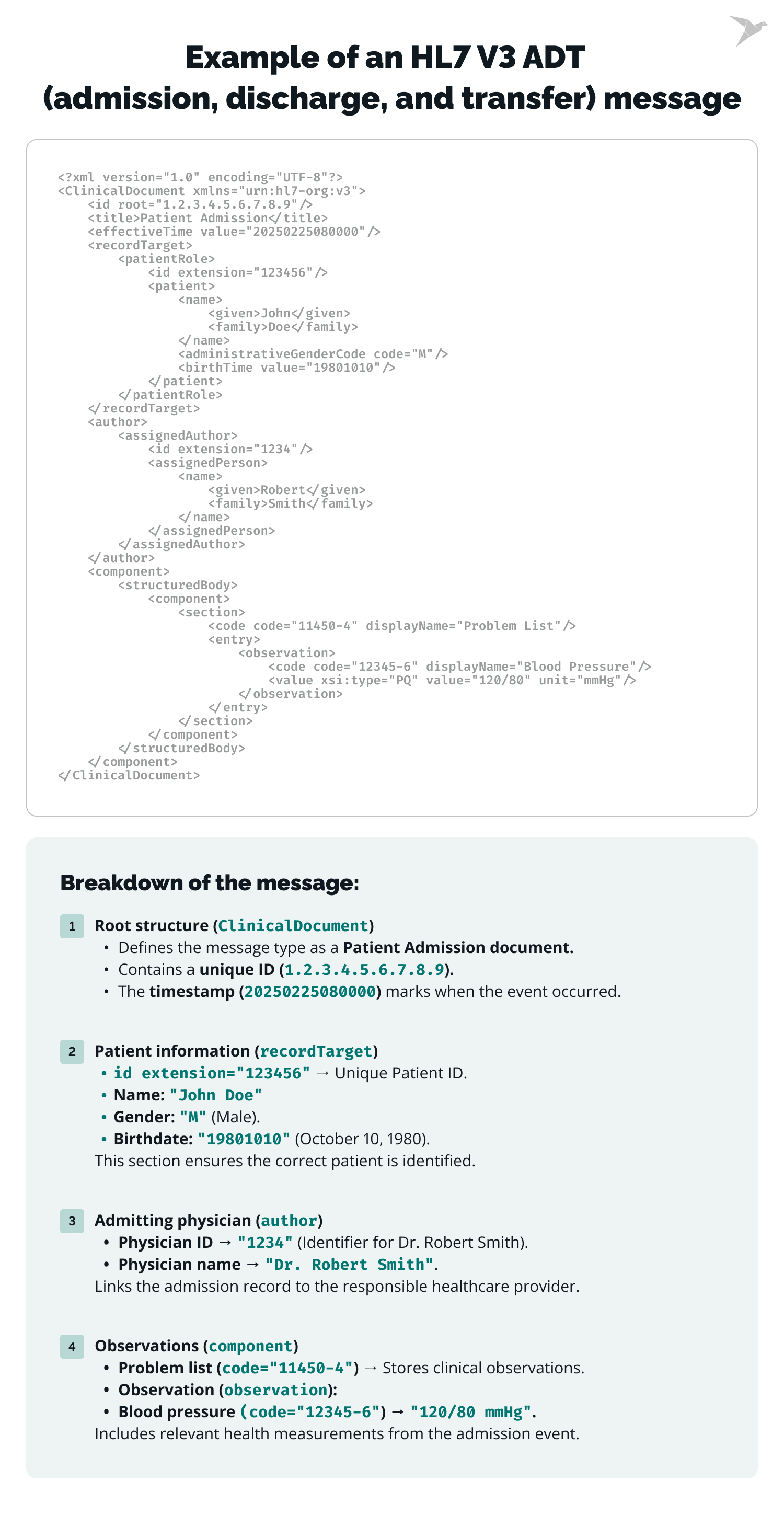
From a technical point of view, HL7 V3 is based on XML rather than the delimited format of HL7 V2. It is more structured and uses a consistent information model (RIM - Reference Information Model).
Let’s see an example (how it looks from the code perspective, NOT how doctors and healthcare providers see this):
HL7 CDA
The HL7 Clinical Document Architecture (CDA) is a document markup standard. It sets the structure and semantics of clinical documents so a discharge summary, a progress note, or a lab report can be created, shared, and archived in one consistent format. CDA's trick is serving two audiences from one file. A clinician reads the document; a machine parses it.
HL7 CCD
The Continuity of Care Document (CCD) is a CDA variant built for one job: moving a patient summary between various healthcare providers when care changes hands. It gathers the clinical and administrative data the next clinician needs first, including problems, medications, allergies, procedures, and lab results. Handovers are where things get dropped, and a CCD exists to make sure they are not.
HL7 FHIR
HL7 Fast Healthcare Interoperability Resources (FHIR) represents the next generation of healthcare data exchange standards. FHIR combines the best features of previous HL7 versions with modern web technologies. Unlike traditional HL7 V2/V3, which rely on structured messages, HL7 FHIR is designed for API-driven, real-time data exchange using REST, JSON, and XML.
FHIR handles fast, scalable healthcare data exchange, which is what mobile apps, cloud services, and AI-driven tools require. Its modular design means you can adopt it in pieces, so modernizing does not mean discarding legacy systems that still work.
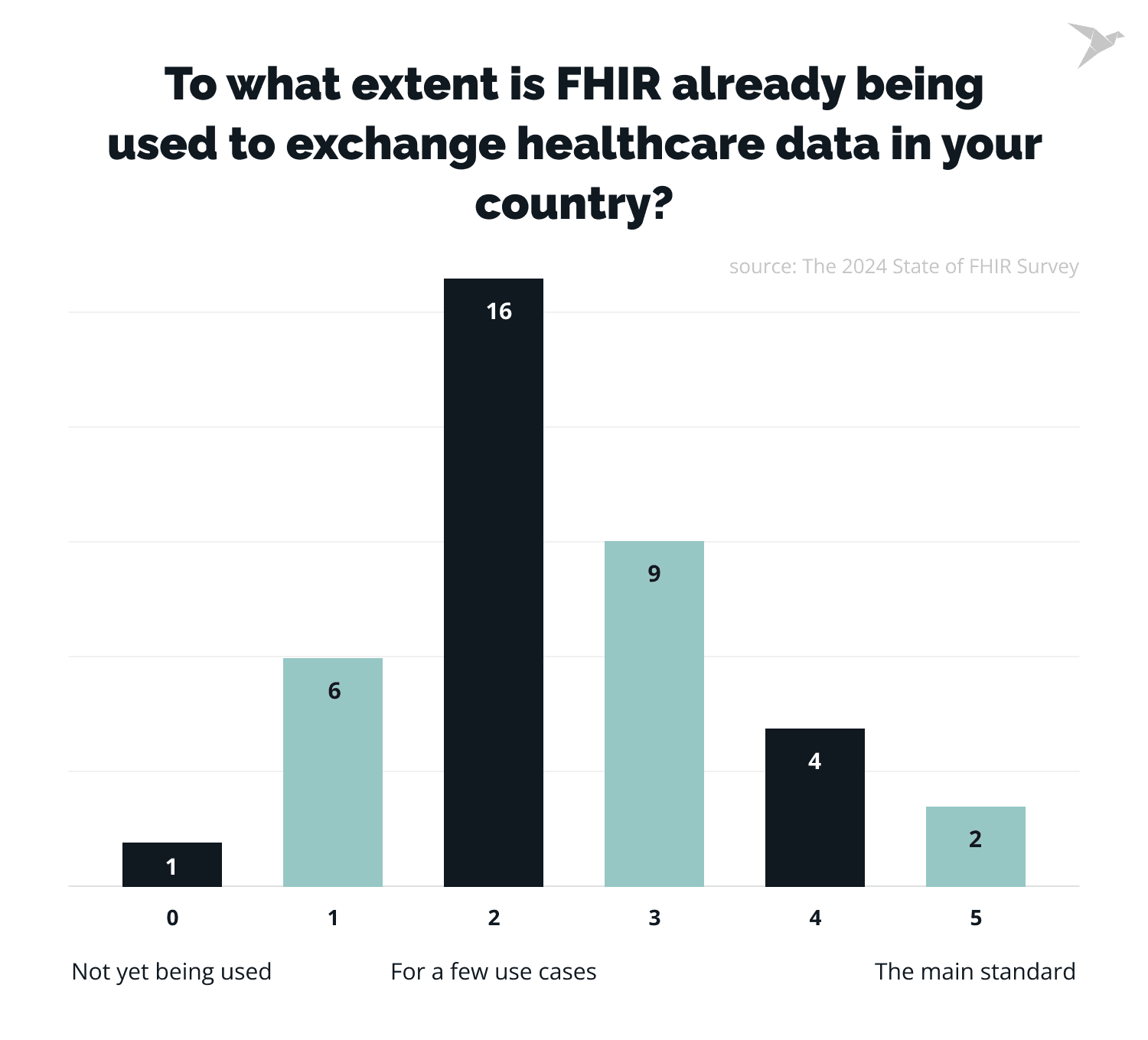
The 2024 State Of FHIR Survey found adoption varies widely by country. Lithuania and Switzerland now treat it as their main standard for healthcare data exchange. In 2023 the list of adopting countries grew to include Belgium, New Zealand, Thailand, and the UK alongside those two, so FHIR is moving past isolated pilots.
Major EHR vendors now support it, and national interoperability frameworks in the US and EU increasingly require it. That is what is driving the shift from message-based to API-driven data exchange. Platforms like Medplum for healthcare systems integrations are built around FHIR for exactly this reason.
Adoption is uneven, though. Plenty of countries still use FHIR for specific applications only, and countries such as Cyprus report growing but partial usage. Around 70% of survey participants confirm implementations that improved information access, while fewer report lower costs or better care. Worth knowing before anyone builds a business case on savings.
Adoption is uneven, though. Plenty of countries still use FHIR for specific applications only, and countries such as Cyprus report growing but partial usage. Around 70% of survey participants confirm implementations that improved information access, while fewer report lower costs or better care. Worth knowing before anyone builds a business case on savings.
HL7 SPL
HL7 Structured Product Labeling (SPL) is an XML-based standard for drug labeling information. It holds ingredients, dosage, and warnings in a consistent structure, which is why agencies like the Food and Drug Administration (FDA) require it.
Because SPL is machine-readable, that labeling flows into EHRs, pharmacy systems, and public drug databases without anyone retyping it. Healthcare providers and patients see the current version rather than whatever was printed last.
HL7 EHR-S FM
HL7 Electronic Health Record System Functional Model (EHR-S FM) is a specification rather than a message format. It defines what an EHR system should be able to do across patient care, administrative processes, and security.
That gives vendors, healthcare providers, and regulators a shared checklist for judging a system. The model covers direct care functions such as clinical decision support, supportive functions such as billing, and infrastructure including security and interoperability.
HL7 PHR-S FM
HL7 Personal Health Record System Functional Model (PHR-S FM) does the same for records the patient controls: medical history, medications, and wellness data they manage themselves.
The emphasis falls on interoperability with provider EHRs and on security, since this data lives outside the clinical perimeter. Patients, healthcare providers, and insurers all use PHR systems for care coordination, symptom tracking, and medication management.
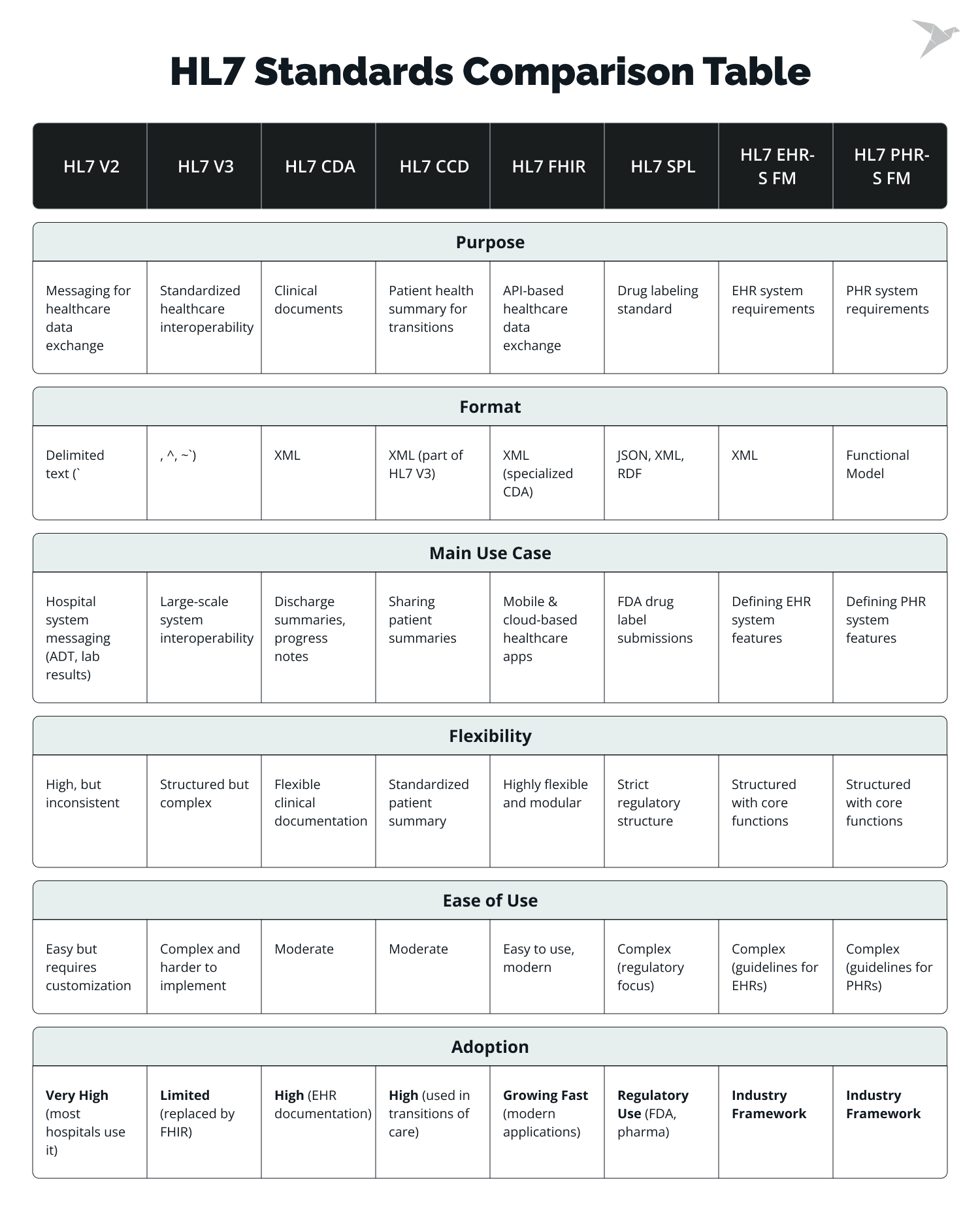
Let’s summarize the key differences and look at the HL7 standards comparison table:
Key takeaways:
- HL7 V2 is what you will actually be integrating with. It is everywhere, and its loose constraints are why two V2 interfaces from different vendors rarely behave identically.
- HL7 V3 solved the consistency problem and priced itself out of the market.
- HL7 CDA is the default for clinical documents, discharge summaries above all.
- HL7 CCD is CDA narrowed to patient summaries.
- HL7 FHIR is where interoperability in the healthcare industry is heading, because it works the way the rest of the web already works.
- HL7 SPL belongs to pharma and drug labeling regulation.
- HL7 EHR-S FM and PHR-S FM define what systems should do. They are frameworks, not formats, and treating them as formats is a common mistake in RFPs.
HL7 Integration Use Cases
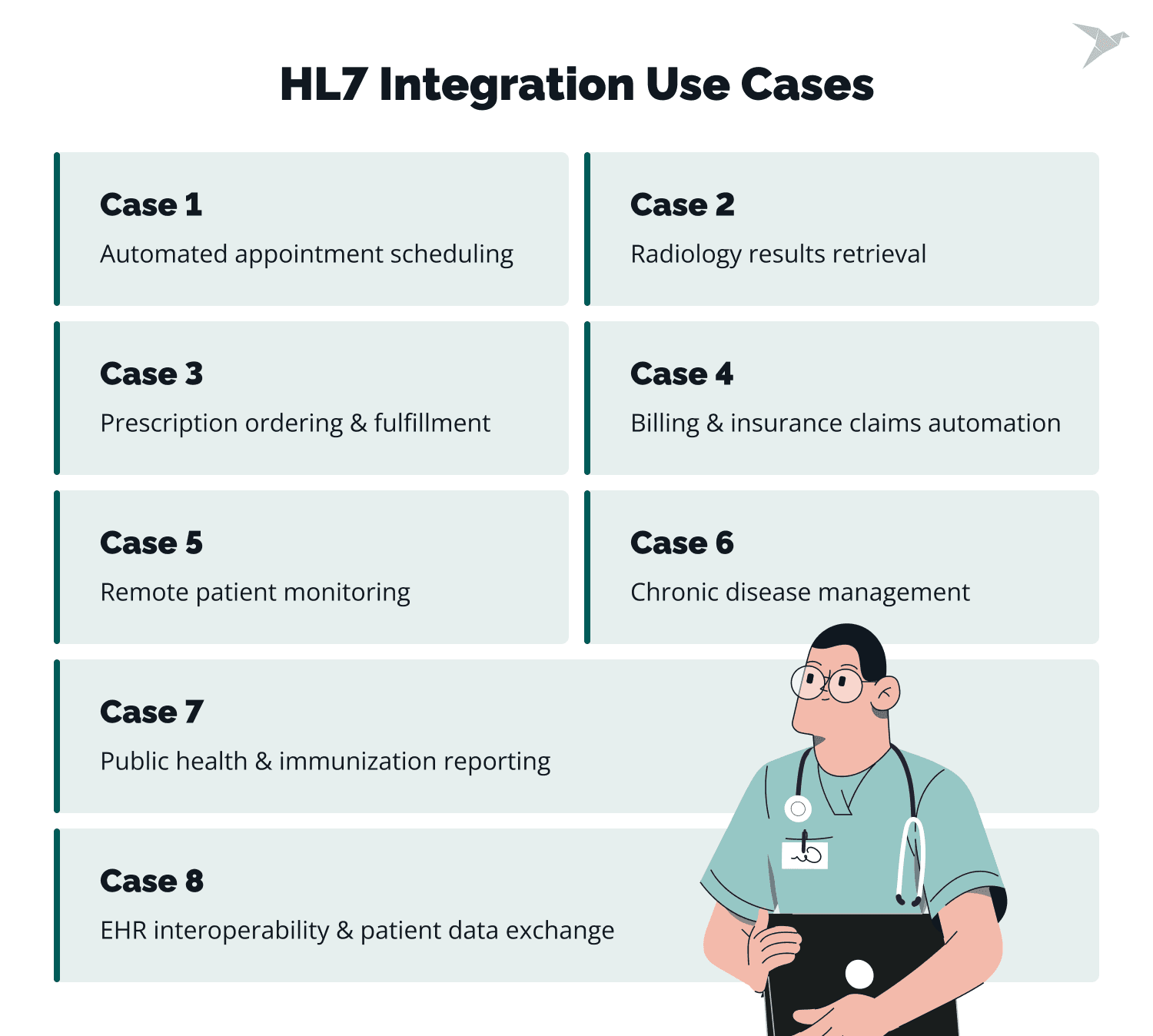
Eight places HL7 does real work:
- EHR interoperability & patient data exchange. The base case. HL7 moves patient data between EHR systems that were never designed to talk to each other.
- Automated appointment scheduling. A booking made in one system appears in the others without anyone re-entering it.
- Radiology results retrieval. A doctor requests a report and it returns from the radiology information system in seconds, rather than a phone call and a wait.
- Prescription ordering & fulfillment. Physicians send orders over HL7, and the pharmacy confirms receipt and processing, so nothing disappears between the two.
- Billing & insurance claims automation. Invoice generation, insurance verification, and claims submission stop being manual work.
- Remote patient monitoring. Wearable medical devices push readings into the EHR and flag critical changes to the care team.
- Public health & immunization reporting. Immunization data goes to state registries automatically, and vaccination records come back the same way.
- Chronic disease management. Standardized messages let specialists share medical summaries for patients whose care spans more than one team.
How HL7 Integration Works: Key Components
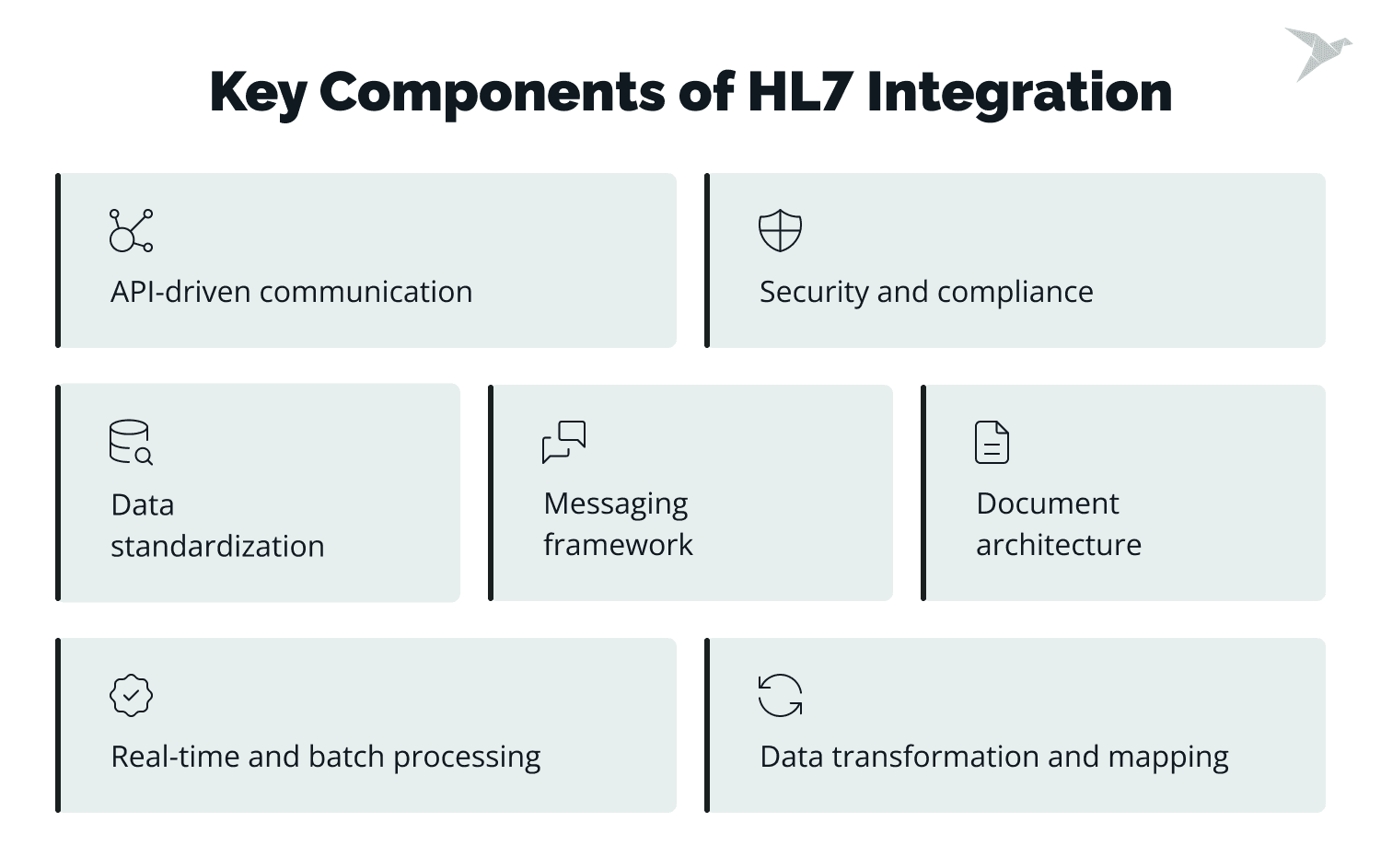
Six components carry the weight here. Get one wrong and the integration technically works while producing data nobody trusts.
Data standardization
Everything starts here. Data arriving from an EHR, a laboratory system, or a mobile health device has to be normalized into HL7 form before anything downstream can use it.
That means mapping data elements such as patient demographics, clinical observations, and diagnostic codes onto standardized formats. The payoff is that every system reads the same value the same way, which is where most integration errors quietly disappear.
Messaging framework
HL7 V2 splits a message into fields and segments in a fixed order, covering patient identification, clinical orders, and the rest. A receiving system knows where to look because position is defined.
V3 goes further with a model-driven approach, improving semantic consistency across messages at the cost of the complexity noted earlier.
Document architecture
Clinical documents use CDA and CCD instead. These keep the clinical narrative readable while the discrete data stays machine-processable, so a discharge summary is both a document a clinician reads and a record a system can index.
Standardized document structures let providers exchange that narrative alongside the data points, and the narrative is usually where the clinical reasoning lives.
API-driven communication
FHIR changed the shape of this. Instead of pushing messages, systems query each other over RESTful APIs using ordinary web protocols, which makes integration with cloud-based systems and mobile applications straightforward in a way it never used to be.
In practice most organizations run both. FHIR APIs sit alongside existing HL7 V2 messaging in hybrid models, because replacing working legacy systems is rarely worth what it costs.
Security and compliance
Health data attracts attackers, so HL7 EMR integration carries strict security requirements. Encryption, secure transmission channels, and real access controls are the baseline for HIPAA and GDPR, and they protect patient information from both external threats and internal misuse.
The bar keeps rising. Auditability, data traceability, and zero-trust architectures now appear as standard requirements in procurement, where a few years ago they were differentiators.
Real-time and batch processing
HL7 integration supports both real-time information exchange, which is critical in emergency care and clinical decision-making, and batch processing, which is used for less time-sensitive information. Real-time integration ensures that patient electronic health care data is available instantly when needed, while batch processing helps manage large volumes of data without compromising system performance.
Data transformation and mapping
Proprietary formats have to become HL7 messages, and that conversion usually runs through middleware. The middleware translates, then validates the output against HL7 schemas, which is the step that catches a malformed message before it reaches a clinical system.
Here is how a full integration runs, start to finish.
Here is how a full integration runs, start to finish.
12 Steps Roadmap of the HL7 Integration Lifecycle
Twelve steps, in the order they actually happen. IT teams and CTOs can use this as a plan, or as a checklist against a plan someone else wrote.

Step 1. Assess the current IT environment
Before anything else, map what you have. Every data source, system, and endpoint the integration will touch, including the legacy systems nobody wants to open, cloud applications, and specialized medical devices. Compatibility problems and security gaps surface here, and finding them now costs a fraction of finding them at step 9.
Key actions:
- Inventory every relevant system: EHRs, PACS, LIS, and anything else holding patient records.
- Catalogue the data formats currently in use.
- Review network architecture and security protocols.
- Confirm which healthcare regulations apply and where.
Step 2. Evaluate HL7 compatibility
Next, find out what your systems can actually do. Read the documentation, ask the vendors directly, and run pilot tests, because a vendor's claim of HL7 support and working HL7 support are not always the same thing. Where support is missing, middleware or custom development fills the gap.
Key actions:
- Confirm compatibility with your EHR and ancillary systems.
- Decide whether middleware or an integration engine is required.
- Cost any system upgrades that answer implies.
Step 3. Define integration objectives and scope
Decide what you are building and how far it reaches. Enterprise-wide, or one department as a pilot. Then set objectives someone can measure: lower data latency, better interoperability, fewer manual corrections.
Key actions:
- Pick your KPIs before build starts rather than after.
- Separate short-term objectives from long-term ones.
- Get stakeholders to agree the goals in writing.
Step 4. Select an HL7 integration approach
Direct point-to-point connections are the simplest to stand up and the worst to live with as systems multiply. An integration engine costs more up front and holds its value. Cloud-based options centralize data exchange and move the maintenance burden off your team.
Key actions:
- Compare direct integration against middleware honestly, including year-three maintenance.
- Weigh cost, scalability, and who carries support.
- Check vendor commitments before signing anything.
Step 5. Build the integration team or partner with a vendor
HL7 work needs people who have done HL7 work. The skill set spans healthcare workflows, messaging protocols, and system architecture, often in the same person, and it is genuinely scarce. Build internally or bring in a partner who has shipped this before.
Key actions:
- Identify who on staff has real HL7 and healthcare IT experience.
- Draw on past integration projects rather than starting from theory.
- Put IT, clinical, and operational people in the same room early.
Step 6. Design the integration architecture
Design before you build. Data flow diagrams, transformation rules, security protocols, and error handling, documented well enough that someone who was not in the room can troubleshoot from it two years later.
Key actions:
- Produce data flow diagrams and mapping specifications.
- Build compliance and data integrity into the design rather than onto it.
- Leave room for the systems you will add later.
Step 7. Implement security measures
Security is not a later phase in health level seven integration. Encryption, authentication, and role-based access control (RBAC) go in as the architecture goes in, aligned to HIPAA, GDPR, or whichever regime covers your medical data.
Key actions:
- TLS/SSL encryption for data in transit.
- RBAC plus multi-factor authentication (MFA).
- Regular security audits and vulnerability assessments.
- Documented compliance with HIPAA, GDPR, or country-specific healthcare regulations.
Step 8. Initiate the integration process
Now build. Configure the communication channels, stand up the HL7 interfaces, implement the transformation rules, and document every setting as you go, because whoever debugs this at 2am may not be you.
Key actions:
- Configure HL7 interfaces and communication protocols.
- Deploy middleware or interface engines where the design calls for them.
- Keep a written record of every configuration setting.
Step 9. Test, validate, and conduct pilot runs
Test properly. Unit, integration, and full system testing against realistic data, validating both accuracy and HL7 schema compliance. Then run a pilot with limited live data, which is where the problems nobody predicted show up.
Key actions:
- Run unit, integration, and system-wide tests.
- Validate data accuracy against HL7 schemas.
- Collect feedback from the clinical staff who will use it daily.
Step 10. Deploy and go-live
Go live in stages. A phased rollout limits how much breaks at once, and something usually does. Watch the real-time data exchanges closely for the first few weeks and expect to adjust configurations.
Key actions:
- Roll out in controlled phases with a rollback plan ready.
- Monitor data flow and system performance continuously.
- Tell end-users and support teams what is changing before it changes.
Step 11. Monitor and optimize continuously
An integration is not finished at go-live. Track data flow, error rates, and performance, and update as systems and regulations move. Interfaces degrade quietly, and the first sign is usually a clinician mentioning that results seem slow.
Key actions:
- Audit the system and review performance on a set schedule.
- Keep a feedback loop open between IT and clinical teams.
- Apply updates and scale capacity as volumes grow.
Step 12. Document and train your team
Document and train. Configurations, troubleshooting guides, and compliance records, plus training for the technical and operational teams who inherit this. Undocumented integrations become the legacy systems that step 1 complains about.
Key actions:
- Write manuals and training materials people will actually read.
- Run training sessions and periodic refreshers.
- Keep compliance documentation ready for audit.
Key Challenges of HL7 Integration
HL7 integration improves interoperability, and getting there is rarely smooth. Skipping past these obstacles produces delays, compliance problems, and performance bottlenecks that only surface after go-live. Eight recurring ones, with what actually helps.
Compatibility issues between legacy and modern systems
Challenge:
Plenty of healthcare organizations run systems that predate modern HL7 entirely, using outdated protocols, proprietary formats, and non-standardized data structures. Connecting those to cloud-based EHRs, mobile applications, or AI-driven analytics is where timelines go. Heavy legacy involvement is the single best predictor of an HL7 project overrunning.
Solution:
- Deploy middleware or interface engines to translate HL7 messages between incompatible systems.
- Use data mapping and transformation tools to standardize different data formats across old and new.
- Where feasible, plan a phased replacement for the worst offenders rather than a single cutover.
Skills and knowledge gaps
Challenge:
The work needs healthcare workflow knowledge, HL7 messaging protocols across V2, V3 and FHIR, data security, and system architecture, usually combined in the same people. Most IT teams do not have that mix, and the gap shows up as configuration errors, slipped dates, and security holes nobody noticed.
Solution:
- Fund formal HL7 training and certification for IT and clinical staff.
- Bring in HL7 specialists to work alongside the in-house team rather than instead of it.
- Build cross-functional teams with clinical informaticists, developers, and system architects.

Integrating diverse data sources
Challenge:
Medical data arrives from EHRs, laboratory systems, imaging platforms, wearable devices, and mobile health apps, each with its own data formats and communication standards. Inconsistent structures produce errors, duplicate records, and a version of the truth that depends on which system you ask.
Solution:
- Standardize at the point of entry using HL7 CDA, CCD, and FHIR frameworks.
- Normalize and transform in real time so different formats converge before storage.
- Use cloud-based integration platforms that already support the standards you need.
Data security and regulatory compliance
Challenge:
HL7 messages carry sensitive medical data, which makes every integration a potential breach path. The weak points are familiar: unauthorized access, data tampering, and mishandling in transit.
Solution:
- Enforce end-to-end encryption (TLS/SSL) on HL7 messages in transit.
- Restrict access with role-based access control (RBAC) and multi-factor authentication (MFA).
- Run security audits and penetration testing on a schedule, not after an incident.
- Keep audit trails and logs that record who accessed what and when.
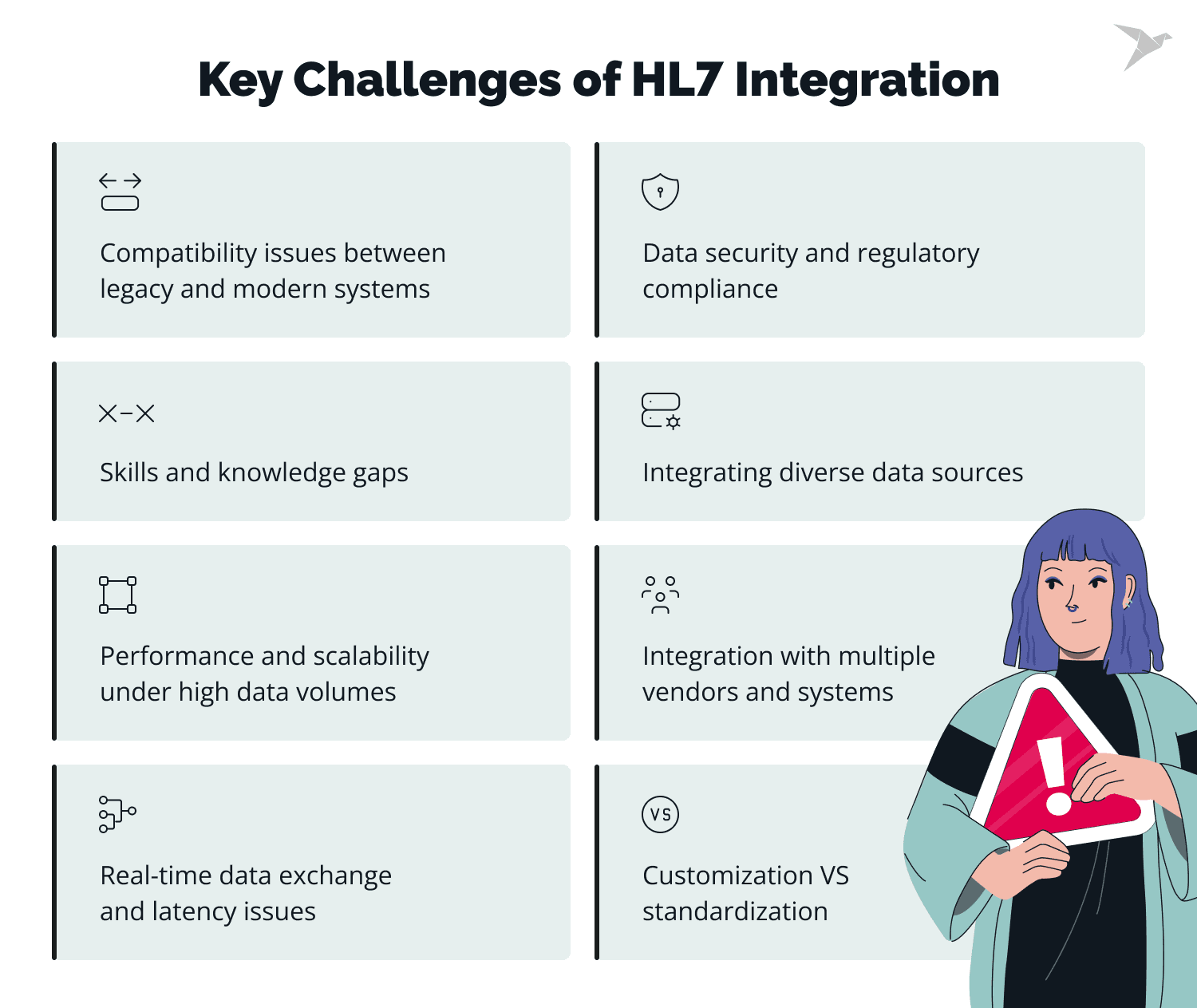
Performance and scalability under high data volumes
Challenge:
Data volumes grow every year, and an integration that copes with today's load can fail next year's. Systems that cannot scale drop messages and slow down, and that delay lands directly on clinical workflows and patient care.
Solution:
- Use cloud infrastructure and load balancing to scale resources dynamically.
- Deploy high-throughput message brokers to manage HL7 queues.
- Tune database indexing and caching for retrieval speed.
- Monitor performance and response times on live dashboards.
Customization VS standardization
Challenge:
HL7 gives you standard messaging frameworks, and every healthcare organization has workflows that do not quite fit them. Customize heavily and upgrades become painful and expensive. Hold rigidly to the standard and the system fails to do what the organization needs.
Solution:
- Run a thorough requirements analysis before integration so you know which deviations are genuinely necessary.
- Use HL7 implementation guides for the standard parts and localize only where required.
- Document every customization, because the next upgrade depends on that record.
Integration with multiple vendors and systems
Challenge:
A typical hospital runs different vendors for EHR, lab, billing, and imaging, and each interprets HL7 slightly differently. The result is inconsistent data exchange, incomplete electronic medical records, and a slow drift toward vendor lock-in.
Solution:
- Set clear HL7 integration protocols and data governance policies that apply to every vendor.
- Favour vendors with a track record of following HL7 compliance guidelines.
- Put API-based integration layers between vendor platforms rather than wiring them together directly.
Real-time data exchange and latency issues
Challenge:
Emergency and critical care depend on real time data exchange. Message processing delays, network latency, or a server bottleneck become clinical delays, and those affect decisions and patient outcomes.
Solution:
- Use low-latency protocols and tune the network path for urgent traffic.
- Stream urgent clinical updates rather than batching them.
- Build failover and redundancy so exchange continues under load.
- Stress test against peak conditions before you meet them live.
Difference Between API and HL7
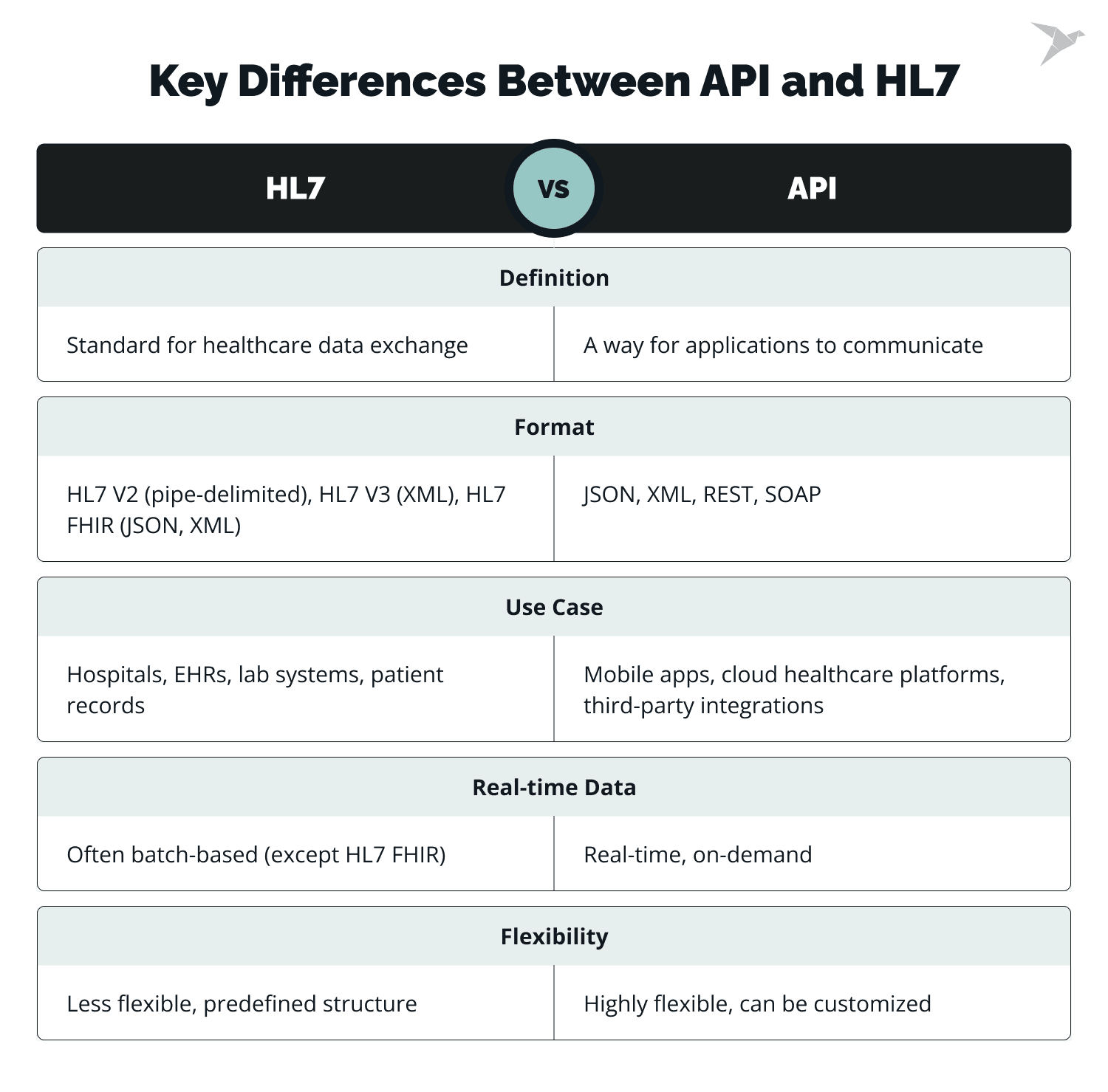
CTOs, healthcare providers, and technology leaders hit this question early. APIs and HL7 both move data, and they are not competing options.
The short version:
- HL7 is a healthcare messaging standard. It defines how medical data is structured and exchanged between systems such as EHRs, labs, and pharmacies.
- API is a method for software applications to communicate, usually over modern protocols like REST and JSON, enabling real-time exchange.
Put differently: HL7 defines what is shared, APIs define how. HL7 FHIR does both, using APIs to move HL7-structured medical data.
Four dimensions where they differ:
Protocol vs. domain-specific standard
APIs are general-purpose. They set the rules for how software talks to software, in any industry, for anything from a web application to a payment flow.
HL7 was built for one domain and one kind of data. FHIR uses API-based communication, but the framework around it exists to handle the complexity, sensitivity, and compliance load that comes with patient information. That narrowness is the point.
Flexibility vs. specialization
An API can be designed around whatever data format the situation calls for, which is why they are everywhere and why they are quick to build.
HL7 trades that flexibility for precision. Clinical terminologies, standardized coding systems, and regulatory requirements are built in, so sensitive medical data arrives with its meaning attached. In healthcare, a value without its context is a safety problem.
Implementation complexity
RESTful APIs are straightforward with common web technologies: JSON, XML, HTTP. Development cycles are short and deployments are quick.
HL7 integration asks more of a team, because it requires understanding both the technology and the clinical processes behind it. FHIR narrowed that gap considerably. V2 and V3 did not, and a first V2 interface routinely takes longer than anyone estimated.
Scalability and adaptability
APIs scale by design and suit cloud environments, letting medical organizations add capacity as demand grows.
HL7 has caught up here. FHIR brings cloud-friendly architecture that handles large volumes without giving up compliance or security, which is what makes HL7 a foundation for modern healthcare rather than a constraint on it.
How TechMagic Can Transform Your HL7 Integration Journey
HL7 integration is a strategic move to enhance patient care, interoperability, and operational efficiency. As a leading custom healthcare software development company, TechMagic delivers HL7 integration solutions that ensure smooth and secure information exchange, compliance, and scalability.
With 12+ years of experience, 200+ clients, and 350+ certified experts, we specialize in custom healthcare software, cloud-based solutions, software integrations, IT consulting, and cybersecurity. Our 92%+ client NPS proves that we deliver only the best solutions.
Comprehensive HL7 integration solutions
At TechMagic, we assess your IT infrastructure, system architecture, and interoperability needs to ensure seamless integration of HL7 V2, V3, CDA, CCD, and FHIR.
TechMagic manages the entire integration lifecycle and provides continuous monitoring, proactive maintenance, and real-time performance optimization to keep your systems secure, scalable, and aligned with industry standards. We modernize legacy systems, enable real-time exchange of data via HL7 FHIR APIs, and build cloud-ready healthcare infrastructures.

Summing Up
HL7 integration is a practical requirement for healthcare organizations that need reliable data exchange and system interoperability. It helps standardize communication, reduce errors, and improve how systems work together.
A well-planned implementation of HL7 makes integration more predictable and easier to scale over time. At the same time, success depends on how well systems, processes, and teams are aligned.
In the next few years, HL7 integration will keep moving toward FHIR, APIs, and faster data exchange. Healthcare organizations that make their systems more flexible now will have a much easier time connecting new tools, supporting connected care, and handling growing data volumes.
If you need support with HL7 data integration or want to modernize your existing setup, the TechMagic team can help you design, implement, and optimize your integration strategy.
FAQ

HL7 integration enables seamless data exchange between healthcare systems, such as EHRs, lab systems, and billing platforms, ensuring standardized and interoperable communication using HL7 interface messaging protocols.
HL7 stands for Health Level Seven. It is a set of international standards defining how healthcare information is exchanged, integrated, and retrieved between different healthcare systems. The "level seven" refers to the application layer of the OSI networking model, which is the layer where the data a human cares about actually lives.
An HL7 interface is the connection that lets two healthcare systems exchange patient information using HL7 messaging standards. In practice it is what makes a lab system and an EHR from different vendors work together when they have no other common ground.
HL7 is a standard that defines the structure of medical data exchange, while an API (Application Programming Interface) is a method used to transmit that data, often leveraging HL7 FHIR for modern, real-time interoperability, especially during the implementation of HL7 in newer digital environments.