 Software Development
 Security Services
 Cloud Services
 AI Services
 Other Services










 TechMagic Academy


ISO 42001: Meaning, Requirements, Benefits, and Everything You Need to Know
Last updated:27 May 2025



What happens when your AI system gets something wrong? Can you explain why? Can you show, on paper, that the decision was fair, secure, and accountable?
ISO/IEC 42001 is the standard that gives you a practical framework for managing those risks. It keeps your AI transparent, explainable, and trustworthy from the first line of code through deployment and beyond.
Maybe your AI makes automated decisions. Maybe it learns on its own, or turns raw data into insight. In all cases, this standard helps you handle what comes with that. ISO 42001 keeps things fair, transparent, and safe, and, what is also important, it doesn’t slow down responsible innovation.
Managing your AI shouldn’t be a headache but a clear path to trust and growth. In our ISO 42001 guide, we will show you how this standard can help you manage AI that you and your customers can trust, while keeping your business one step ahead in a fast-changing world.
Key takeaways
- ISO/IEC 42001:2023 helps you manage AI safely and ethically across its whole lifecycle. At some level, it is an AI management system standard.
- Healthcare, finance, automotive, retail, government, wherever you operate, ISO 42001 guides how you handle ethical AI development, AI risks, and regulation.
- It complements ISO 9001 (quality management) and ISO 27001 (information security). So you can fold AI governance into the systems you already run instead of standing up a separate one.
- It follows a proven cycle. That’s what keeps your AI systems effective, compliant, and improving over time.
- ISO 42001 helps you catch AI risks like data bias and privacy gaps early, so you can fix them before they become critical. And that’s what responsible development looks like in practice.
- The standard is built for real AI governance. It balances innovation with accountability, so you can build trust and put AI to work for growth with confidence.
What is the ISO 42001 Standard?
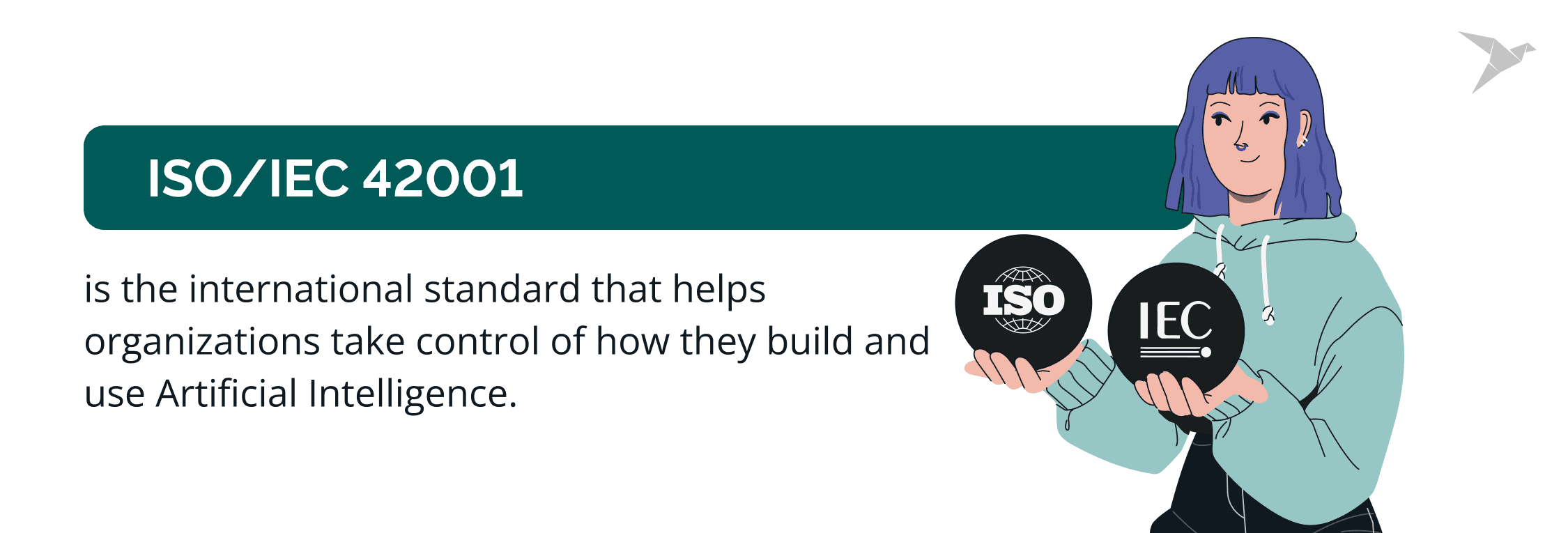
ISO/IEC 42001 is the newest international standard for taking control of how you build and use Artificial Intelligence. It landed in late 2023. Its job is straightforward: keep AI management systems (AIMS) safe, fair, and trustworthy.
Pay attention that ISO/IEC 42001 is a management system standard (MSS). When your organization implements it, you put in place policies and procedures for AI governance. Rather than looking at the details of specific AI applications, it provides a practical way of managing applicable controls, AI-related risks, and opportunities.
Who should consider ISO 42001?
This one is for organizations of any size that develop, provide, or use AI-based products or services. Public-sector agency, private company, non-profit, the industry doesn’t matter. It earns its keep wherever AI shapes key decisions and daily operations, and it slots in next to the management systems you’re already running.
Location doesn’t change that. ISO 42001 matters most where AI laws are strict, Europe being the obvious example. But as AI spreads into more of the business, it’s just as relevant everywhere else.
ISO 42001 goal
The goal is to guide you through managing AI responsibly at every stage. First design sketch. Daily operations. Eventual retirement. It also nudges you to look wider than the system itself: how your AI affects customers, employees, and society, and which core principles you’ll hold to along the way.
ISO/IEC 42001 and PDCA
The standard applies using PDCA (plan–do–check–act) methodology. Here is how it happens.
Defining the scope of the AI management system
Start by defining the scope of your AI management system. Which parts of the organization will the AIMS cover? What controls do you need to manage them? Answer those first.
Part of this is producing a statement of applicability. It lists every control and process you’ll put in place to keep data quality high.
Supporting development and ensuring continual improvement
The standard backs your AI management system with steady improvement and maintenance. It asks you to watch how your AI systems perform, internal audits included, so they keep meeting expectations rather than drifting.
Monitoring and improving the system
The last phase of Plan-Do-Check-Act puts your monitoring to work. You take what you’ve seen and act on it, correcting issues and inefficiencies where they show up. This is where continuous improvement kicks in. You refine your AI systems to manage risk better and keep pace with new challenges, new regulation, or a shifting market.
Discover our comprehensive cybersecurity services

What Are the Focus Areas of ISO 42001?
Now, let’s take a look at 10 areas that the ISO 42001 standard focuses on.
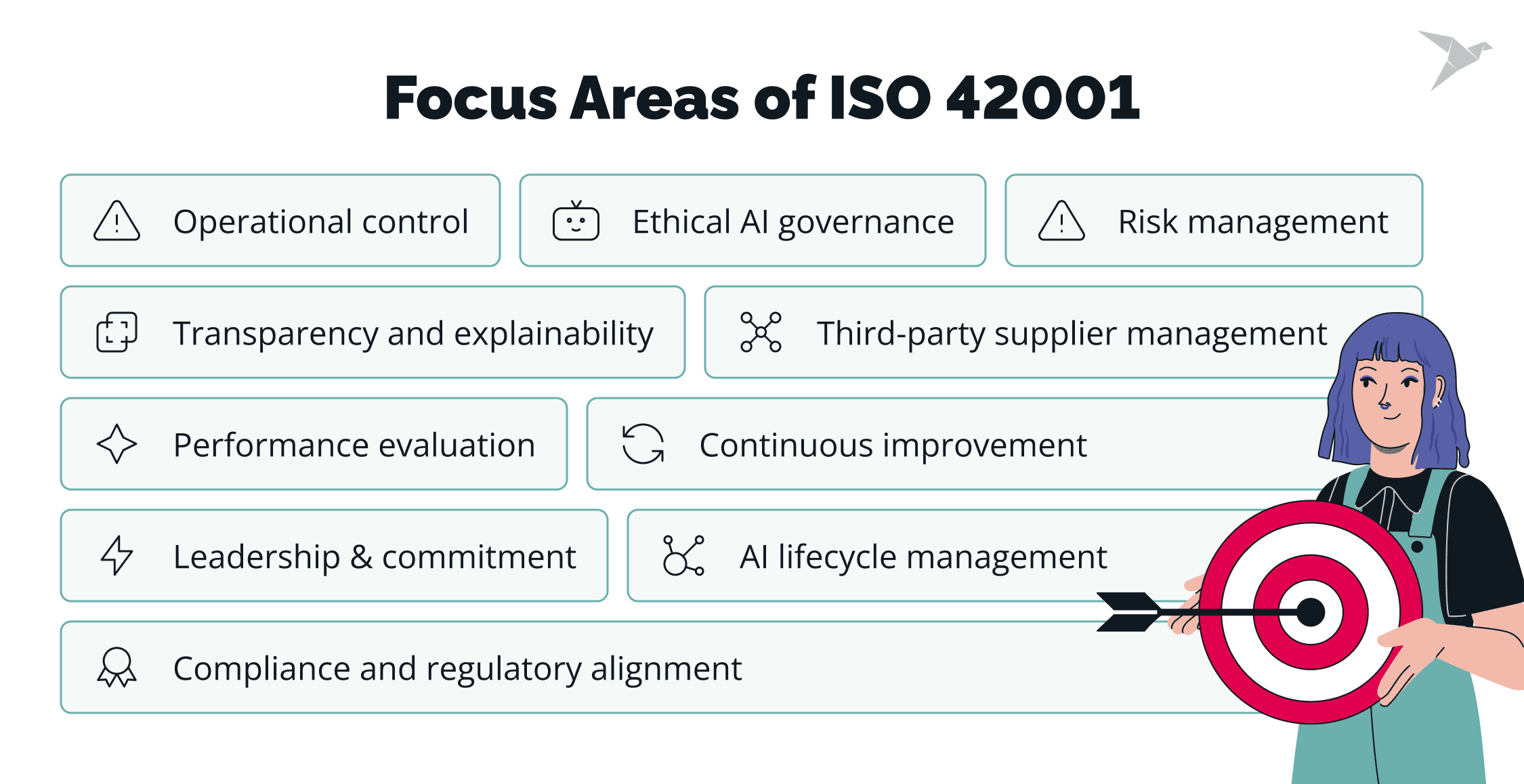
1. Risk management
AI systems come with their share of risks: some expected, some not so much. ISO 42001 helps you take a proactive approach by guiding you through identifying, assessing, and mitigating these risks early.
Risks can range. Here are only a few examples:
- data biases;
- privacy concerns;
- algorithmic discrimination;
- unintended consequences of automated decisions.
The standard helps you catch AI security risks before they spiral. Spot them early, act on them early, and you sidestep reputational damage, operational disruption, and legal trouble. There’s a trust dividend, too. Stakeholders can see the security controls you’ve put in place to reduce harm.
2. AI lifecycle management
An AI system’s life doesn’t end at deployment. It keeps going. ISO 42001 makes sure your AIMS is managed properly at every stage, from first design to retirement.
Which means more than building the thing. You track the whole AI lifecycle:
- how it performs,
- how it evolves over time,
- and how it should be retired when it’s no longer useful or safe.
Manage AI across that full arc and it stays effective, compliant, and aligned with both your business goals and your ethics. Keep monitoring and improving, and it won’t go outdated, ineffective, or quietly risky on the cybersecurity side as the technology and the market move.
3. Leadership and commitment
ISO 42001 treats strong leadership as non-negotiable for good AI management. Top management has to back AI governance, fund it properly, and keep it pointed at the wider business goals.
Leaders set the tone. They put clear policies in place, build a culture of responsibility, and make sure ethical AI practices reach every level, not just the teams closest to the models.
Without real commitment from the top, governance frameworks don’t hold. That commitment is what keeps the organization anchored to its goals and its ethical standards, and it’s what drives accountability down through the ranks.
4. Ethical AI governance
ISO 42001 leans hard on ethical governance. The point is to put fairness, transparency, and privacy first in your AI systems, which heads off discrimination, bias, and misuse of personal data before they start.
Follow the standard and your AI decisions rest on a sound ethical framework. That lowers the risk of harm to individuals, to groups, to society at large. Ethical governance also earns something slower to build: long-term trust from customers and users, which is exactly what gives AI innovation room to grow.
5. Compliance and regulatory alignment
ISO 42001 gives you a foundation for meeting AI regulation, the rules on the books today and the ones coming next, from the EU AI Act to data-protection law like GDPR. Already mapping controls to security frameworks or NIST compliance requirements? Good. ISO 42001 extends that same discipline to your AI systems and keeps your practices current as the regulatory picture shifts.
The payoff is twofold. You lower your exposure to non-compliance penalties, and you mark yourself as a serious, trustworthy player in AI. Certification also tells regulators, customers, and stakeholders that your AI-based systems clear a high bar for legal and ethical accountability.
6. Transparency and explainability
People accept AI when they understand it. How it works, how a decision got made. That’s why transparency and explainability sit at the heart of ISO 42001. Your AIMS shouldn’t be a black box.
The standard pushes for clear documentation of how your AI systems reach their decisions, so you can explain how and why any given outcome happened. That builds confidence with users, regulators, and everyone else with a stake. And when someone questions a decision, you can actually walk them through it instead of shrugging.
7. Third-party supplier management
Plenty of organizations lean on third-party suppliers for AI tools, data, and services. Useful, but it carries risk. ISO 42001 stresses managing those relationships so every tool, service, and data provider meets the same high bar for security, ethics, and compliance that you hold yourself to.
That covers:
- assessing the fairness of algorithms,
- ensuring data privacy,
- making sure third-party systems align with your own governance principles.
Handle your suppliers well and you cut the odds of an outside system dragging down your AI outcomes, or your reputation. It keeps the whole AI ecosystem ethical, secure, and compliant, not just the parts you built yourself.
8. Operational control
The standard calls for clear processes at every stage of the AI lifecycle. Standardized steps for design, testing, deployment, and monitoring. Solid mechanisms for troubleshooting and updates when something needs fixing.
Operational control cuts errors, keeps systems effective, and makes change easier to absorb. Run a readiness assessment as you maintain these processes and you head off surprises, which is what keeps AI a reliable tool for the business rather than a wildcard.
9. Performance evaluation
To keep AI systems hitting their targets, ISO 42001 asks you to evaluate your AIMS regularly. That means:
- measuring how well AI is meeting business objectives,
- ensuring systems are working as intended,
- and identifying areas for improvement.
In practice, that’s setting clear metrics, reviewing outcomes, and feeding what you learn back into data-driven decisions. Regular monitoring and feedback loops help you catch emerging risks, tune performance, and stay current with regulation that never sits still.
10. Continuous improvement
AI moves realy, realy fast. A system that works today may not next quarter. ISO 42001 puts real weight on continuous improvement, asking you to evaluate and refine your AI systems on a regular basis.
That keeps your solutions effective, relevant, and safe as the technology and your business needs change. Build a culture of continuous learning and you stay ahead, with your AIMS lined up against the latest advances and standards instead of last year’s.
Key Requirements of ISO 42001 Certification
Like any other regulatory standard, ISO 42001 outlines very specific requirements that organizations must meet to achieve certification. Let’s break them down.
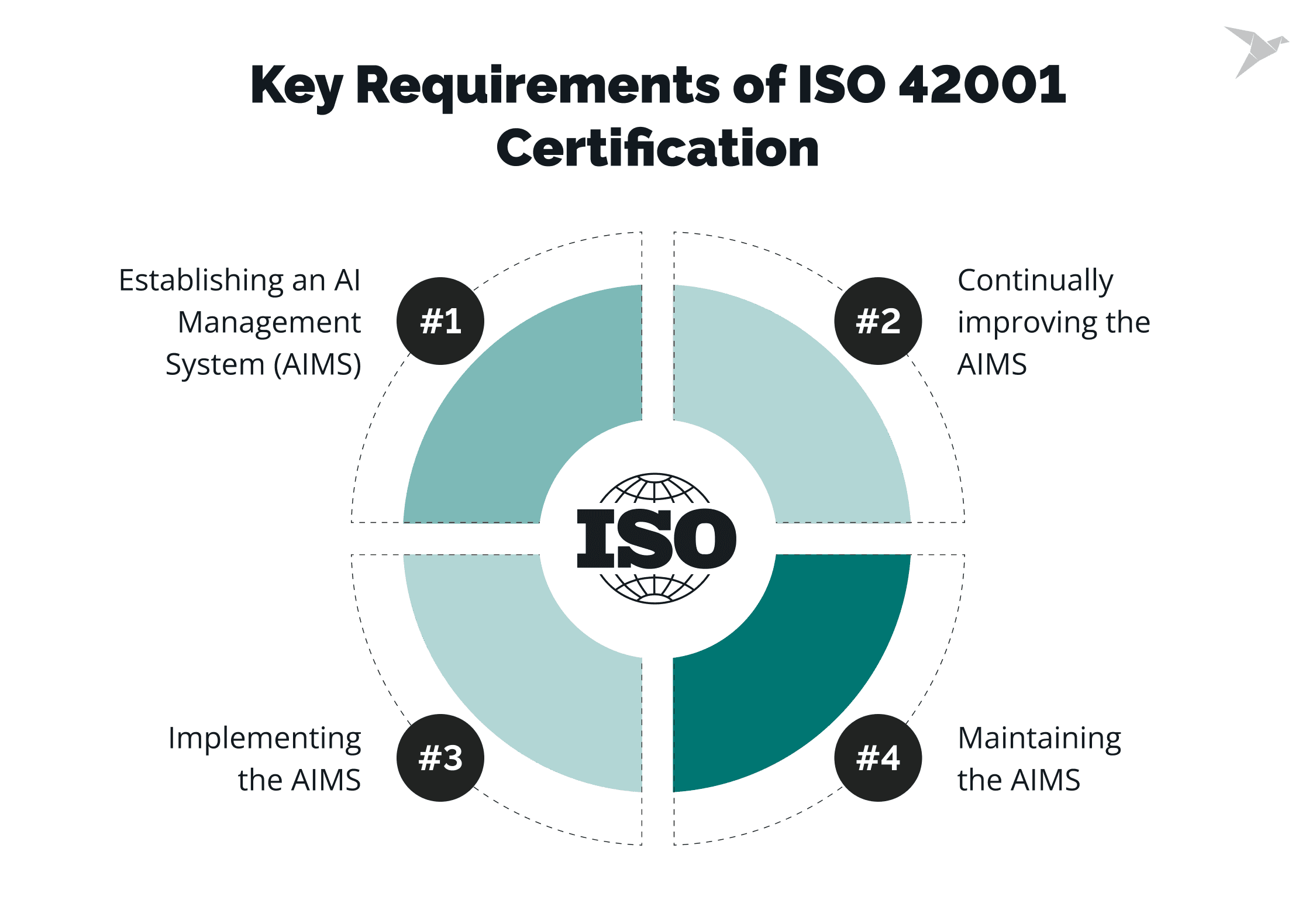
Establishing an AI Management System (AIMS)
The first requirement is to set up a clear AI Management System (AIMS). A handful of specific tasks go into that.
Define governance structure
Name your key stakeholders, leadership, project managers, AI ethics officers, and set clear roles and responsibilities for overseeing AI systems. Everyone should know what they own.
Create policies and procedures
Write the policies for developing, deploying, and maintaining AI systems. Then line them up with your business objectives, your regulatory requirements, and your ethical guidelines.
Document AI goals and scope
Set clear objectives for your AI systems. What they’re for, what you expect from them, and where they’ll operate inside the organization.
Ensure legal and ethical compliance
Make sure every AI system follows the relevant regulation, data-protection law included, and holds to your ethical principles: fairness, transparency, accountability.
Implementing the AIMS
With the AIMS defined, the next job is putting it to work across your operations.
Training and educating employees
Train the people involved in AI management, and do it regularly, so they know the governance, ethics, compliance, and operational side cold.
Allocate necessary resources
Put real money and real people behind the rollout. Usually that means hiring skilled professionals and investing in the technology you actually need.
Integrate AIMS into business operations
Build AI governance into the day-to-day, so systems get developed, deployed, and maintained to the standards you’ve set, even when a busy week is tempting everyone toward shortcuts.
Establish internal communication channels
Open clear channels between the teams working on AI projects. That’s how governance stays transparent and consistent instead of fragmenting team by team. The point is simple. Put every part of AI governance into practice, and use AI responsibly across the whole organization.
Maintaining the AIMS
ISO 42001 stresses keeping the AIMS alive over time and improving it as you go. In practice, that comes down to a few things.
Regular performance reviews
Run periodic assessments that check AI system performance against your KPIs, so the systems keep meeting both business goals and ethical standards.
Continuous risk assessment
Run regular risk assessments to catch new or shifting risks, from ethical concerns to security vulnerabilities. Risk isn’t a one-time audit item.
Update systems as needed
Update your policies and procedures as you learn, as regulation changes, and as the technology moves. Keep your AI systems aligned with current business and regulatory requirements.
Monitoring for compliance
Review your AI systems against internal policy and external regulation, and prepare an audit report when you need one. Part of that is staying current with new legal requirements as they land, so you’re not scrambling once one takes effect.
Continually improving the AIMS
The last requirement is continuous improvement of the AIMS. ISO 42001 asks you to monitor and evaluate your AI systems on a regular basis.
Implement a feedback loop
Gather feedback from your AI system’s users, stakeholders, and auditors regularly. That’s how issues and openings to improve actually surface.
Monitor AI system performance
Use performance data to judge how well your AI systems run and to spot where they can get better, whether that’s efficiency, safety, or compliance.
Update and refine processes
Take what the evaluations and feedback tell you, then adjust your AI processes, algorithms, and governance frameworks to fix problems and improve outcomes.
Conduct regular audits and reviews
Run internal audits to test how well your AI governance holds up and to find what needs refining. Then set a schedule for ongoing performance and compliance reviews.
This steady cycle keeps your AI systems effective, safe, and compliant, even as new challenges and opportunities come up.
ISO/IEC 42001 and Other Standards
ISO/IEC 42001 is designed to slot in beside your other standards and reinforce them. Here’s how it connects with the rest to form one coherent approach to governance.
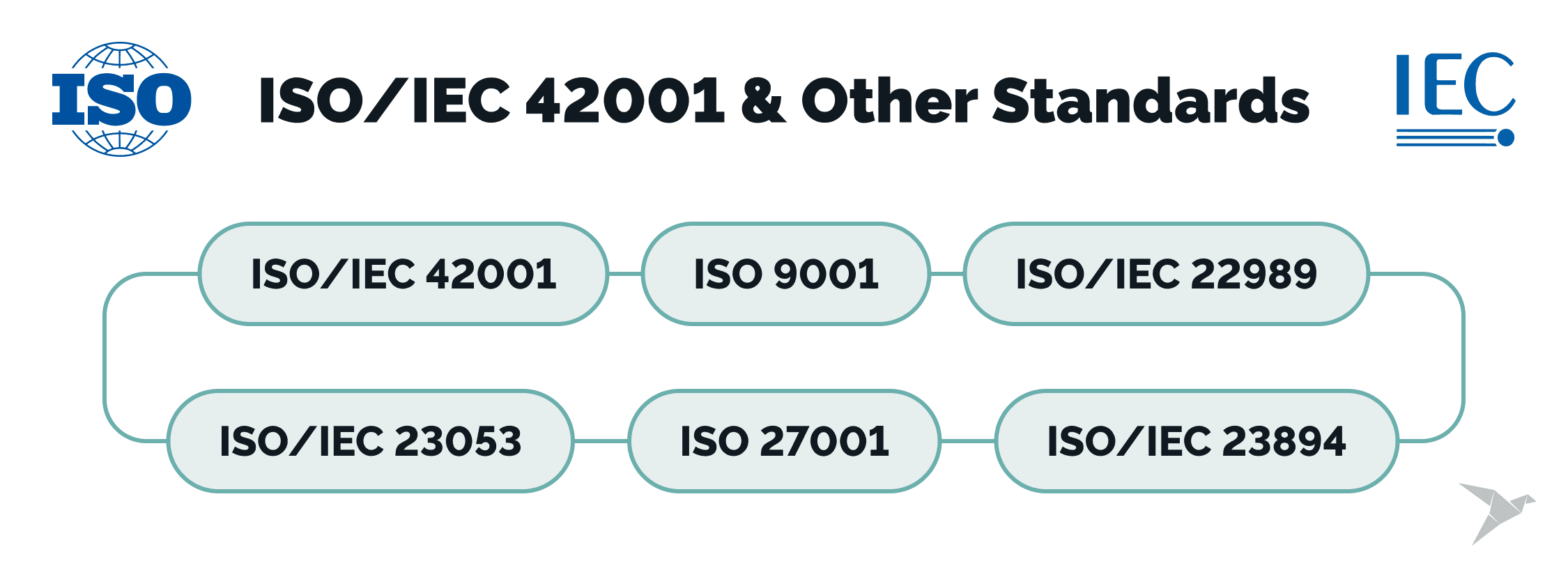
ISO 42001 and ISO 9001 (quality management)
ISO 9001 and ISO 42001 both push for good management. But they cover different ground, and that gap really shows once AI enters the picture.
ISO 9001 is about quality management across all your business processes. It keeps products and services meeting customer requirements and regulatory expectations, and it drives continuous improvement. The payoff is consistency, tighter operations, and happier customers.
ISO 42001 is narrower. It governs the AI systems inside your organization. Where ISO 9001 handles overall quality, ISO 42001 takes on what’s specific to AI: ethics, bias management, regulatory compliance, and transparency in how AI decides. It also covers responsible development, deployment, and ongoing oversight, because AI brings complications that need their own governance.
The two aren’t rivals. They complement each other. ISO 9001 sets the general quality framework; ISO 42001 goes deep on AI governance. Run both, and your AIMS comes out high-quality and reliable, but also ethically sound, legally compliant, and transparently managed.
In practice, ISO 9001 lays the quality foundation. ISO 42001 builds on it, with a focused view of managing AI systems responsibly and transparently as those systems move to the center of how you operate.
ISO 42001 and ISO 27001 (information security)
ISO 27001 guards your data and information systems against security threats. It covers confidentiality, integrity, and availability. As a framework for information security, it helps you protect sensitive data, fend off cyberattacks, and stay compliant with data-protection regulations.
ISO 42001 goes further. It governs the AI systems themselves, giving you a full approach to managing AI models and algorithms and keeping them secure, transparent, and in line with your ethical standards.
Here’s the split. ISO 27001 compliance protects the data your AI systems use. ISO 42001 makes sure the systems themselves are built, deployed, and maintained responsibly, tackling risks like algorithmic bias, keeping decisions explainable, and meeting AI-specific regulations.
Together they cover both sides: the data and the technology behind AI. ISO 27001 locks down your information assets. ISO 42001 keeps the AI itself responsible, ethical, and secure.
Run both and you can manage your Artificial Intelligence systems with real confidence. Your data stays protected, you meet regulations, and you earn trust with customers and stakeholders.
Other relevant standards
ISO/IEC 22989 (AI terminology)
ISO/IEC 22989 sets a shared vocabulary for AI: common terms and definitions everyone can use. That matters for ISO 42001, which is all about managing, developing, and deploying AI responsibly.
A shared vocabulary cuts confusion. It keeps teams aligned and lets you explain AI clearly to stakeholders, regulators, and clients. It also makes ISO 42001 easier to put in place, especially around risk management, transparency, and ethical governance.
Take terms like bias, algorithm, explainability, and data governance. When you apply ISO 42001’s governance frameworks, clear definitions of those matter a lot. Together, the two standards keep AI-based systems managed responsibly, support AI risk management, and make sure everyone across the organization is talking about the same thing.
ISO/IEC 23053 (AI and ML framework)
ISO/IEC 23053 frames a generic AI system built on Machine Learning. It lays out the core components and processes, which helps you structure and manage your AI technologies.
It also tackles common ML issues: keeping AI models accurate, preventing bias in the data, and avoiding errors during training. Pair it with ISO 42001, and you get a tighter, more structured way to manage and govern AI systems.
ISO/IEC 23894 (AI risk management)
ISO/IEC 23894 is about AI risk. It lays out practical steps to identify, assess, and address the risks that come with AI-based systems, so your AI stays safe and responsible.
Pair it with ISO 42001 and your AI governance gets stronger. Together, they catch risks early, like bias, transparency gaps, and unintended consequences, so your AI runs effectively and ethically. Less potential harm, more trust and performance.
Main Benefits of ISO 42001 Certification
ISO 42001 requires structured risk management and impact assessments. It helps your team make smarter, data-driven decisions about AI development and deployment. It also gives you a clear process to evaluate the benefits and risks of AI projects, so you can move forward with confidence.
The standard balances managing risk with encouraging innovation. Certification doesn’t box you in. It gives you a solid framework for exploring new AI applications while keeping the downsides in check.
And the benefits don’t stop there. A few more are worth weighing.
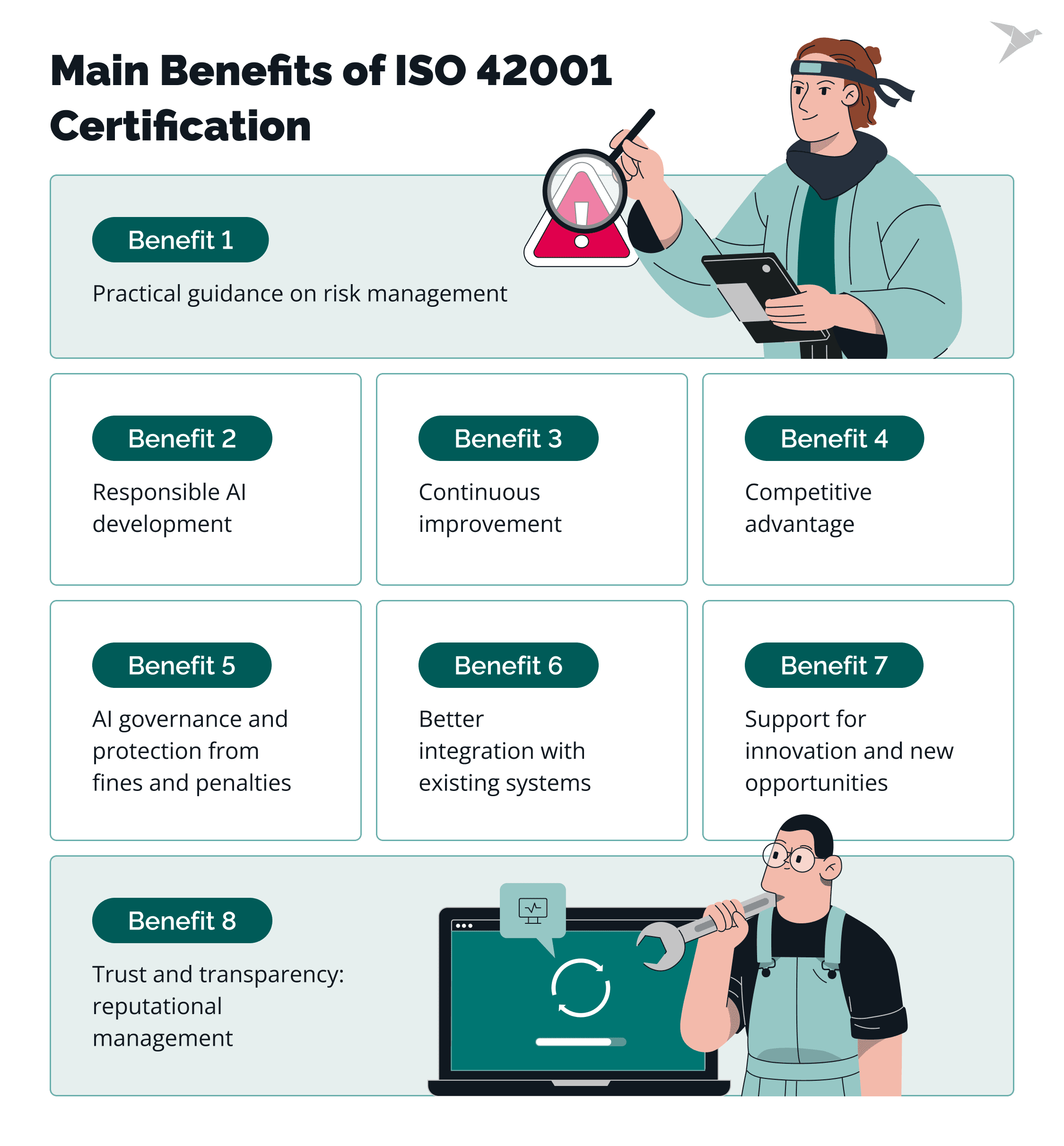
Responsible AI development
ISO 42001 certification steers you toward building and using AI responsibly. It rewards thoughtful design and deployment, and it helps you dodge the usual traps, bias and unfair treatment among them. What you get out the other side is AI that respects users and society, plus innovation that’s safer and easier to sustain.
Practical guidance on risk management
One of the standard’s biggest strengths is how clearly it structures the work of finding and managing AI-related risk. Bias in the data, the unintended consequences of an AI decision, it helps you catch and handle these early. Fewer surprises. Real protection from reputational or operational damage.
Take a financial company using AI to approve loans. Say the algorithm quietly favors one group over another. That’s a genuine risk. With ISO 42001’s structured risk management, the company can:
- identify this bias early,
- adjust the AI model,
- prepare for the external audit by an independent third party;
- prevent unfair decisions that could lead to legal trouble or damage to its reputation.
AI governance and protection from fines and penalties
ISO 42001 gives you a strong base for meeting legal and regulatory requirements, upcoming laws like the EU AI Act included. Fall out of step with those evolving rules and the bill arrives fast: fines, legal challenges, brand damage.
Complying with ISO 42001 shows regulators and customers that your AI practices meet recognized international standards. It says you’re proactive, trustworthy, and serious about doing this right.
That doesn’t only help you dodge penalties. It strengthens your standing in the market. And as buyers increasingly demand responsible AI, winning clients and building long-term partnerships gets a good deal easier.
As you put these controls into practice, a lot of companies also look at compliance automation platforms and Vanta alternatives to centralize evidence, speed up audits, and line ISO 42001 up with frameworks like ISO 27001 or SOC 2.
Trust and transparency: reputational management
Trust matters whenever you deploy AI-based systems, and it matters most when those systems touch people’s lives or sensitive data. ISO 42001 compliance builds it by pushing for clear documentation, explainability, and accountability across the AI lifecycle. That openness gives users, partners, and stakeholders confidence, which makes adoption a lot smoother.
Continuous improvement
AI changes fast, as well as its risks. ISO 42001 helps you keep pace with regular check-ins and updates to your AI-based systems. A risk-based approach means you catch and fix problems early instead of waiting for them to blow up. Over time, learning and improving stop being projects and just become how you work, which keeps your AI safe, effective, and matched to what your business and customers need.
For example, a healthcare provider using AI does not just set it and forget it. To meet regulatory compliance, they have to monitor how the AI performs as new medical information comes in. And following a process like ISO 42001, they can quickly update the AI to improve accuracy and reduce bias. That meant fewer mistakes, safer patients, and trust from regulators and the public alike.
Better integration with existing systems
In short, integrating artificial intelligence governance like this keeps your operations efficient and your risk management tight.
ISO 42001 works hand-in-hand with standards you probably already use, like ISO 9001 for quality and ISO 27001 for security. That means you don’t have to build your AI governance from scratch or juggle multiple, disconnected processes.
Instead, certification folds AI management straight into your existing quality and security workflows. The result is simpler across the board: less paperwork, fewer overlaps, clearer accountability between teams.
Competitive advantage
ISO 42001 certification puts you out front on ethical AI, which sets you apart in a crowded market. It’s a plain signal of a forward-thinking approach, and it pulls in clients who care about responsible innovation.
Support for innovation and new opportunities
Finally, it balances governance with flexibility. Certification doesn’t slow innovation down. Moreover, it gives you a clear, structured way to weigh new AI opportunities and go after them with confidence.
Challenges in Aligning with ISO 42001
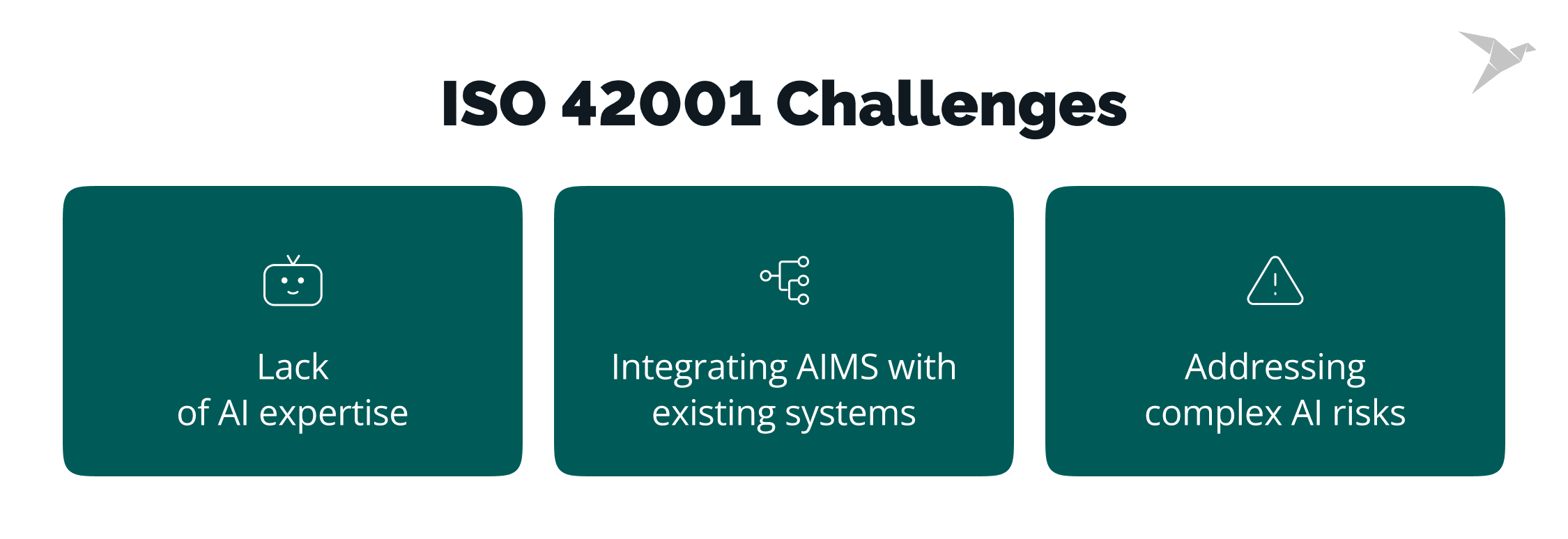
Organizations often face several hurdles when working to align with ISO 42001, particularly as they aim to manage AI risks.
Integrating AIMS with existing systems
Bringing an AI management system into your current workflows can be tricky. It takes careful planning of data management processes to make sure new AI governance fits smoothly with your existing processes, without slowing things down or causing disruptions.
Addressing complex AI risks
AI brings unique and sometimes unpredictable risks. Spotting them early and managing them through effective AI controls is a challenge. Organizations need to handle everything from bias and privacy concerns to unintended AI behaviors, which requires a deep understanding and a proactive approach.
Lack of AI expertise
Many organizations find it hard to hire or train people with the right skills to manage AI responsibly. Understanding AI ethics, technical risks, and compliance demands specialized knowledge that may not be available in-house, making effective AI governance tougher to implement.
We Help You Overcome Every Challenge of ISO 42001 Alignment
Aligning with ISO 42001 comes with its share of hurdles, from integrating new AI management systems without disrupting your current operations to tackling complex AI-specific risks and even bridging gaps in internal AI expertise. That’s exactly where we can help.
Our team pairs deep security and compliance consulting experience with hands-on AI work. We’ve helped organizations like yours fold AI governance into existing workflows without slowing anything down, keeping every process clear and efficient along the way.
We know the risks AI brings, bias, privacy, unpredictable behavior, and we know how to catch and manage them before they turn into real problems. Worried about a skills gap? We offer expert guidance to build, strengthen, or round out your AI team.
Our approach is practical and results-focused. We meet each challenge head-on and shape the solution around your specific needs and goals. And we don’t stop at compliance, either. We help you turn it into a competitive advantage, one that builds trust and drives growth.
Let’s discuss how we can guide you through every step of your AI journey
Final Thoughts
As AI becomes deeply woven into everyday business operations, managing it responsibly is a legal requirement now. Not all organizations were prepared for this, but here is where ISO 42001 comes into play.
It offers a straightforward, practical way to govern AI management systems ethically and effectively. Don’t think about it as another annoying regulation but as a way to protect your business from risks like bias and security issues, stay ahead of fast-changing regulations, and build AI that your customers and regulators can trust.
We expect ISO 42001 to be adopted rapidly worldwide, especially in regions with strict AI laws like the EU. It will become a key part of how organizations integrate AI governance with existing quality and security standards, creating a seamless, unified approach to managing technology responsibly.
Because AI technology and its challenges evolve quickly, ISO 42001 will keep adapting too, giving you the latest guidance to keep your AI systems safe and effective. Whether you’re just starting your AI journey or looking to strengthen your existing systems, ISO 42001 equips you with the tools to manage AI confidently and turn compliance into a true business advantage.
FAQ

ISO/IEC 42001 (ISO 42001) is a global standard for AI governance. It lays out how to establish, implement, maintain, and continuously improve an Artificial Intelligence Management System (AIMS), in an organization of any size or reach. It’s meant for anyone who develops or uses AI-driven products or services, and it promotes responsible creation and use of AI.
Yes, especially if your organization uses AI-based products or builds AI technologies. Certification protects you from penalties and financial losses by keeping you compliant with AI-related regulations, from data-protection laws to emerging AI-specific standards.
It also signals intent. Following ISO 42001 shows a real commitment to ethical AI and lowers the risk of costly legal issues, fines, and reputational damage. In short, it protects your business and marks you as a responsible, trusted leader in AI.
Both touch on governance and management, but their scope differs. ISO 27001 is about information security: protecting your data, systems, and processes from security threats, with a focus on confidentiality, integrity, availability, and risk mitigation.
ISO 42001 is about Artificial Intelligence governance. It’s a framework for managing AI systems and the parts that interact within them, covering AI impact assessment, ethics, transparency, risk management, and compliance with rules like data-privacy laws. So ISO 27001 keeps data handling secure; ISO 42001 keeps the AI itself ethical and responsible.
Put simply: ISO 27001 protects information. ISO 42001 manages AI systems responsibly and transparently.
ISO 9001 is broader. It covers quality management systems (QMS) across every part of a business, keeping products and services in line with customer expectations and regulatory requirements while driving continuous improvement.
ISO 42001 is narrower and AI-specific. Where ISO 9001 maintains quality across processes, ISO 42001 goes deeper into developing, deploying, and governing AI responsibly, taking in ethics, risk management, AI-specific compliance, and transparency and accountability in how AI decides.
The key difference you should pay attention to: ISO 9001 covers general quality management, and ISO 42001 targets the specific challenges and ethics that come with AI systems.