 Software Development
 Security Services
 Cloud Services
 AI Services
 Other Services















 TechMagic Academy


Penetration Testing Types: Which One Your Project Needs
Last updated:17 January 2024


How resilient are your digital defenses against the ever-shifting tides of cyber threats? What measures ensure your systems remain impregnable, safeguarding critical data from the clutches of malicious actors? These questions enclose the essence of penetration testing.
Penetration testing, or pen testing, is a controlled way to measure how secure a system really is by finding and exploiting its vulnerabilities. In practice, that means probing an organization's networks, databases, and critical information systems for weak points.
No company is immune. Even with strong infrastructure and strict security controls, some risk always remains. That is why penetration testing sits inside most organizations' risk assessment and security plans. Security experts run these tests by stepping into a hacker's shoes, learning how the infrastructure actually works and finding the risks hiding in it.
When choosing penetration testing services, it helps to know which approach fits your security goals. This post walks through types of penetration test, the Black Box, White Box, and Grey Box methods and where each one fits best. Here is how they compare.
Key takeaways
- A black box penetration test simulates an outside attacker with no internal knowledge, while white box testing provides full access to source code and environment for deeper coverage of security vulnerabilities.
- Gray box penetration tests sit in between, giving testers partial knowledge (like test credentials) to gain access to high-risk systems faster.
- Social engineering tests check how well employees resist phishing and manipulation rather than probing technical flaws.
- Physical penetration testing simulates break-ins, lock-picking, or talking staff into opening restricted areas.
- Many security teams now pair traditional pen testing with AI-driven scanning tools that flag anomalies faster, though human testers still handle exploitation and context automation tends to miss.
Why Regular Penetration Testing Is Important?
Cyber threats keep growing in both frequency and severity, and they put businesses of every size at risk. The usual suspects: ransomware, phishing, and web attacks like cross-site scripting (XSS) and SQL injection.
Penetration testing works from a hacker's point of view, finding and fixing weaknesses before a real attacker can use them. Traditional security scans mostly flag things that might be problems. A pen test goes further: it confirms which vulnerabilities are real and shows what they would actually cost the business.
Penetration Testing Types: What Are The Different Approaches To Penetration Testing?
Penetration testing is one of the core ways to protect a system. Done right, it is the most direct method for probing security and showing where it breaks. Testers work in three distinct approaches.
Black Box Testing
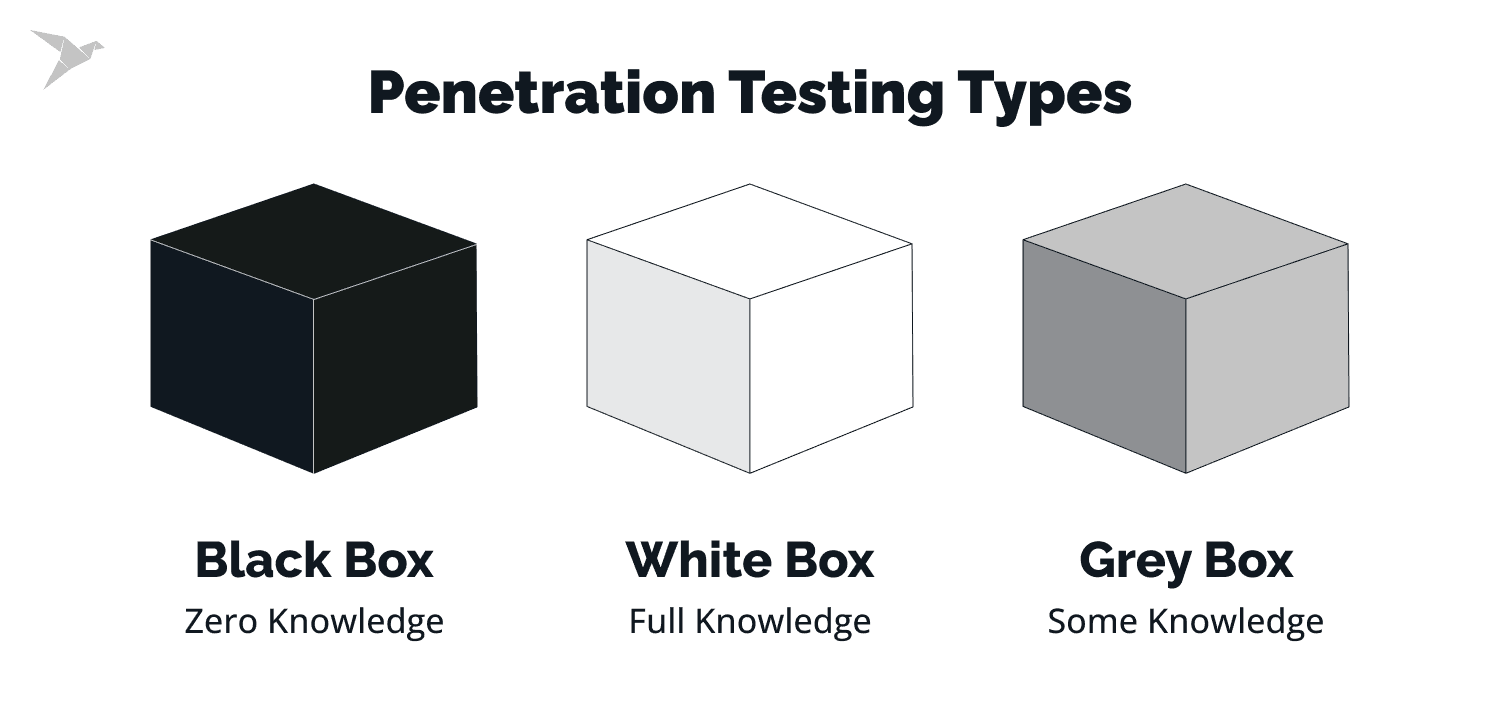
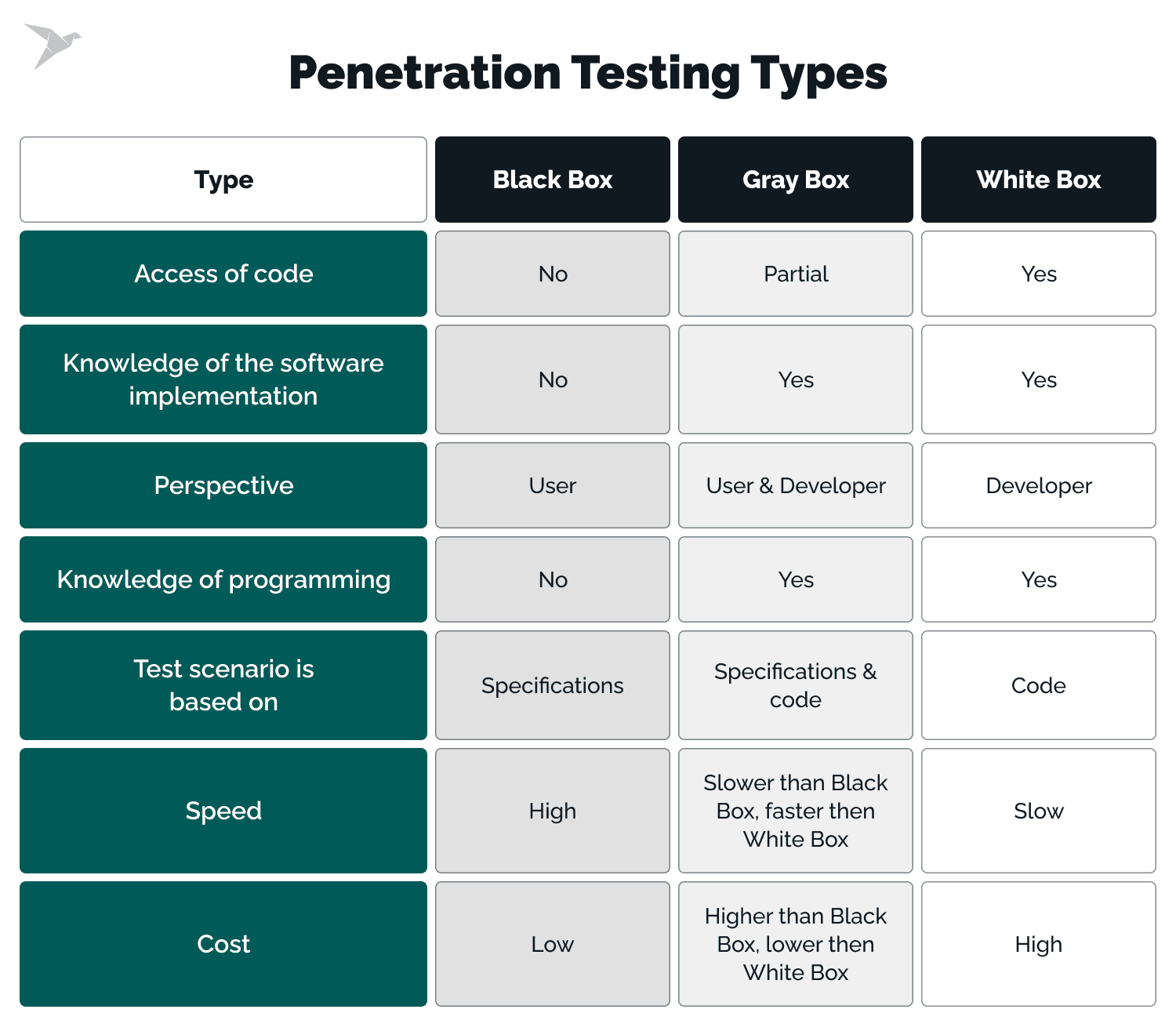
In a black box penetration testing , the tester plays an ordinary outside hacker with no inside knowledge of the target. The work is dynamic: analyzing running programs and systems on the target network with a mix of automated scanners and manual techniques. The tester knows the expected outputs but not how the system produces them, and never looks at the source code. The focus stays on results, not internals.
The goal of a black-box test is to find the vulnerabilities an attacker could exploit from outside the network.
Because the tester starts with so little, black-box tests tend to run quickly, as long as the tester can find and exploit something in the outward-facing services. The trade-off is real: if the perimeter holds, weaknesses in internal services can go unnoticed and unpatched.

Grey Box Testing
Grey box penetration testing, sometimes called insider attack simulation, sits in the middle. The tester gets partial knowledge, maybe network diagrams, documentation, or limited access to the internal network, but not full access. In web application testing, for example, handing the team a set of test credentials is a classic gray-box setup. The tester sees more than an outsider would, but less than in a white-box test.
Gray-box testing aims for a more focused, efficient read on network security than a black-box test can give. With design documentation in hand, testers go straight to the high-risk systems instead of guessing where they are. An internal account then lets them examine the defenses behind the perimeter, the way an attacker would once they had a foothold and time inside the network.
White Box Testing
White box penetration testing gives security engineers full access to the target: credentials, network diagrams, documentation, and source code. The tester works with a deep set of system and network details, from schema and source code to OS information and IP addresses.
That access buys a thorough look at both internal and external vulnerabilities. The tester works to understand how the application functions, then tries to break it with the source code in front of them. That is the opposite of black-box testing, where the source code stays out of reach.
Penetration Testing Methods
External penetration testing
External testing looks at everything a company exposes to the internet: web applications, APIs, corporate sites, email systems, domain name servers. The goal is to find and fix the weaknesses that any attacker with an internet connection could reach. It plays out as an ethical hacker going after your external web servers, hosting, and internet-connected devices.
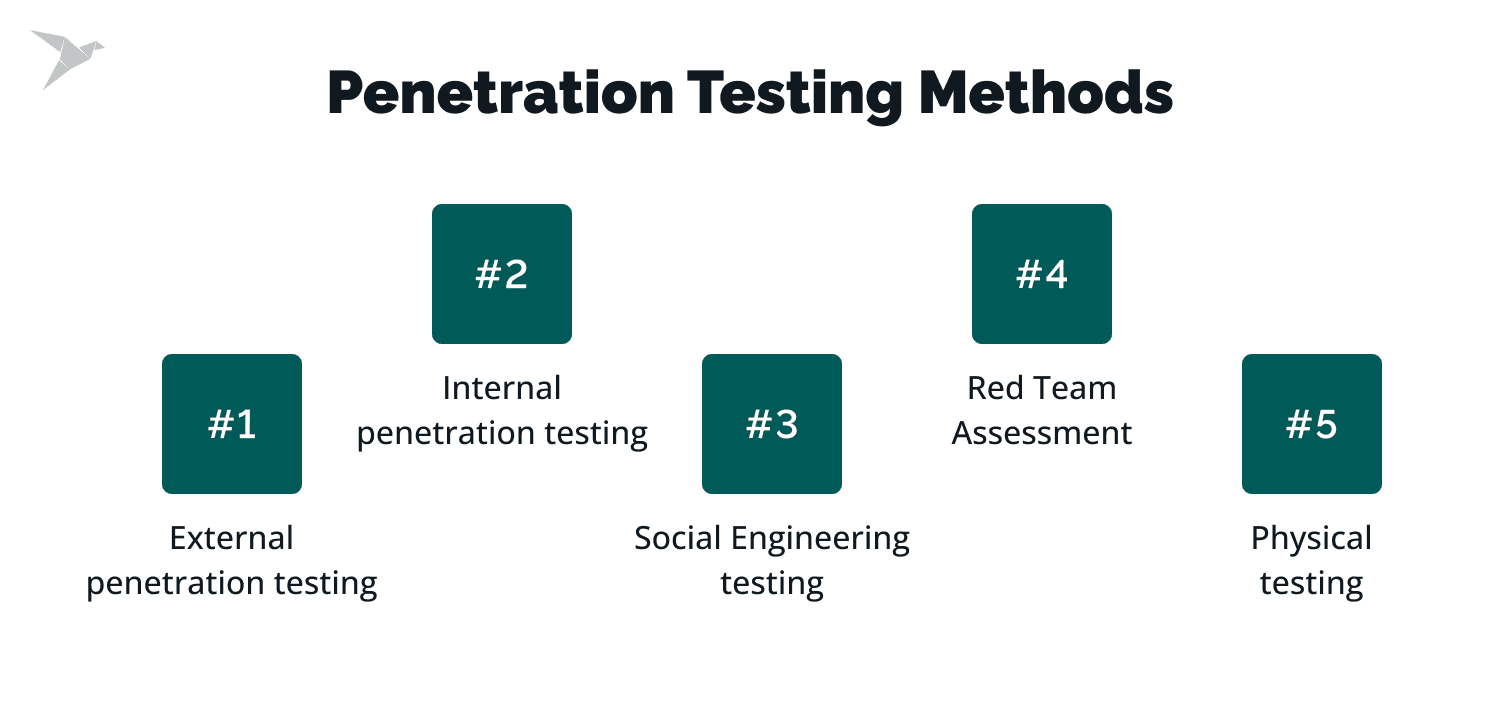
Here the focus is the security of systems that touch the internet directly. That covers the defenses around websites, databases, web applications, and File Transfer Protocol (FTP) servers, together known as the organization's perimeter security.
Penetration tester works as outsider, trying to reach critical business systems and data with no prior knowledge or access. It is a useful exercise because it copies the exact techniques external attackers use, and it shows how well your systems hold up against a real breach attempt.
Join our upcoming webinar to get practical guidance before your next audit

Internal Penetration Testing
Internal penetration testing mimics an attacker who is already inside the network. It shows how insider threats, whether deliberate or accidental, could put the organization at risk.
Security teams or authorized users play the insider. A common setup uses a staff account that has been compromised, usually through phishing. That lets the test measure the damage a user with elevated privileges could do. Working from the inside, the goal is to find the paths someone could take to steal sensitive data or disrupt operations.
Social engineering testing measures how vulnerable an organization is to human manipulation. Where most testing targets technical flaws, this method looks at the human side of security and how well it holds up.
The point is to see how well employees resist deception and spot a threat. That means testing whether they catch phishing attempts, suspicious access requests, and other social engineering tricks.
Red Team Assessment
A red team goes on offense, simulating external attacks, while a blue team defends. The two end up pitted against each other, each looking for gaps in the other's game.
The red team's job is to breach the organization the way a real attacker would, finding and exploiting weaknesses across digital, social, and physical fronts. These exercises show how resilient you really are, and how well you can detect, respond to, and recover from a serious attack.
Physical Testing
Here the testers focus on physical threats, the kind that involve getting into a location in person. A simulation might mean picking a lock, walking off with a device, or talking an employee into opening the server room door.
The goal of physical penetration testing is to find gaps in physical defenses: procedures that get skipped, intrusion alarms that fail, weak spots in perimeter fencing, or security staff who do not catch an intruder.
Areas of Pen Testing: 8 Types of Penetration Testing
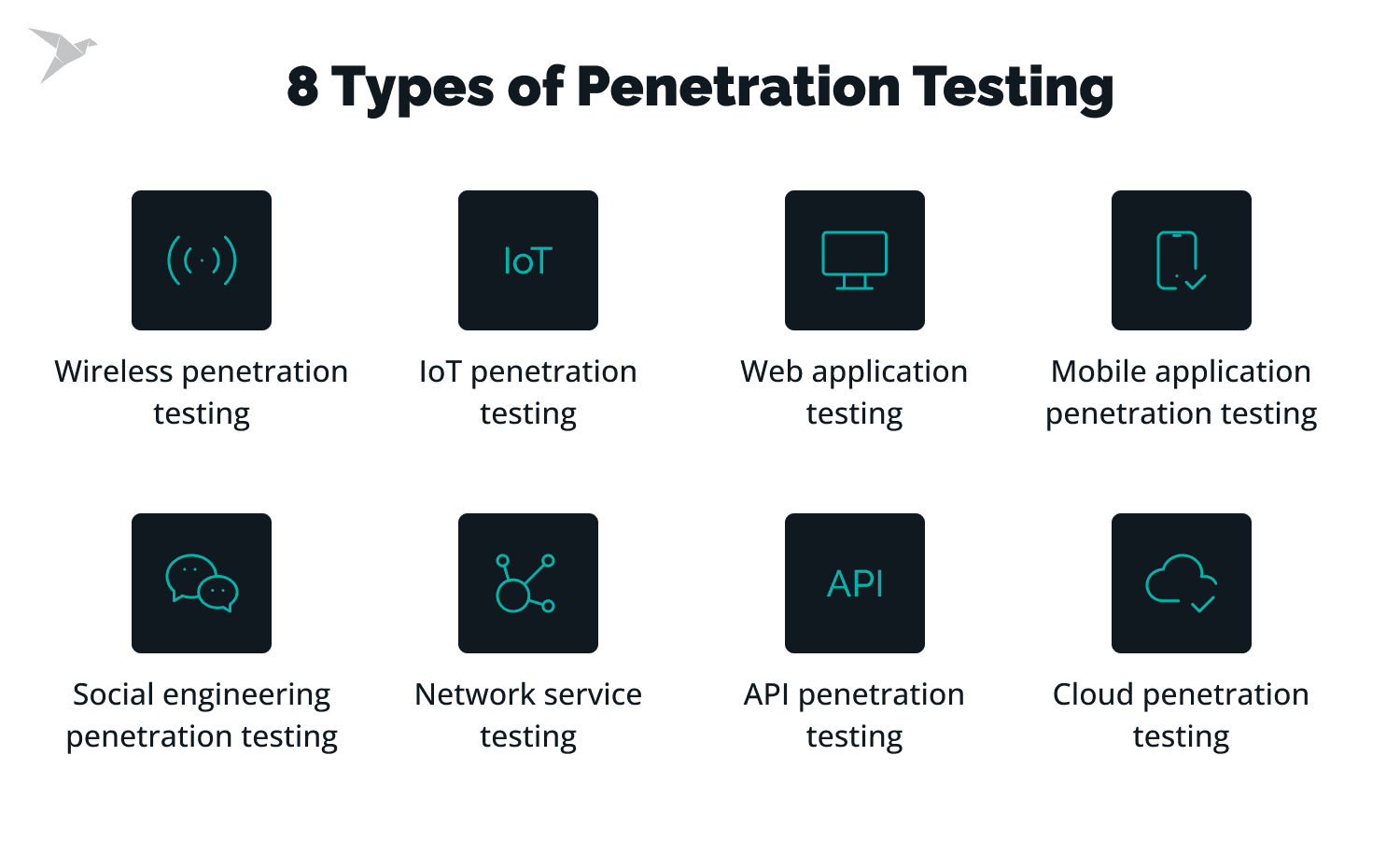
Wireless penetration testing
Wireless penetration testing checks how open your network is to intrusion over the air. It focuses on Wi-Fi security specifically, as opposed to Bluetooth, BLE, ZigBee, or other radio protocols, which can also be tested but need specialized kit like software-defined radio.
The aim is to find and exploit weaknesses in Wi-Fi networks that would let someone onto the organization's network. Testers use a range of tools to scan for wireless networks and detect flaws, then run active attacks, like capturing and cracking WPA2 handshakes, or passive ones, like standing up a rogue access point to harvest wireless credentials.
Organizations can employ penetration testing to find the vulnerability of their Wi-Fi networks to potential attacks. Evaluating access points, wireless clients, and diverse wireless network protocols (like Bluetooth, LoRa, Sigfox) uncovers common vulnerabilities such as encryption flaws and weaknesses in Wi-Fi Protected Access (WPA) keys.
To gain insight into our approach, read the case study

IoT penetration testing
The Internet of Things (IoT) is a tangle of familiar pieces, cloud services, operating systems, and applications, wired together with a set of smart devices on the same network.
IoT penetration testing looks for the weaknesses built into IoT devices and systems, then recommends how to close them. The work spans a lot: misconfigured open ports, unpatched software, factory-set backdoor accounts and default passwords, pulling firmware apart to spot issues, getting past anti-tamper protections, and finding ways into the device or jailbreaking it through interfaces like JTAG, UART, or SPI.
Web application testing
Web application penetration testing is a full evaluation of how secure a web-based system is. It follows a structured framework, usually starting from a baseline checklist like the OWASP Top 10 for Web Applications.
The tester works through the application carefully, hunting for flaws like SQL injection, cross-site scripting, and cross-site request forgery. Each one that turns up gets tested hard to see whether it could open the door to critical data or hand over control of the application.
Web application penetration testing encompasses the detection of vulnerabilities related to data validation, integrity, authentication, user session management, and more. Testing a web application typically involves three phases: reconnaissance, vulnerability identification, and attempts to exploit these vulnerabilities to access applications or backend systems illicitly.
Mobile application penetration testing
Mobile application penetration testing involves comprehensively evaluating mobile apps and their associated APIs. Penetration testing experts employ both manual and automated tools to detect vulnerabilities, specifically in mobile apps, known for their inherent high-risk nature. The choice between manual vs automated penetration testing depends on the complexity of the application, as manual testing can uncover more intricate vulnerabilities that automated tools might miss.
Penetration testing aims to uncover intricate security concerns, such as business logic flaws, deployment configurations, and injection vulnerabilities within apps running on diverse operating systems like Android, iOS, and Windows UI. These assessments often align with OWASP Top 10 Mobile guidelines and, for more comprehensive evaluations during Software Development Life Cycle, follow the OWASP Mobile Application Security Verification Standard (MASVS).
See how we helped Unimed prepare for its ISO 27001 certification

Social engineering penetration testing
Social engineering penetration testing digs into how security-aware a company's employees are, looking for the gaps an attacker could exploit. These tests build scenarios where an attacker tricks an employee into handing over sensitive information or access to a critical system.
Where other methods chase technical flaws, social engineering goes after human psychology. It can happen remotely, through phishing emails or phone calls that fish for sensitive information, or on-site, by trying to walk into the building. Either way, the goal is the same: getting a person, usually an employee, to give up something valuable.
Network service testing
Network penetration tests look for weak points in your network infrastructure, on-site or in the cloud. That work matters because it protects your sensitive data directly. Testers review configurations, encryption, and patching to map out the paths an attacker might take, examining servers, firewalls, routers, printers, switches, and workstations along the way.
Finding those weaknesses heads off attacks that exploit misconfigured firewalls, target switches or routers, or run through DNS, proxy, and man-in-the-middle (MiTM) tricks. The work itself covers a lot of ground: bypassing firewalls, testing routers, slipping past intrusion prevention and detection systems (IPS/IDS), footprinting DNS, scanning open ports, and attempting SSH attacks.
API penetration testing
An API penetration test hunts for vulnerabilities in an application programming interface (API), acting like a malicious user to see how open the application is to attack.
API testing works a lot like web application testing, and the tooling overlaps too, usually Burp Suite and OWASP ZAP, sometimes with Postman or Swagger alongside. APIs even earned their own section in the 2024 edition of the OWASP Top 10, a sign of how much they now matter.
A few things are specific to APIs, though. You test authentication and authorization closely, and you probe attack vectors like mass assignment, access-control flaws such as IDORs and BOLAs, and rate limiting. Those checks are where a lot of API risk actually lives.
Cloud penetration testing
Cloud penetration testing goes after weaknesses in infrastructure and applications, Software as a Service apps especially, running on public clouds like Amazon Web Services, Microsoft Azure, and Google Cloud Platform (GCP). The aim is to reach sensitive data and take control of the target infrastructure.
Cloud services like AWS Cognito, Azure AD, S3 buckets, and RDS often carry their own misconfigurations. That is why it pays to bring in an experienced pentester who knows these services, understands their quirks, and can work them properly during the assessment.
Penetration Testing Steps
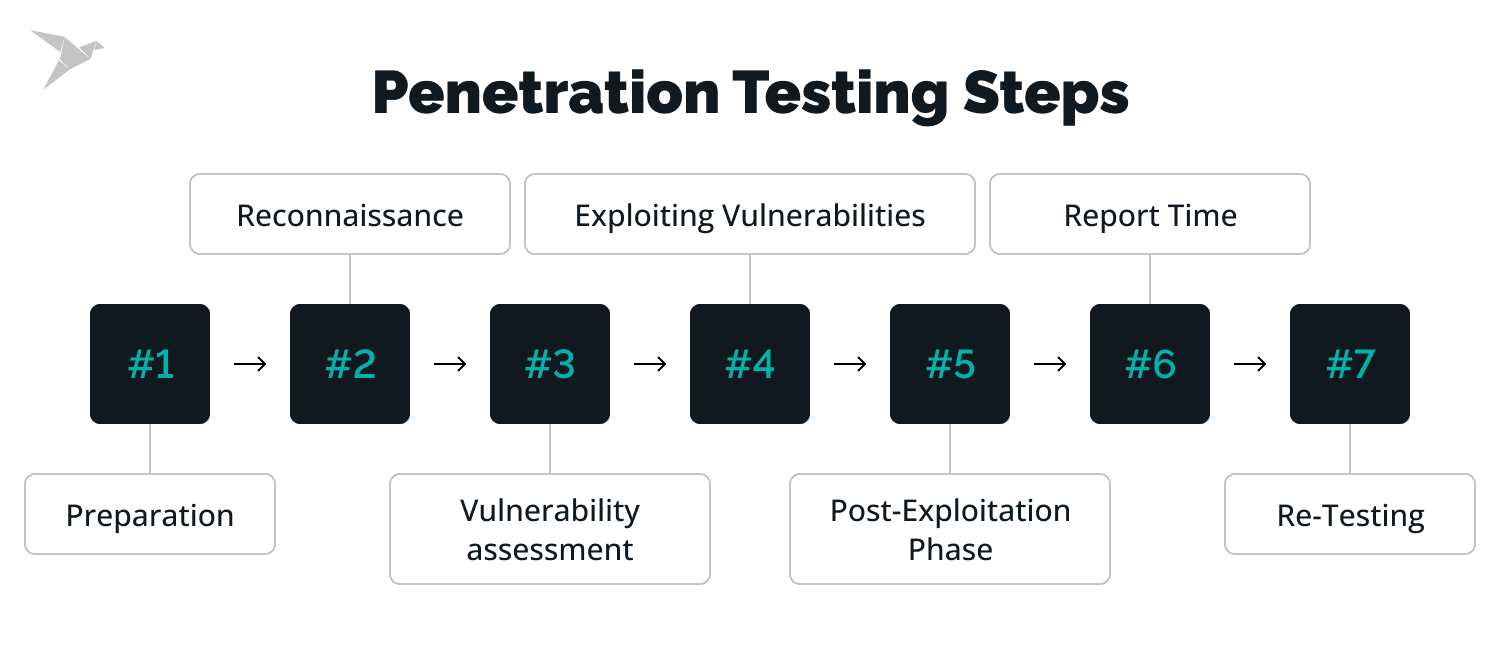
A typical penetration test runs through several phases. Which ones get the most attention depends on the test's aim and scope, and the exact steps can shift from one provider to the next.
- Preparation. The tester and client agree on the details up front: which systems are in scope, what methods the tester will use, and any extra goals or legal terms.
- Reconnaissance. The tester gathers information about the target, from the people involved to the technology they run and how their systems are set up.
- Vulnerability assessment. With that information in hand, the tester switches to an attacker's mindset and starts identifying and weighing the weaknesses in the client's systems.
- Exploiting vulnerabilities. The tester now acts on what they found, always staying inside the scope set during preparation.
- Post-exploitation. After breaking in, the team pulls as much information from the system as they can, then looks for ways to escalate privileges or hold onto access over time.
- Reporting. The tester writes up the engagement for the client: the methods used, which vulnerabilities were exploited, how to fix them, and anything else worth flagging.
- Retest. The tester may come back to re-run the checks and confirm the fixes held. This step is optional, but clients often ask for it to be sure.
Learn how we helped Elements.Cloud set up cybersecurity for their product

TechMagic is Your Pentesting Service Partner
Finding vulnerabilities is only the starting point. A compliance or cybersecurity program stays effective when you maintain it and review it on a regular schedule. That is what keeps it able to handle new threats as they emerge.
Our penetration testing services team helps companies across industries find and fix hard-to-spot vulnerabilities, spanning internal and external infrastructure, wireless and web applications, mobile apps, network setups, and configurations. No two architectures are the same, so we adapt the testing approach to fit how your systems are actually built.

FAQ
The right penetration testing type depends on a few things: how big your organization is, how complex your IT setup is, what compliance rules you face, and how your business runs. A cybersecurity expert can assess your specific risks and point you to the type that fits best.
The best time for a pen test is before a breach happens. If one does occur, a post-breach remediation test confirms that your fixes actually worked. As a rule, run tests during development or before a system goes live in production.
Schedule security testing at least once a year, and add assessments after major infrastructure changes, before a product launch, or during a merger or acquisition. If you hold a lot of personal or financial data, or face strict compliance rules, test more often than that.