 Software Development
 Security Services
 Cloud Services
 AI Services
 Other Services















 TechMagic Academy


Importance of Serverless Security: Attack Vectors and Best Practices
Last updated:2 March 2026

Serverless makes it easy to build and scale applications, but it also changes where things can go wrong. Teams no longer manage servers or virtual machines, yet they are still responsible for protecting code, data, and access.
That shift often creates blind spots. In fact, misconfigurations and access issues remain one of the leading causes of data breaches in cloud environments.
The challenge comes from the serverless model itself. Applications are built from small, event-driven functions running across managed cloud services, triggered by APIs, queues, or cloud storage events. Each function introduces a new entry point, new permissions, and new dependencies. Without a clear security strategy, these distributed systems can expose more risk than traditional setups.
This article explains how to secure serverless applications in practice. You will learn where the most common attack vectors come from, how can serverless improve security, what makes serverless security different, and which practices help reduce risk without slowing down development.
Key takeaways
- Serverless shifts responsibility, but does not remove it—teams still own application-level security and access control.
- Distributed architectures increase the number of entry points, which raises the risk of misconfigurations and exposure.
- Most security issues come from permissions, event triggers, and dependencies, not infrastructure.
- Effective serverless security combines clear ownership, strong access control, and continuous monitoring.
- A consistent approach to identity, configuration, and data protection is essential as systems scale.
What Is Serverless Security?
Serverless security focuses on protecting applications that run without managed servers. Services such as Google Cloud Functions handle infrastructure, scaling, and runtime management. This shifts part of the responsibility to the cloud provider, but not all of it.
The cloud provider is liable for the serverless web application security of cloud components — the vendor stores data, monitors network elements, and takes care of the operating system. They secure the underlying platform. Your team is still responsible for application logic, access control, data protection, and configuration. This shared model is central to serverless application security and requires clear ownership across teams.
Benefits of serverless
Serverless architecture helps teams focus on building features instead of managing infrastructure. This can simplify development and reduce operational overhead.
Key benefits include:
- No infrastructure management. Cloud providers handle servers, scaling, and maintenance, so teams can focus on code.
- Automatic scaling. Applications scale up or down based on demand without manual intervention.
- Cost efficiency. You pay only for actual usage, which can reduce costs for variable workloads.
- Faster development cycles. Smaller, function-based components make it easier to build, test, and deploy updates.
- Built-in cloud integration. Serverless services work well with other cloud tools, which simplifies building and connecting systems.
These advantages make serverless a practical choice for many modern applications, especially when speed and flexibility are important.
Where security risks come from
Serverless systems are distributed and event-driven. This creates different security risks compared to traditional applications.
Common sources of risk include: overly broad permissions, insecure event triggers, exposed secrets, vulnerable dependencies, and misconfigured services. Because functions are short-lived and interconnected, small issues can spread quickly if not controlled.
Threats in Serverless Security
Serverless architectures can consist of dozens, sometimes even hundreds, of small services that form a single application. This is one of the key security challenges in modern cloud native systems. The short-lived nature of serverless functions makes monitoring and audits harder, especially because teams no longer control traditional server management and must instead secure distributed cloud services and related storage systems.
Event-driven injection
Development teams do not always see every possible event path in a serverless application. Unlike more predictable web flows, serverless functions can be triggered by many sources across cloud services. Once a malicious or unexpected input is processed, it can trigger event injection. This makes event validation an important part of maintaining a secure serverless environment.
Over-privileged functions
In serverless systems, permissions should be easier to define because functions are small and focused. In practice, that does not always happen. Limited knowledge of IAM settings, fast release cycles, or changes in function scope can lead teams to grant more access than a function actually needs.
Over time, these excess permissions often stay in place, especially when older functions are split into smaller ones and access rules are not reviewed. This weakens the overall security posture and makes overprivileged functions a common and persistent risk.
Insufficient logging and monitoring
Any application needs sustainable monitoring and logging. In serverless environments, this is harder because functions appear and disappear quickly across cloud services. Without proper visibility, teams may miss malicious activity, unexpected costs, or failures. This applies across platforms, including AWS Lambda and Microsoft Azure Functions, where short-lived execution can make incidents harder to trace.
Components with known vulnerabilities
Because serverless functions are small and closely connected to microservices, they often rely on many third-party libraries and dependencies. This creates supply chain risk. Vulnerable packages, rushed updates, and unchecked integrations can introduce security issues that spread quickly through cloud native applications.
Broken authentication
Since an application is available in the cloud, anyone can attempt to access it. The goal is to provide a good user experience while keeping out unwanted users. In serverless applications, weak authentication mechanisms can make exposed endpoints easier to abuse. Strong identity controls are essential to keep the environment protected and maintain a secure serverless environment.
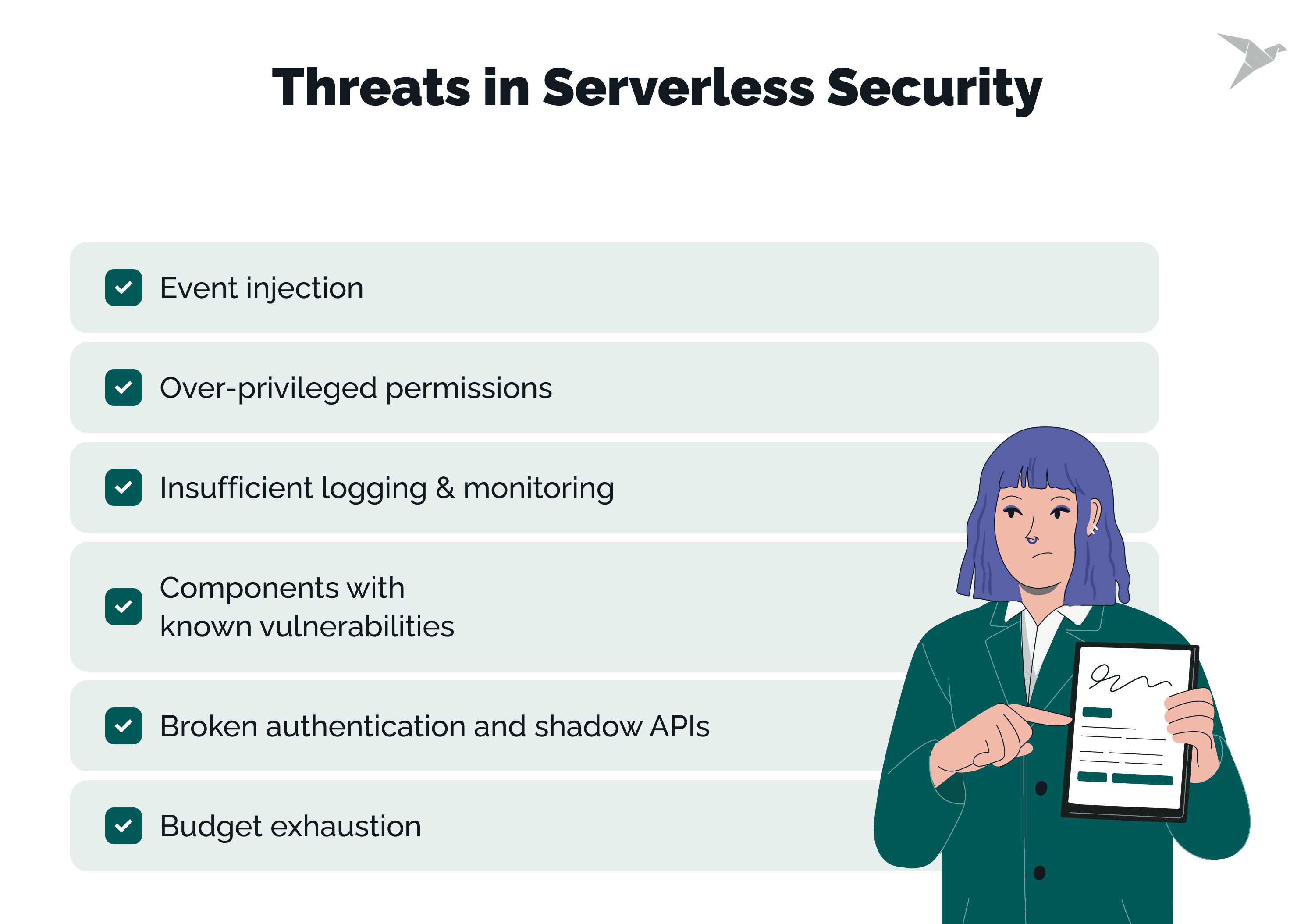
Budget exhaustion
Autoscaling is one of the main benefits of serverless, but it can also be abused. In a denial-of-wallet attack, a large volume of fake requests triggers repeated function execution and drives up costs.
This can happen through direct requests, automated bots, or even compromised integrations such as IoT device connections. In some cases, the same flood of requests may also carry malicious payloads, turning cost abuse into event data injection at the same time.
Shadow APIs
Shadow APIs are endpoints published outside the normal review and deployment process. Because they are not tracked properly, security teams may not see them, monitor them, or apply the right controls. That makes them easier for unauthorized users to find and exploit.
These APIs often lack strong authentication, may expose sensitive data, and can sometimes allow attackers to access files or misuse poorly protected encryption keys. Unchecked API endpoints can also become another path for event data injection, especially in distributed serverless systems.
Best Practices to Improve Serverless Security
Serverless applications often rely on many small services and functions working together. That flexibility comes with a trade-off: the more services you have, the harder they are to track, secure, and maintain.
Each function can become a potential entry point if it is exposed publicly, and managing permissions across a growing number of services can quickly become difficult. Without a clear access model from the start, teams may grant overly broad permissions just to keep development moving, which increases risk.
What to focus on in practice
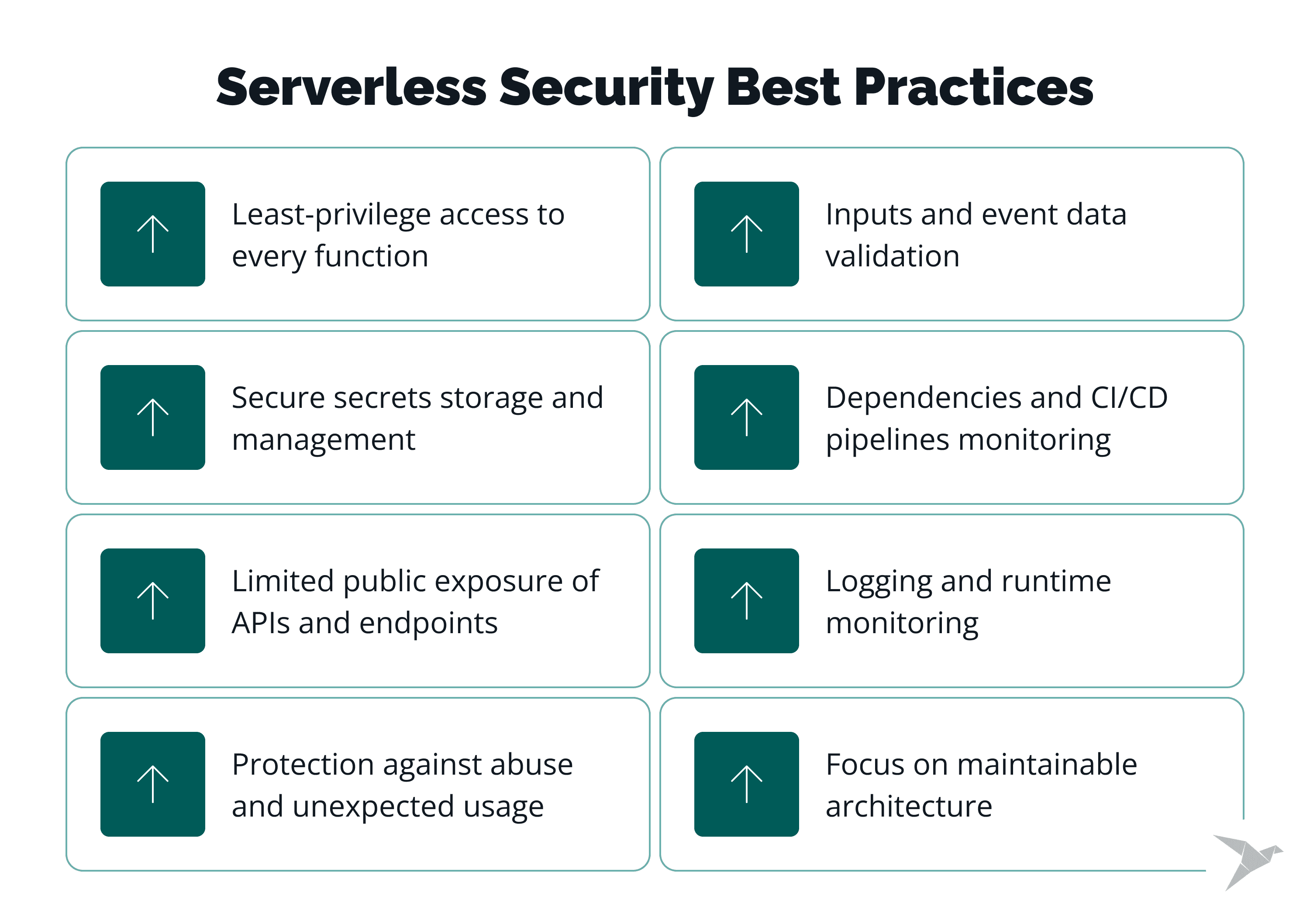
Effective cloud security in serverless environments depends on a few consistent practices:
- apply least-privilege access to every function;
- validate inputs and event data;
- store and manage secrets securely;
- monitor dependencies and CI/CD pipelines;
- limit public exposure of APIs and endpoints;
- enable logging and runtime monitoring.
These steps help reduce security risks while keeping the flexibility that serverless architectures provide. Let's take a closer look at serverless security best practices.
Start with identity and least privilege
Permissions remain one of the main sources of security concerns in the serverless model. Each function should have only the access it needs to perform its task. Overly broad permissions are still a common issue, especially in fast-moving projects where access rules are not reviewed regularly. Clear security responsibilities help teams manage access more consistently.
Validate events, not just inputs
Serverless applications rely on events from many sources, not only user input. Functions can be triggered by APIs, queues, or storage updates, so every event should be treated as untrusted. Validating untrusted message formats helps prevent injection and misuse across systems with unique security risks.
Protect secrets and configurations
Sensitive data should never be stored directly in code or exposed through weak settings. Use centralized tools to manage secrets and enforce secure configurations across environments. Misconfigurations remain a leading cause of sensitive data exposure in serverless systems.
Move from logging to runtime visibility
Logging is still important, but it is no longer enough on its own. Teams need continuous visibility into how functions behave in real time. Monitoring execution patterns and using runtime application self-protection helps detect anomalies earlier and respond faster.
Secure APIs and limit exposure
Every public endpoint increases risk. Functions exposed through HTTP or APIs should require authentication and be protected with rate limits and appropriate security controls. Internal services should not be publicly accessible unless necessary.
Manage dependencies and pipelines
Serverless applications often rely on many third-party libraries and automated pipelines. These can introduce risks if not monitored. Regular scanning of dependencies and build processes helps protect serverless workloads and reduces exposure across cloud resources.
an E-Learning app for sales people using JS and Serverless on AWS

Protect against abuse and unexpected usage
Autoscaling can be misused through excessive or malicious requests. Setting limits on usage and monitoring request patterns helps prevent unexpected costs and reduces the risk of denial-of-wallet attacks. This is an important part of a broader security strategy.
Focus on maintainable architecture
Smaller functions can reduce impact if something goes wrong, but too many functions can increase complexity. Unlike traditional server-based protection methods designed for virtual machines, the serverless model requires balancing function size with maintainability and clear access boundaries.
Serverless deployments are less about infrastructure and more about control and visibility. While providers secure the platform, serverless security requires teams to manage access, behavior, and configurations across distributed systems. Consistent security practices are essential to keep systems reliable and secure.
Serverless Security Trends
Serverless security is no longer an emerging topic. It is becoming a standard part of cloud strategy, shaped by real-world adoption, stricter compliance needs, and more complex architectures.
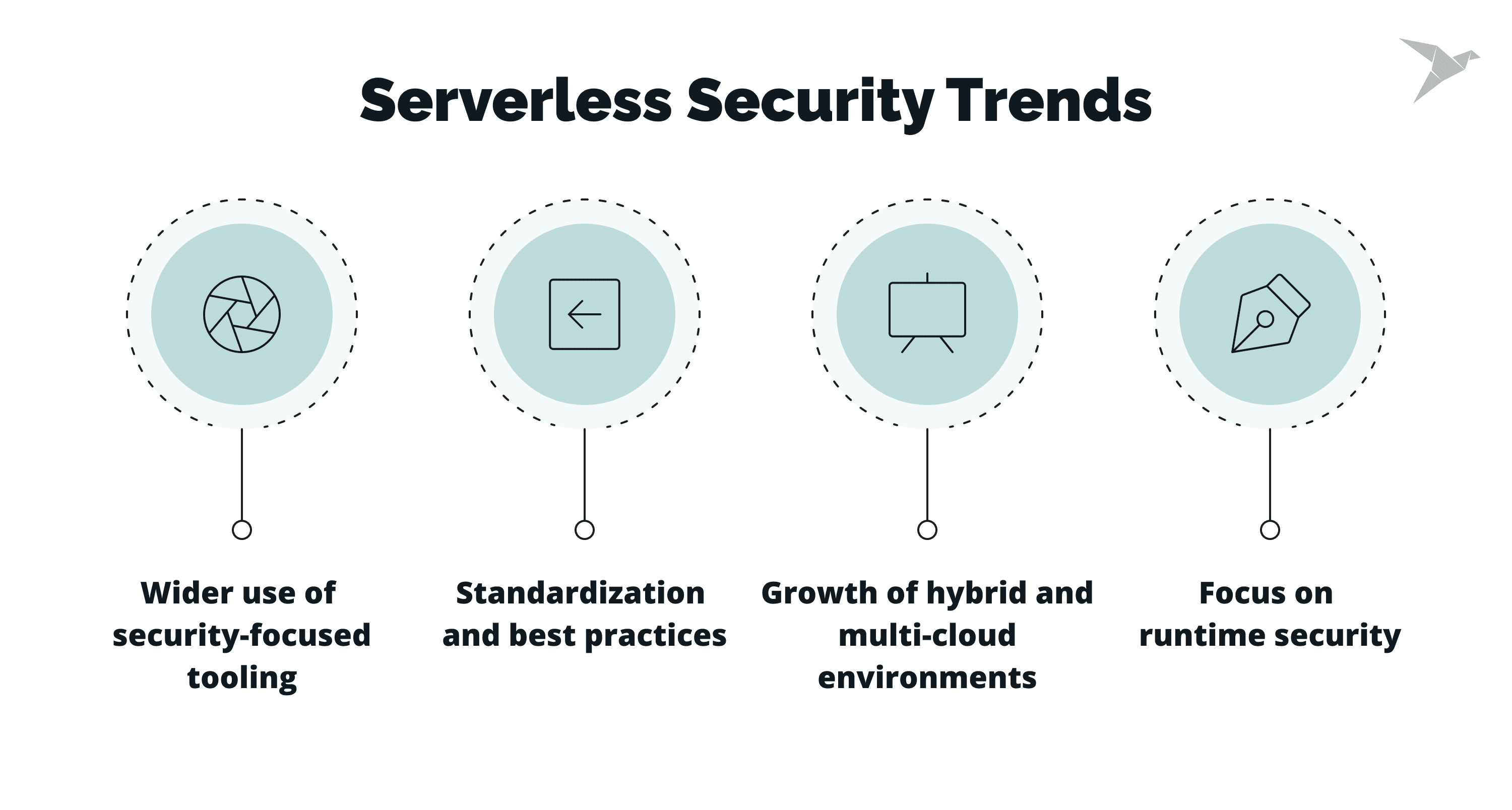
Wider use of security-focused tooling
Security tooling for serverless has matured. Platforms now offer built-in monitoring, runtime protection, and automated misconfiguration detection. Cloud providers have expanded native capabilities, while third-party tools focus on visibility across functions, APIs, and event flows.
At the same time, teams are moving toward “shift-left” practices and integrate security checks into CI/CD pipelines to catch issues before deployment rather than after.
Standardization and best practices are improving
Serverless is no longer as fragmented as it was a few years ago. Industry frameworks and guidance from organizations like CNCF, OWASP, and cloud providers have helped define clearer best practices for identity management, event validation, and configuration security.
Compliance requirements are also shaping this space. As more companies run production workloads on serverless, security controls need to align with standards such as ISO 27001, SOC 2, and industry-specific regulations.
Growth of hybrid and multi-cloud environments
Most organizations no longer rely on a single model. Serverless functions are often combined with containers, traditional services, and multiple cloud providers.
This hybrid approach increases flexibility but also introduces new risks. Security teams need consistent visibility and control across environments, which makes centralized monitoring, identity management, and policy enforcement more important.
Runtime security is becoming more important
Static checks and log review are still useful, but they are no longer enough on their own. A growing share of serverless security work is focused on runtime behavior, because event-driven functions can be abused in ways that are hard to catch through configuration scanning alone. In practice, this means more attention to anomaly detection, function-level telemetry, and real-time response.
Conclusion
Security in serverless is based on the shared responsibility model. The cloud service provider secures the infrastructure, while your team handles application logic, identities, and configurations, often including sensitive elements like environment variables and data encryption. According to the Cloud Security Alliance, many organizations still struggle to apply consistent controls across serverless environments, especially as systems grow.
So, serverless security is now a core part of cloud strategy. It is a standard part of modern cloud computing, used across industries to build scalable and flexible systems. As adoption grows, so do the security challenges that come with managing applications without direct control over the underlying infrastructure.
Recent reports show that misconfigurations and access issues remain among the top causes of cloud incidents, with a large share of breaches linked to preventable security vulnerabilities rather than advanced attacks. This highlights a simple point: most risks come from how systems are configured and managed, not from the platform itself.
Complexity will grow with distributed architectures
The future of serverless is closely tied to the rise of distributed cloud services and hybrid environments. Applications will continue to combine functions, APIs, containers, and third-party integrations. This increases flexibility but also expands the attack surface.
As serverless computing services evolve, security will need to move closer to the development process. More teams are already adopting automated checks, runtime monitoring, and integrated policies to keep up with this complexity.
Security will shift from reactive to continuous
Looking ahead, security will become more proactive and continuous. Static checks alone will not be enough. Organizations will rely more on real-time monitoring, automated response, and built-in controls across the entire application lifecycle.
This is where security testing services play an important role. Regular testing, validation, and review help teams identify weak points early and maintain control as systems scale.
What to focus on next
Serverless security is not about eliminating risk. It is about managing it with the right structure, visibility, and processes. Teams that invest in clear ownership, strong access control, and continuous monitoring will be better prepared to handle the next wave of complexity.
We’re just a message away and happy to help.

FAQ

Serverless computing is a cloud model where developers build and run applications without managing servers. The cloud provider handles infrastructure, scaling, and availability, while teams focus on writing code and defining application logic.
In serverless computing, applications are built from many small, event-driven components instead of a single system. This makes it harder to track security events and requires a stronger focus on permissions, configuration, and runtime behavior rather than infrastructure.
Strong access management is essential. Each function should have only the permissions it needs, and sensitive actions should be protected with multi-factor authentication to reduce the risk of unauthorized access.
An API gateway acts as a control layer between users and serverless functions. It helps manage authentication, rate limiting, and request validation, which reduces exposure and protects backend services.
Serverless apps often rely on many third-party dependencies, which can introduce vulnerabilities if not monitored. Regular updates and security checks are important, especially in fast-moving serverless deployments where new code is released frequently.