
 Software Development
 Security Services
 Cloud Services
 AI Services
 Other Services














 TechMagic Academy


Top Cybersecurity Service Providers in 2026
Last updated:22 June 2026


Cybersecurity has become more crucial than ever. Data breaches, malware attacks, and online scams are constant threats that evolve with alarming frequency and sophistication. Navigating this landscape requires robust security partners, and choosing the right one is a real challenge.
We prepared this guide to make that search easier. We cover the most prominent companies that provide cybersecurity services worldwide, the product vendors that build the tools behind them, and the criteria that matter when you pick a partner.
To avoid any unearned ranking, each group below is listed alphabetically, not ranked first to last, and every company is described with the same structure, including limitations. We have tried to be objective, but we recommend choosing a cybersecurity service provider based on your needs rather than its position here.
Key takeaways
- The strongest cybersecurity partner depends on your size, environment, and compliance needs, specific security solutions, and not brand recognition.
- Service providers (Accenture, Deloitte, Secureworks, Synack, ScienceSoft, TechMagic, and others) deliver testing, MDR, and consulting; product vendors (CrowdStrike, Palo Alto, Fortinet, and peers) build the tools behind them.
- Look for a transparent testing methodology, real remediation support, compliance alignment, strong cyber security measures, and verifiable client evidence.
- Every provider here is rated (G2, Gartner Peer Insights, or Clutch) and described with the same structure, including limitations.
- The groups are listed alphabetically, not ranked, so choose by fit rather than position.
How We Selected the Companies on This List
Generic cybersecurity vendor lists tend to reward visibility over substance. A company can rank highly on brand recognition while still running checkbox-style assessments that miss the vulnerabilities that actually get exploited. This list was built from a different starting point.
As a security engineering and pentesting team at TechMagic, we evaluated providers the way we'd evaluate a potential partner on a real engagement: based on technical depth, operational transparency, and whether the work holds up when it is actually tested.
Our team conducts penetration testing and security assessments across web applications, cloud environments, APIs, and mobile platforms, primarily for FinTech, HealthTech, and SaaS clients operating under SOC 2, ISO 27001, and HIPAA. That delivery context shaped what we looked for.
To cross-validate, we referenced independent sources, including Gartner Peer Insights, Forrester's security services research, and verified client reviews on Clutch and G2. Where analyst positioning conflicted with practitioner feedback, we weighted the latter. (Disclosure: TechMagic is included in this list, and we applied the same structure and scrutiny to our own entries.)
Evaluation criteria
- Technical methodology. We looked for providers who show how they test, not just what they test. Firms that publish CVEs, contribute to research, or document methodology signal that their process can withstand scrutiny.
- Scope and coverage. Effective coverage depends on whether a provider can work across your actual attack surface: web and mobile apps, cloud, APIs, and internal networks.
- Remediation quality. Finding vulnerabilities is the baseline. We weighted firms that explain root causes, prioritize fixes by exploitability and business impact, and verify that remediation closes the gap.
- Compliance alignment. For organizations under SOC 2, ISO 27001, HIPAA, or PCI DSS, a provider's familiarity with those frameworks directly affects audits and customer security reviews.
- Verified client evidence. We looked for independently verifiable signals: published case studies, detailed Clutch or G2 reviews, and disclosed references.
Cybersecurity outsourcing provide flexibility and scalability, which allows you to tap into specialized expertise without the overhead of maintaining an in-house security team. Ultimately, use this list as a springboard for further research, tailoring your final decision to the specific threats, budget, and industry regulations your organization faces.
Best CyberSecurity Service Providers Worldwide
Listed alphabetically, not ranked.
Accenture Security
Accenture Security is a leading global cybersecurity service provider and part of the broader Accenture professional services network. It leverages its deep industry expertise and advanced technology solutions to help organizations protect their critical assets.
Key offerings:
- Cybersecurity strategy;
- Identity & Access Management (IAM);
- risk assessment and threat detection;
- Managed Security Services (MSS);
- incident response and digital forensics.
Strengths:
- Global scale with end-to-end coverage, from strategy through incident response.
- Deep industry and regulatory expertise across many sectors.
Limitations:
- Enterprise pricing and engagement model are a poor fit for SMBs.
- Delivery quality can vary by region and the team assigned.
Rating/recognition: Consistently positioned as a leader in analyst evaluations (Gartner, Forrester).
Deloitte Cyber
Deloitte Cyber is a leading cybersecurity service provider within Deloitte, a global professional services network. They help organizations navigate today's complex cyber security landscape by offering a wide range of services.
Key offerings:
- Security Strategy & Consulting.
- Penetration Testing & Vulnerability Management.
- Managed Security Services.
- Security Awareness Training.
- Compliance & Risk Management.
- Data & Privacy Services.
Strengths:
- Connects security to audit, risk, and compliance work across the enterprise.
- Broad global reach for multinational programs.
Limitations:
- Enterprise-oriented cost and engagement structure, not aimed at mid-market.
- Skews toward advisory and strategy more than hands-on, always-on testing.
Rating/recognition: Broadly recognized as a leader in analyst evaluations of cyber consulting.
KnowBe4
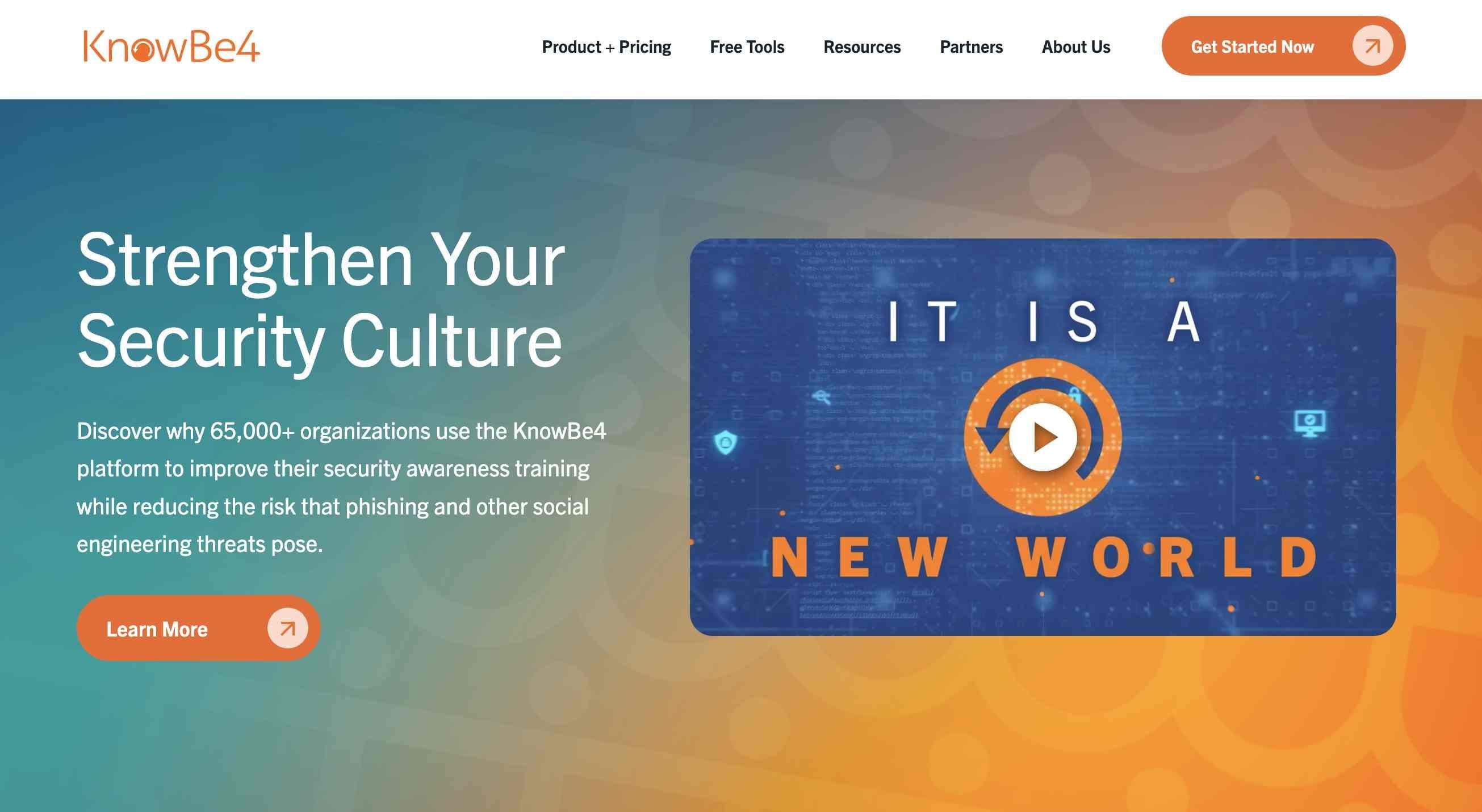
KnowBe4 focuses on security awareness training. Their offerings include a variety of training that help companies prepare employees for possible risks and teach them how to detect and prevent phishing attacks.
Key offerings:
- Security awareness training platform.
- Phishing simulations.
- Security culture programs.
Strengths:
- The market-leading security awareness platform, with a large content library and realistic phishing simulations.
- Strong reporting that supports risk-based, data-driven awareness programs.
Limitations:
- Narrow focus on awareness; it does not provide testing, MDR, or broader security services.
- Some users report repetitive content and limited customization.
Rating/reviews: 4.6/5 from 2,200+ reviews on G2; the #1 security awareness platform on G2 for several years.
Orange Cyberdefense
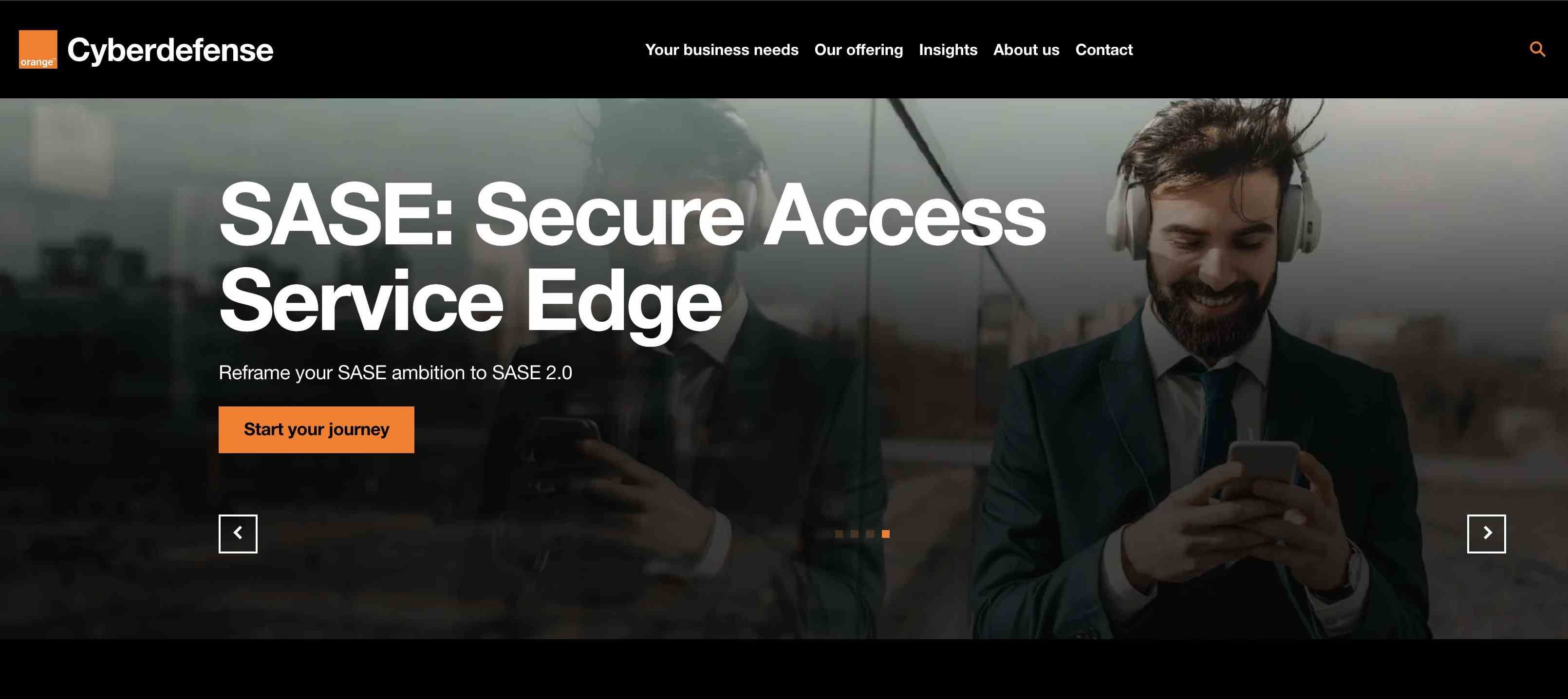
Orange Cyberdefense is a subsidiary of the Orange Group, a global telecommunications operator. As a cybersecurity provider, they offer a wide range of services to help organizations of all sizes defend against cyber threats. It has a global presence with 18 Security Operations Centers (SOCs) and 14 cyberSOCs distributed worldwide, catering to the diverse needs of international clients.
Key offerings:
- Managed Security Services (MSS).
- Penetration Testing & Vulnerability Management.
- Security Consulting.
- Cyber Threat Intelligence.
- Security Awareness Training.
Strengths:
- Large global SOC footprint and MSS scale for international clients.
- Strong threat intelligence and consulting depth.
Limitations:
- Small public review footprint relative to its size.
- Implementation and maintenance are not always the most user-friendly.
Rating/recognition: Recognized in Gartner's Managed Security Services and MDR market guides.
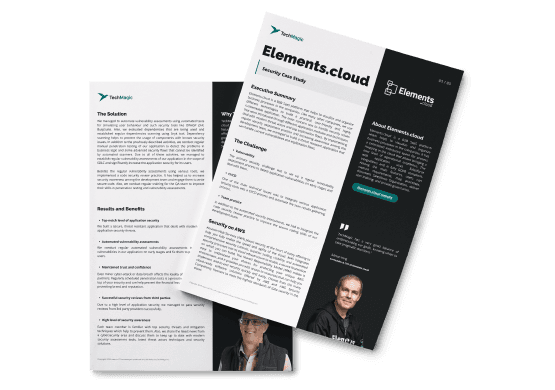
CyberSecurity services for Elements.Cloud
ScienceSoft
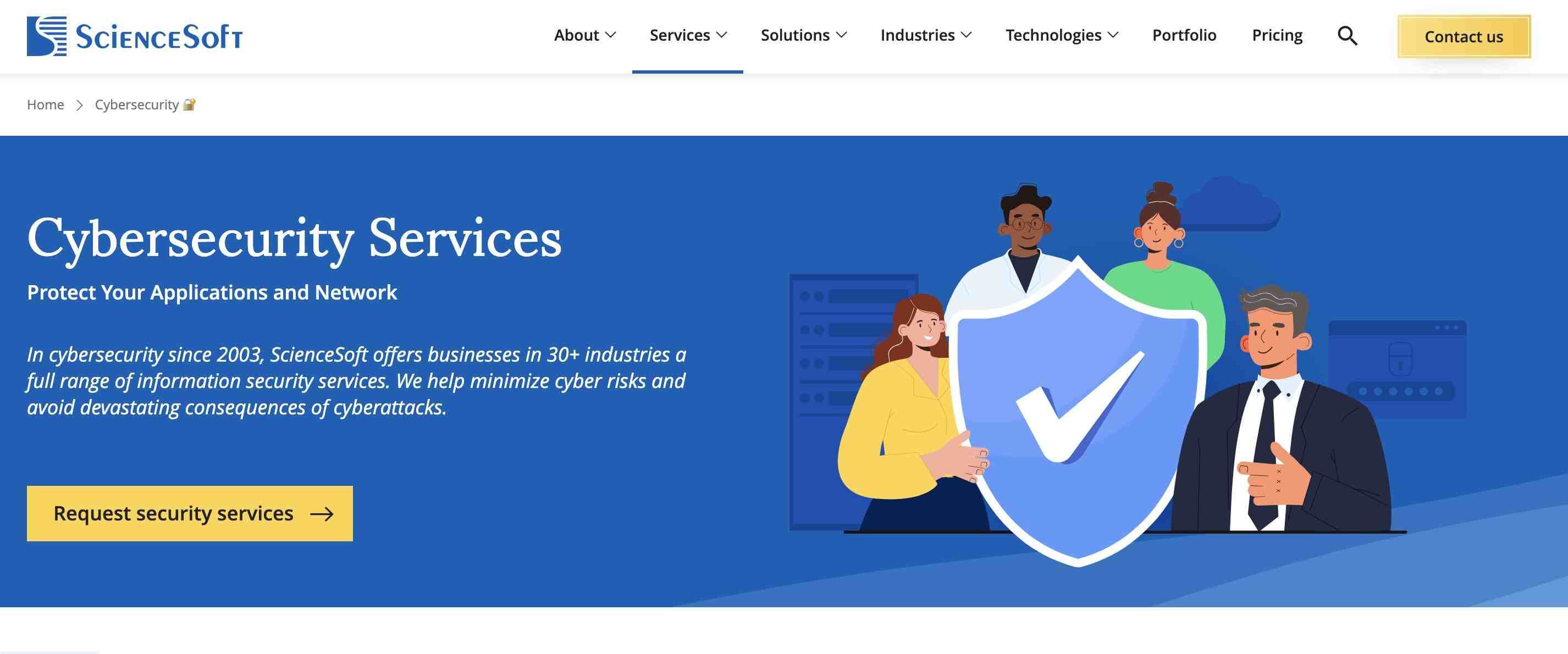
ScienceSoft is a global IT consulting and software development company that offers a variety of cybersecurity services designed to help organizations protect their data and systems. ScienceSoft's security experts can help assess your current security posture, identify vulnerabilities, and develop a customized security strategy.
Key offerings:
- Security Consulting.
- Penetration Testing.
- Managed Security Services (MSS).
- Security Awareness Training.
- Compliance Services.
Strengths:
- Broad IT and security capability under one roof, ISO 9001 and ISO 27001 certified.
- Clear, actionable reporting noted consistently in client reviews.
Limitations:
- Security is one of many service lines rather than a pure-play focus.
- Smaller brand presence than the global consultancies.
Rating/reviews: 4.8/5 from 41 reviews on Clutch; recognized as a top penetration testing company by Clutch.
Secureworks
Secureworks is a leading cybersecurity company known for its managed security services and threat intelligence capabilities.
They offer a comprehensive suite of cybersecurity services for organizations of all sizes. They act as an extension of your security team, providing 24/7 monitoring, threat detection, and incident response.
Key Offerings:
- Managed Detection and Response (MDR).
- Taegis Security Platform for managing and analyzing security data.
- Threat Intelligence.
- Vulnerability Management.
- Security Assessments and Testing.
Strengths:
- Mature MDR with strong, intelligence-driven threat detection.
- Acts as a 24/7 extension of in-house teams.
Limitations:
- Alert noise can require manual tuning.
- Reporting customization is limited compared with some platforms.
Rating/reviews: Taegis MDR is 4.6/5 on G2 (48 reviews).
Synack
Synack is a leading cybersecurity service provider of crowdsourced security testing, offering a unique approach to vulnerability identification. The company is known for maintaining a global network of over 1,500 highly skilled security engineers and ethical hackers called the "Red Team".
Key offerings:
- Penetration Testing.
- Bug Bounty Programs. Organizations can offer rewards to the Red Team for responsibly disclosing vulnerabilities.
- Synack Platform for bounty programs. The platform helps communicate with researchers, manage vulnerability reports, and issue bounties.
Strengths:
- Scalable, continuous testing backed by a vetted researcher community.
- Clear, auto-generated reports aligned with the development lifecycle.
Limitations:
- Weaker coverage of infrastructure and architecture reviews.
- The crowd model is less of an embedded, advisory relationship.
Rating/reviews: 4.8/5 on both G2 and Gartner Peer Insights; a G2 Leader for penetration testing.
TechMagic
TechMagic is a software development company with a strong security focus, providing comprehensive cybersecurity solutions. The team is dedicated to assessing and fortifying web and mobile applications and cloud and network environments at every stage of the software development lifecycle.
Key offerings:
- Managed security services.
- Penetration testing services.
- Security awareness team training.
- ISO 27001 consulting services.
- SOC2 consulting & readiness services.
Strengths:
- CREST-accredited manual penetration testing combined with security embedded in the SDLC.
- Compliance focus (SOC 2, ISO 27001, HIPAA) for regulated FinTech and HealthTech work.
Limitations:
- Smaller and less brand-recognized than the global firms on this list.
- Product- and scale-up-focused rather than always-on enterprise SOC/MDR.
Rating/reviews: ~4.8/5 across 50+ reviews on Clutch; recognized by Clutch among top cybersecurity and vulnerability-management providers.
Top Сyber Security Solutions Providers
This list contains tech giants. These companies focus not on providing cybersecurity services but on creating their own technological solutions to protect businesses.
Cisco
As a leader among cybersecurity software companies, Cisco offers a wide range of cybersecurity software, including firewalls, intrusion prevention systems, and security software. They specialize in integrated security solutions that can be deployed across an entire network.
Key offerings:
- Firewalls.
- Security orchestration, automation, and response (SOAR).
- Network access control.
- Secure software-defined wide area networks (SD-WAN).
- Identity and access management (IAM).
- Security segmentation advisory.
- Security risk management advisory.
- Zero trust strategy.
- Security and cyber ops courses.
Strengths:
- Deep, integrated security across the network, with a broad portfolio and strong support.
- Strong fit for organizations standardized on Cisco infrastructure.
Limitations:
- Complexity and cost; value is highest within the Cisco ecosystem.
- Smaller teams may find the breadth more than they need.
Rating/reviews: Cisco Secure Firewall rates ~4.5/5 on G2 and Gartner Peer Insights.

CrowdStrike
CrowdStrike is a leader in cloud-delivered endpoint protection. It provides a comprehensive platform that protects against various threats, including malware, ransomware, and phishing attacks. Its endpoint detection and response solutions can quickly identify and remediate threats.
Key offerings:
- Endpoint protection and response (EDR).
- Threat intelligence.
- Managed security services.
- Cloud Security Assessment.
- Penetration Testing.
- Endpoint Recovery.
- Cybersecurity Maturity Assessment
Strengths:
- Cloud-native EDR/XDR leader with fast detection and strong threat intelligence.
- Turnkey managed service that resolves incidents rather than handing them back.
Limitations:
- Premium pricing, often with multi-year commitments.
- Value is highest when consolidating on the Falcon platform.
Rating/reviews: 4.6/5 from 578 reviews on G2.
CyberArk
CyberArk provides services that secure identities on any infrastructure, including hybrid, SaaS, and multi-cloud. CyberArk is a leader in privileged access management (PAM) solutions, focused on securing privileged accounts and least privilege security.
Key offerings:
- Access management.
- Identity governance and administration.
- Privileged access.
- Endpoint privilege security.
- Remediation services.
- Strategic consulting services.
Strengths:*
- Widely regarded as the gold standard in PAM, with strong vaulting, session, and credential controls.
- Strong compliance and auditability.
Limitations:
- Setup and onboarding can take months in larger environments.
- Some capabilities depend on connectors and admin tuning.
Rating/reviews: 4.7/5 across ~305 reviews on G2 and other platforms.
Fortinet
Fortinet is one of the largest cybersecurity service providers. It offers a broad suite of security products, including intrusion prevention systems, antivirus software, and endpoint security. It is known for its high-performance security solutions for large enterprises.
Key offerings:
- Wide range of security products from firewalls and antivirus software to private cloud.
- Intrusion prevention systems (IPS).
- Secure software-defined wide area networks (SD-WAN).
- Incident Response.
- Managed Detection & Response (MDR).
- Ransomware Advisory Services.
- Security Advisory Services.
- SOC-as-a-Service (SOCaaS).
Strengths:
- High performance and strong price/performance for large networks.
- Very broad product suite under one vendor.
Limitations:
- Value is highest within the Fortinet ecosystem.
- Management depth requires in-house expertise.
Rating/reviews: 4.4/5 from 1,490+ reviews on G2.
IBM
IBM is a major hardware, software, and cloud computing services provider, but it is also one of the biggest cybersecurity companies. IBM offers a wide range of cybersecurity solutions and products, including threat intelligence, incident response, and security consulting. It is known for its deep security expertise and ability to help organizations build comprehensive security programs.
Key offerings:
- Security intelligence and analytics platform (QRadar).
- Incident response.
- Cybersecurity consulting.
- Threat intelligence platform.
- Managed cybersecurity services.
- Unified endpoint management (UEM).
Strengths:
- Deep enterprise security expertise and broad coverage (QRadar SIEM, X-Force).
- Strong fit for large, regulated environments.
Limitations:
- QRadar is resource-intensive and needs significant tuning; enterprise pricing.
- Note the 2024 sale of QRadar SaaS assets to Palo Alto Networks when planning long-term.
Rating/reviews: QRadar rates ~4.4/5 on Gartner Peer Insights and G2.
Palo Alto Networks

Palo Alto is one of the top cybersecurity solutions providers in the USA. It offers advanced threat protection, intrusion prevention systems, and endpoint security. Its innovative next-generation firewalls use machine learning to identify and block malicious traffic.
Key offerings:
- Cloud-native application protection.
- Endpoint protection.
- Threat intelligence and incident response services.
- Wide range of security services: SOC assessment, penetration testing, ransomware readiness assessment etc.
Strengths:
- Unified platform spanning network, cloud, and application security.
- AI-driven detection and response via Cortex.
Limitations:
- Platform-centric; value is highest when consolidating on Palo Alto.
- Enterprise pricing and configuration complexity.
Rating/reviews: Cortex Cloud rates 4.1/5 on G2; Prisma Cloud rates highly on Gartner Peer Insights.
Rapid7

Rapid7 offers various security tools that help organizations collect and analyze security data to identify threats and vulnerabilities. They also provide penetration testing tools and a security orchestration, automation, and response (SOAR) platform.
Key offerings:
- Penetration testing tools (Metasploit).
- Security data and analytics platform (InsightIDR).
- Security orchestration, automation, and response (SOAR) platform (InsightConnect).
- Managed detection and response.
- Managed vulnerability scanning.
- Product consulting.
- Training and certifications.
- Penetration services.
- IoT security testing.
Strengths:
- Strong vulnerability management (InsightVM) integrated with detection, plus Metasploit pedigree.
- Open, transparent platform.
Limitations:
- Enterprise-oriented; full value depends on adopting the wider toolset.
- Response automation is less mature than some competitors for certain cases.
Rating/reviews: 4.3/5 from 256 reviews on G2.
Sophos
Sophos is a global provider of cybersecurity services, offering a wide range of products and solutions to protect organizations of all sizes. Sophos offers endpoint security solutions, including next-generation firewalls, endpoint detection and response (EDR), and anti-malware software. They protect devices like laptops, desktops, and servers from malware, phishing attacks, and other cyber threats. One of Sophos' key differentiators is its focus on "Synchronized Security," a philosophy emphasizing integrating its various security products. This integration allows for better communication and threat intelligence sharing between these products, resulting in a more robust and unified security posture.
Key offerings:
- Endpoint Security.
- Network Security.
- Cloud Security.
- Managed Security Services (MSS).
Strengths:
- Strong endpoint/XDR (a G2 #1 XDR) with low false positives and effective ransomware protection.
- Synchronized Security integrates products for a unified posture.
Limitations:
- Large-network deployments need careful rollout planning.
- Some users note limited attack visibility and slower support.
Rating/reviews: 4.6/5 from 2,340 reviews on G2.
Trellix
Trellix combines McAfee Enterprise and SSE expertise to offer comprehensive security solutions for endpoints, networks, and clouds.
Key offerings:
- Trellix XDR platform.
- Threat intelligence.
- SIEM.
- Endpoint and server protection.
- Cloud and network protection.
- Consulting services.
Strengths:
- Broad XDR coverage across endpoint, network, and cloud.
- Strong threat intelligence heritage.
Limitations:
- High CPU/memory usage reported on some endpoints.
- Policy and agent tuning requires expertise.
Rating/reviews: Trellix Endpoint Security rates 4.6/5 on Gartner Peer Insights.
Rising Cybersecurity Threats in 2026
Attackers are getting faster, better-funded, and more targeted. Cyber attacks now hit companies of every size, and security vulnerabilities that go unaddressed tend to get exploited. Organizations that want comprehensive cybersecurity solutions need to know what they're actually up against.
AI-driven attacks and data protection
Attackers now use AI to write phishing emails at scale, generate fake audio and video, and probe systems faster than human analysts can track. Security teams use the same tools to flag anomalies and triage alerts.
What's changed is the pace — both sides move quicker, and data protection has become harder as more sensitive records move across cloud services. The cybersecurity companies that handle this well are building AI into detection, not just marketing.
Threats to cloud infrastructure
Governments and criminal groups both go after cloud infrastructure — the servers, storage, and networks that businesses increasingly depend on. When those systems go down or get breached, the damage spreads fast.
Demand for cloud security services has grown as a result, particularly for companies running workloads across multiple providers where misconfigured access or unpatched services create easy entry points.
Zero trust access and enterprise solutions
The old approach of trusting anything inside the corporate network doesn't hold up when staff work remotely and apps run in the cloud. Zero trust access treats every login and connection as potentially compromised and checks it before granting access.
For larger companies, enterprise solutions that tie together identity, endpoints, and network monitoring have become the standard way to manage this — not as a future aspiration, but as something vendors now expect as a starting point.
Intrusion detection, database security, and newer malware
Many intrusion detection tools still rely on known attack signatures, which means they miss anything new. Attackers know this and write malware in languages like Go and Rust specifically because most scanners don't handle them well.
Database security gets less attention than it should — breaches that expose customer records or financial data often trace back to a misconfigured database or a credential that was never rotated. Good cyber security services cover all three areas, because leaving one unaddressed tends to be where incidents actually start.
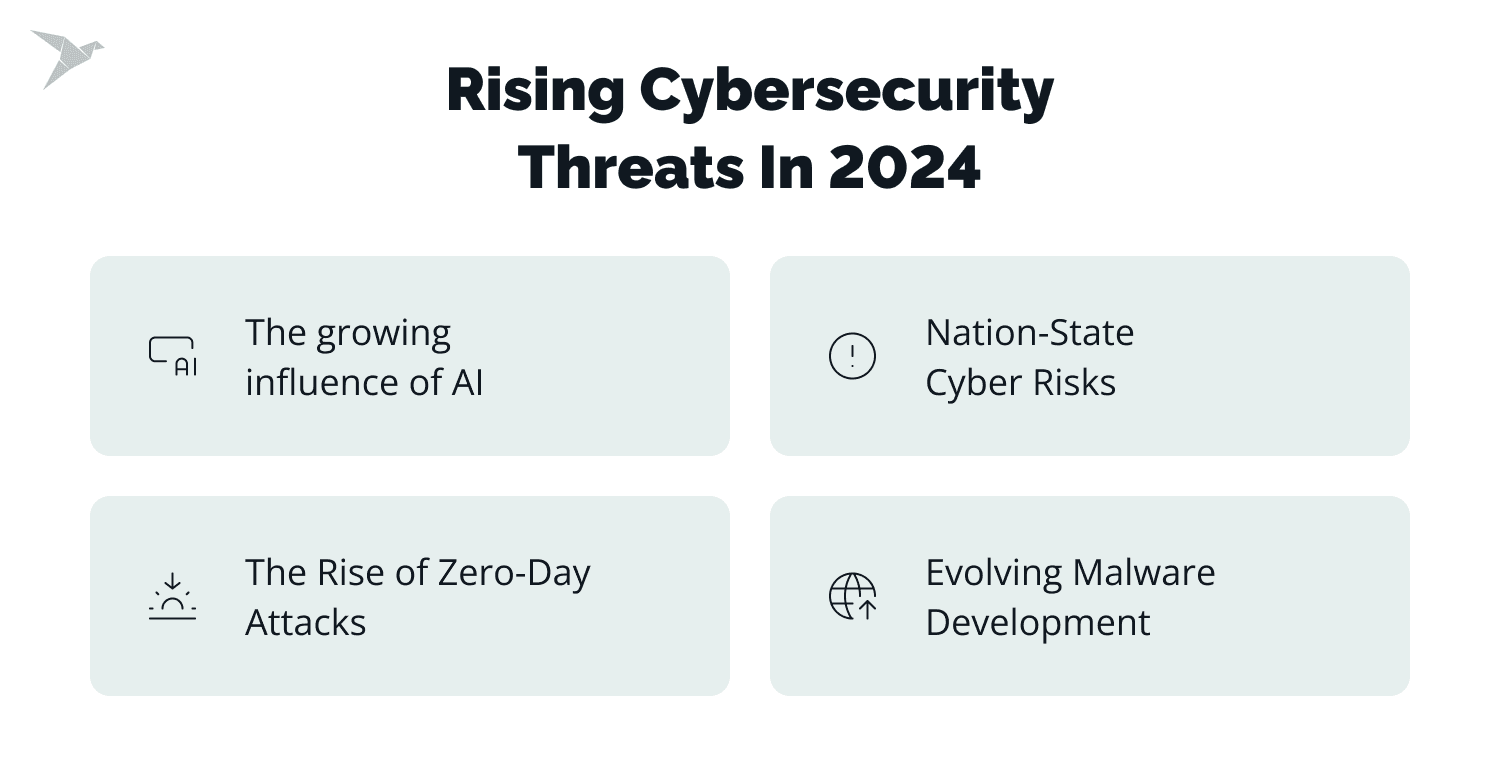
The growing influence of AI
Artificial intelligence will be used in both offensive and defensive cyber operations. Attackers will use AI to create phishing campaigns, fake news, and deepfakes. Therefore, the main task of the defenders is to leverage AI for faster threat detection and response.
Nation-state cyber risks
Cyberattacks will continue to be used in geopolitical conflicts to achieve economic and military goals. Even the US elections and the Olympic Games may be at risk.
The rise of Zero-Day Attacks
A zero-day attack occurs when hackers exploit vulnerabilities that were previously unknown. The number of such attacks is expected to grow. The targets include traditional systems, edge devices, virtualized software, and outdated technologies.
Evolving malware development
Attackers continue to increase the use of modern programming languages such as Go, Rust, and Swift to develop malware that is difficult to detect using traditional methods.
The ever-evolving threat landscape forces companies to be strategic with their cybersecurity budgets and demand exceptional value from service providers.
Best Cybersecurity Companies & Services by Clutch
TechMagic
TechMagic is a software product development company with a strong security focus. It offers a robust cybersecurity solution for businesses and goes beyond basic IT services. A team of certified professionals specializes in penetration testing, managed security, compliance preparation, and security training, empowering businesses with comprehensive protection.
Services:
- Penetration testing services: Web and mobile application, cloud and network infrastructure pentest.
- Managed security services: embedding security practices in SDLC.
- Security awareness team training on identification and mitigation of common security risks.
- Compliance guidance: ISO, SOC2 certification preparation.
TPx Communications
TPx, a leading managed services provider, empowers businesses to thrive by simplifying operations, optimizing networks, and enhancing security.
- Services:
- Breach detection and incident response.
- Digital forensics and audit.
- Threat and attack simulations.
Foresite Cybersecurity
Foresite is a global leader in managed cybersecurity and compliance solutions. They offer a comprehensive suite of services to help businesses of all sizes stay secure and meet evolving data protection regulations.
Services:
- Managed SIEM.
- Network security.
- Cloud security.
- Cybersecurity consulting.
- Application security.
- Breach detection and incident response.
Vumetric Cybersecurity
Vumetric is an ISO9001-certified company offering services for detecting and remediating threats. Its team holds top certifications (ISO 9001, OSCP, CISSP) for reliable security assessments. It has a proven track record across diverse industries, from enterprise to small and medium-sized businesses and government agencies.
Services:
- Penetration testing services.
- Security audits.
- Specialized cybersecurity services.
Packetlabs Ltd.
Packetlabs, a Canadian cybersecurity service provider, specializes in in-depth penetration testing. Their SOC 2 and CREST certifications ensure top-tier security assessments beyond basic testing, including adversary simulations and application security evaluations.
Services:
- Threat and attack simulations.
- Application security.
- Cloud security.
- Cybersecurity consulting.
- Network Security.
Sikich
Sikich is known primarily for accounting and advisory services, but it also has a strong focus on cybersecurity. The company offers a wide range of services for both defensive and offensive security, from various types of audits and testing to managed services and compliance preparation.
Services:
- Managed security.
- Penetration testing services.
- Threat monitoring and incident response.
- Digital forensics.
- Security audits.
UnderDefense
UnderDefense is a cybersecurity company that performs various security tests and provides its platform for managed detection and response.
Services:
- Penetration testing.
- Social engineering.
- Incident response.
- Managed detection and response (MDR).
- Managed SIEM.
TechMD
TechMD's specialty lies in optimizing cloud solutions to empower businesses. However, they are also known as a robust cyber security service provider.
Services:
- Breach detection and incident response.
- Managed SIEM.
- Cloud Security.
- Cybersecurity Consulting.
- Identity and access management.
- Network security.
CyberDuo
CyberDuo offers a comprehensive package of services, including managed IT, cyber security solutions, cloud implementations, and penetration testing. Their team tackles the ever-growing challenge of data security with expertise and dedication.
Services:
- Breach detection and incident Response.
- Cloud security services.
- Cybersecurity consulting.
- Digital forensics and audit.
- Identity and access management.
- Managed SIEM.
- Network security.
- Vulnerability management.
Dataprise
A leading Managed Service Provider (MSP) with 300+ certified engineers. Their integrated IT solutions and services encompass security. It includes network security monitoring, infrastructure protection, collaboration, mobility, and end-user support.
Services:
- Breach detection and incident response.
- Penetration testing.
- Virtual Ciso.
How to choose a cybersecurity vendor?
In today's ever-evolving threat landscape, selecting the right cybersecurity provider is paramount. While brand recognition can be a starting point, it shouldn't be the sole deciding factor. We recommend prioritizing your organization's specific needs. Here's a roadmap to guide your selection process:
Identify your weaknesses
Conduct a thorough internal security assessment to pinpoint vulnerabilities and areas requiring the most attention. Are you concerned about potential cloud security breaches? Do you need assistance with regulatory compliance? Understanding your unique security posture will help narrow down the ideal provider.
Match needs to services
Cybersecurity providers offer a diverse range of services. Review each provider's specific services and ensure they align with your identified vulnerabilities. Do they specialize in penetration testing to uncover hidden weaknesses? Do they provide ongoing threat intelligence and monitoring to mitigate risks proactively?
Evaluate expertise and experience
Once you've shortlisted providers based on service offerings, delve deeper into their expertise and experience. Look for certifications, industry recognition, and client testimonials demonstrating their ability to address your needs.
By following this needs-based approach, you'll be well-positioned to select a cybersecurity provider who will become a trusted partner in safeguarding your organization's valuable data and infrastructure.
Emerging Trends in Cybersecurity You Should Follow
A lot has shifted in the past two years. The threats security teams dealt with in 2024 look different from what's landing in 2026 — both in scale and in sophistication. Here's what's actually worth paying attention to right now.
Agentic AI is changing both sides of the fight
Generative AI moved fast in 2024. In 2026, the bigger story is agentic AI — systems that don't just generate content but take actions autonomously. Attackers are already using it to run persistent phishing campaigns that adapt mid-conversation, probe defenses in real time, and produce convincing deepfake audio for business email compromise.
The FBI's 2025 Internet Crime Report recorded over $16.6 billion in cybercrime losses in the US alone, a 33% jump from the prior year, with AI-assisted fraud accounting for a growing share. On the defense side, security teams are leaning into AI for threat detection and alert triage — but the gap between how fast attackers iterate and how fast defenders can deploy new tools remains uncomfortably wide.
Outcome-driven metrics are replacing checkbox compliance
For years, security reports were written for auditors, not executives. That's been changing, and in 2026 the shift is more pronounced. Outcome-driven metrics (ODM) tie security investments directly to asset protection and business continuity — instead of counting alerts fired, you're measuring how much of your critical infrastructure is covered, how quickly incidents get contained, and what exposure remains after controls are applied.
Gartner has been pushing this framework, and CISOs are picking it up because it gives board members something they can actually act on. Organizations that adopt ODM report cleaner conversations between security and leadership, and faster sign-off on remediation budgets.
Human error is still the entry point
Phishing still accounts for the majority of initial access in breaches — Verizon's 2025 DBIR put it at over 70% of social engineering incidents. Annual security awareness training hasn't moved the needle much, because knowing what a phishing email looks like doesn't automatically change behavior under pressure.
What's working better are Security Behavior and Culture Programs (SBCPs), which replace one-off training with ongoing reinforcement, real simulations tied to individual risk profiles, and positive feedback loops rather than punitive ones. A growing number of organizations are also using role-based micro-training delivered in the flow of work — a short prompt when an employee is about to share a file outside the organization, for example, rather than a 45-minute course once a year.
Third-party risk has become impossible to ignore
The MOVEit breach, the Change Healthcare attack, and a string of software supply chain incidents in 2024-2025 made one thing clear: your security posture is only as strong as your weakest vendor's. In 2026, third-party risk management has moved from a compliance checklist item to a board-level concern.
Security teams are now expected to continuously monitor vendor exposure, not just complete an annual questionnaire. Tools that pull real-time signals on vendor security posture have grown significantly, and contracts increasingly include breach notification timelines and right-to-audit clauses. Organizations running SOC 2 or ISO 27001 programs are also under pressure to extend those expectations to their critical suppliers.
Continuous Threat Exposure Management is gaining real traction
CTEM is Gartner's framework for continuously identifying and reducing your actual attack surface rather than running periodic assessments and hoping nothing changes in between. It works in five stages: scoping what matters, discovering what's exposed, prioritizing by real exploitability (not CVSS score alone), validating that controls actually work, and mobilizing the right teams to fix what's broken.
Gartner's research suggests that organizations with a mature CTEM program can reduce breach risk by up to two-thirds compared with peers running traditional vulnerability management. In 2026, more vendors are building CTEM workflows into their platforms, and the framework has moved from "interesting concept" to something security leaders are actively budgeting for.
Identity has replaced the perimeter as the primary security boundary
With remote and hybrid work locked in as a permanent model and SaaS applications multiplying, the network perimeter doesn't mean what it used to. Attackers don't need to breach the firewall if they can steal a credential and walk in through a legitimate login. Identity and Access Management (IAM) combined with zero trust principles — verifying every access request, applying least-privilege controls, and assuming breach by default — has become the foundational layer of enterprise security in 2026.
According to Microsoft's 2025 Digital Defense Report, over 99% of identity attacks could be stopped with basic MFA and conditional access policies, yet adoption remains uneven. Privileged access management (PAM), continuous session monitoring, and identity threat detection are the areas where leading organizations are currently investing most heavily.
Conclusion
Cybersecurity threats are escalating in 2026, targeting everything from businesses of all sizes to significant events like the US elections and the Olympic Games. Attackers leverage cutting-edge technology and increasingly sophisticated methods, making early detection difficult. As a result, companies face difficulty finding a reliable cybersecurity service provider.
Use our list as a guide, but remember to base your choice on your business's specifics. Look beyond brand recognition or product quantity; prioritize providers with proven expertise in your industry and the specific threats you face.

FAQ
Cybersecurity is a cornerstone in 2026 because the threat landscape keeps expanding and data keeps growing in value. As businesses adopt more cloud and connected technology, the attack surface multiplies, and breaches can mean major financial loss, reputational damage, and compliance penalties. Effective security measures are vital for detecting, responding to, and preventing threats.
We prioritized technical depth, operational transparency, remediation quality, and compliance alignment, and we cross-validated with Gartner Peer Insights, Forrester research, and verified Clutch and G2 reviews. Where analyst positioning conflicted with practitioner feedback, we weighted the latter, and we disclosed that TechMagic is included in the list.
The most pressing threats include AI-powered attacks and deepfakes, zero-day exploits, nation-state activity tied to geopolitical conflict, and stealthier malware written in modern languages like Go and Rust. Staying current with patching and deploying layered, secure remote access, vulnerability analysis, and AI-assisted defenses is essential.
Look for a provider whose services match your specific gaps, with a transparent testing methodology, strong remediation support, relevant compliance experience, and verifiable client evidence (detailed Clutch or G2 reviews, case studies, references). Fit for your industry and threat profile matters more than brand size.
Cybersecurity providers act as your reliable partner in several ways. They find weaknesses in your systems before attackers do, and keep an eye out for suspicious activity. They train your employees to be vigilant and help you develop a plan for handling security incidents if they occur.
Also they provide a range of services from vulnerability management to security architecture, depending on your specific needs. By partnering with a cybersecurity company, you gain the knowledge to stay ahead of cyber threats and protect your business.
Gartner's security predictions highlight a future focused on proactive measures and measurable outcomes. They recommend continued investment in AI-powered defenses and a shift towards Outcome-Driven Metrics (ODM) to prioritize real-world security impact. Additionally, a move from generic security awareness to Security Behavior and Culture Programs (SBCPs) is expected to create a more ingrained security culture within organizations.
Also, Gartner emphasizes the importance of robust third-party risk management strategies. Proactive defense is a central theme, with Continuous Threat Exposure Management (CTEM) allowing for faster response times and reduced breach risk. Finally, the AIM (Alignment, Integration, Management) approach underscores the importance of solid core security practices to build overall cyber resilience.
There are many ways to keep up with all the trends in the security industry. You can read specialized cybersecurity resources and subscribe to their newsletters. Attending professional events and exhibitions is also an excellent way to learn about the news.
In addition to getting helpful information, you can meet representatives of the providers of the services you need. You can also subscribe to Techmagic's blog to stay updated on trends and solutions. Fill out the form below to stay up to date with all the trends in the cybersecurity industry.