 Software Development
 Security Services
 Cloud Services
 AI Services
 Other Services















 TechMagic Academy


The Real Cost of Managed SOC: Is It Worth It for Your Business?
Last updated:5 May 2025



9 in 10 organizations in the US were at risk of a material cyberattack in the following year, according to the Statista cybersecurity survey. Managed Security Operation Centers (managed SOCs) provide a straightforward solution, offering continuous monitoring and fast response to cyber threats.
Your business gets expert protection it needs, and you can focus on what you do best.
Key takeaways
- A SOC has three parts: the team, the tools they use, and the infrastructure underneath. All three have to work for the defense to hold.
- A managed SOC gives you round-the-clock monitoring, threat detection, and fast incident response, all run by cybersecurity specialists.
- Internal teams usually get stuck on two things: finding the expertise and running the back-end infrastructure. A managed SOC covers both.
- SOC pricing hides costs that are easy to miss when you compare quotes side by side.
- Your final price depends on team size, tools, infrastructure, and the ongoing cost of keeping it all running.
What is a Managed Security Operations Center?
A Managed Security Operations Center is an outsourced service that protects a company's systems and data against cyber threats. Managed SOC works around the clock. A team of cybersecurity specialists watches your environment, catches threats early, and steps in when an incident hits.
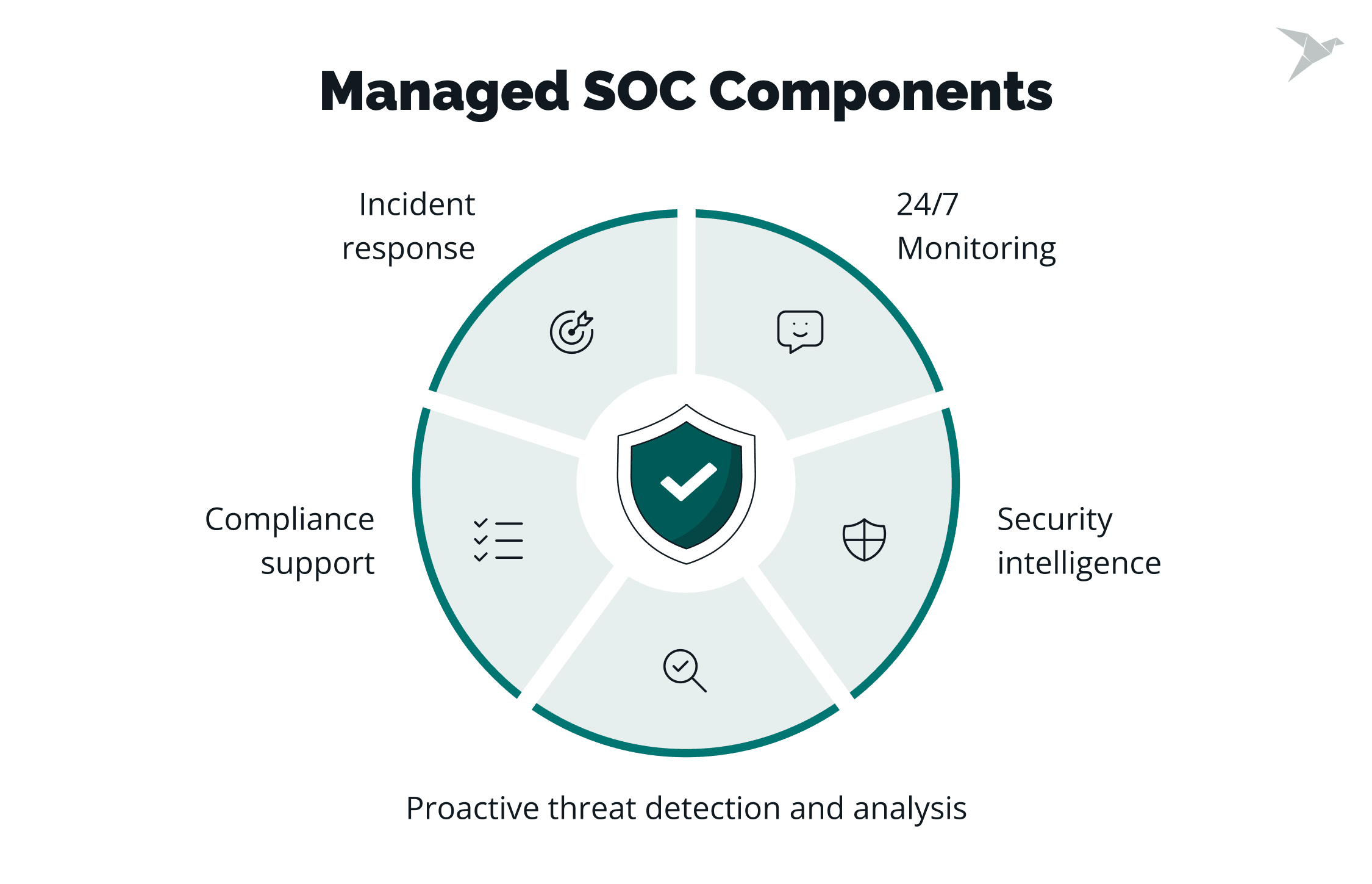
The service comes from a third-party vendor that supplies both the technology and the people to keep your systems safe. Its core work usually covers:
- 24/7 monitoring and alert triage;
- threat detection and analysis;
- security event monitoring and incident response;
- security intelligence;
- regulatory and compliance support.
SOC vs. managed SOC
A Security Operations Center (SOC) is an in-house team that watches for security incidents and responds to them in real time. Building one yourself is expensive, even when you know how to build a SOC. You hire a dedicated team, buy advanced security tools, and pay to run them month after month.
A managed SOC hands that burden to a provider. They take over the day-to-day monitoring and give you the experts and the technology behind them, without the cost of standing up your own center.
So what actually separates the two? Scope
A managed SOC has three parts working together: a skilled team, the security tools they depend on, and the infrastructure that runs underneath both.
The team is the part you see. It works 24/7 to watch your environment, investigate what looks wrong, and respond when something is. The tools are what make that possible: firewalls, intrusion detection systems, SIEM (Security Information and Event Management) platforms, and threat intelligence feeds. Take those away, and the team is watching blind.
Underneath sits the infrastructure, the physical or cloud systems that host everything. Someone has to maintain and upgrade it so it keeps pace with new threats. With a managed SOC, all of that becomes the provider's job. You outsource the tools, the infrastructure, and the expertise instead of building and maintaining each piece yourself.
Key distinctions of managed SOC are:
- You get specialized cybersecurity experts without the ongoing cycle of hiring, training, and keeping security staff.
- The tools and infrastructure come with the service. Maintaining and upgrading them stays the provider's responsibility, so they are not your capital expense.
- The provider carries the operational costs, and you pay only for the services you actually use.

Why Do Businesses Prefer Managed SOC?
From our experience, a few reasons come up again and again when organizations choose a managed SOC over an internal build.
Businesses get access to expertise without the cost of in-house hiring
Building an in-house security team is slow and costly. Beyond salaries, you also have to pay for security tools, infrastructure, and the ongoing work of training and upgrades.
A managed SOC gives you that expertise from day one. You reach professionals who deal with complex threats for a living, and you skip the overhead of managing them. You also pay only for the services you need, and most of the savings come from this.
So, in general, instead of buying advanced tools, maintaining infrastructure, and hiring full-time staff, you get the same top-tier expertise and technology for a fraction of the setup cost.
They have scalability on demand
Security needs grow with the business, and they rarely grow evenly. Obviously, the tools, infrastructure, and expertise that protect a 20-person company do not fit a 200-person one. A managed SOC scales with you. Expand into a new market, add users, or roll out new systems, and the service adjusts to match.
That flexibility keeps your security posture in step with your growth. You hand off the complex infrastructure work and stay focused on your core business, knowing specialists are watching the rest.
Theuy get more time and resources for innovation
Outsourcing security operations frees your internal teams from work that pulls them away from the product. Instead of managing security processes, they spend their time on scaling and building. For a company competing on speed, that focus is worth as much as the security itself.
In most cases, this is why businesses without the resources to run security internally so often land on a managed SOC. They get the expertise and the flexibility, and they do not have to think about the parts they were never staffed to handle.
Check our

Key Factors Influencing the Cost of Managed SOC
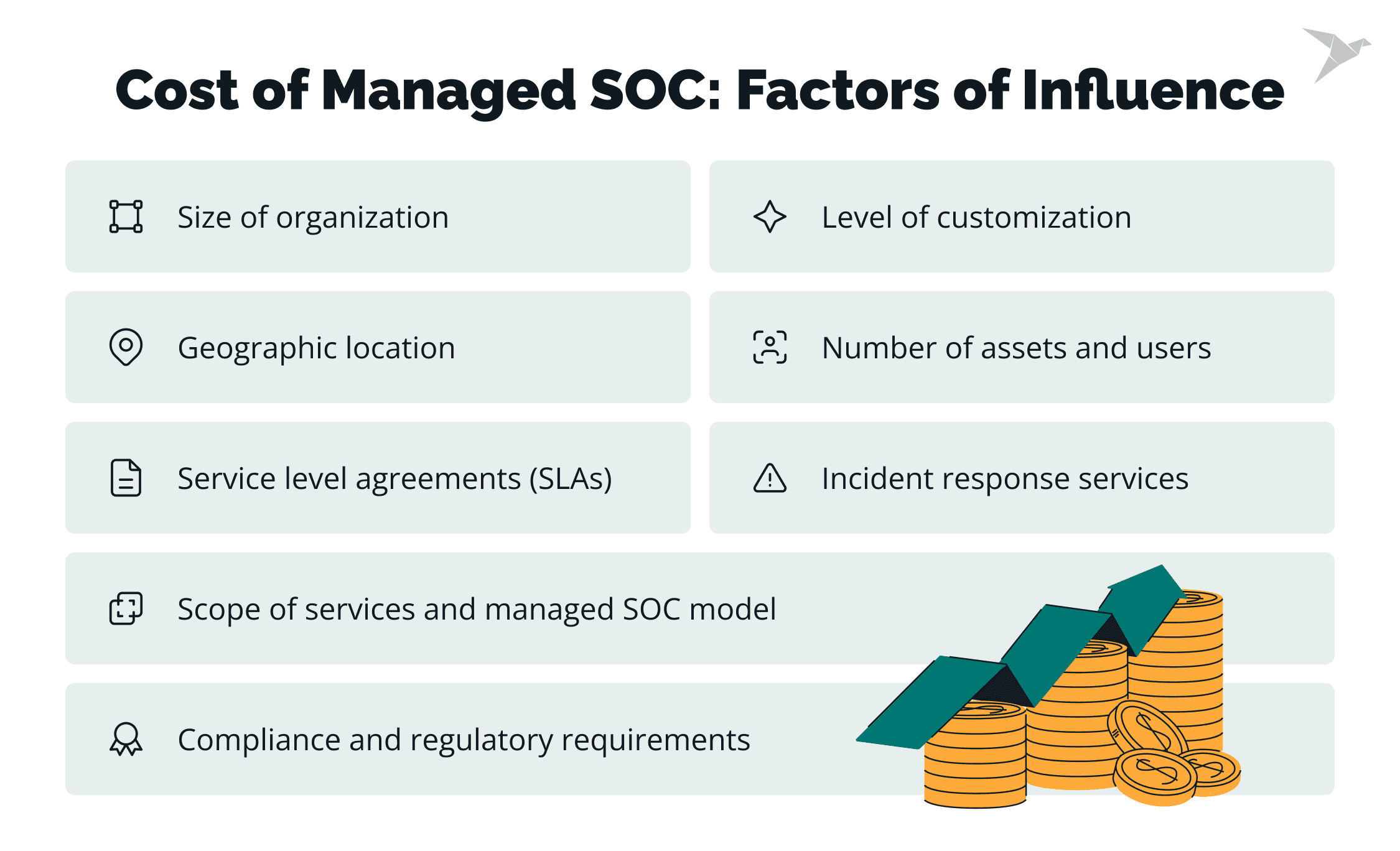
Managed SOC pricing moves with a handful of factors. When you’re aware of them, you can size your own needs and read a quote for what it really contains.
Scope of services and managed SOC model
Scope is one of the biggest cost drivers in this case. Some organizations need basic monitoring and alerts, while others may want the full picture: threat intelligence, incident response, and compliance management. The wider the scope, the higher the price.
How much you need depends on your risk. Larger businesses, and any business in a regulated industry, tend to need the fuller service. As the coverage grows, so does the cost, because more resources and deeper expertise go into managing a complex environment.
Size of organization
Bigger organizations need more of everything: more monitoring tools, more analysts, more advanced capabilities. A mid-sized business might do fine with a basic SOC setup plus a few add-ons. But as a company grows, its threats get more complex, and the cost of managing them climbs alongside.
Level of customization
Some organizations want a SOC tuned to their exact environment. That can mean configuring monitoring systems a certain way, setting specific response protocols, or integrating with existing IT infrastructure. Custom work carries a premium, because it takes specialized expertise and time.
Compliance and regulatory requirements
Healthcare, finance, and government all answer to strict standards such as GDPR, HIPAA, and PCI-DSS. Compliance with them can add regular audits, detailed reporting, and specific security controls to the service. Businesses in these industries usually pay more for a managed SOC as a result.
Geographic location important too
A managed SOC provider’s location matters too; a provider in a high-cost region tends to charge more. And if you operate globally, you may need a provider with SOCs distributed across regions, which adds to the bill.
Number of assets and users
The count of endpoints and users is a direct lever on price. More assets mean more to monitor and manage, so the cost rises with them.
Service level agreements (SLAs)
SLAs that promise faster response times and more comprehensive coverage can increase managed security operation center pricing. The higher the service level and the more guaranteed support you require, the more you can expect to pay.
Incident response services
Including incident response services as part of your SOC offering can add significant costs, with some incidents potentially adding $10,000 to $100,000 or more per response. This is an important consideration if your organization requires rapid, comprehensive incident remediation.
How Much Does Managed SOC Typically Cost for Business Types?
The cost of Managed SOC services varies based on your business size and specific security needs. The total price typically includes:
- security tools;
- staffing and overhead;
- implementation and maintenance services;
- infrastructure and operational costs.
The managed security team covers all of this, while in the case of an in-house option, you’ll have to pay for these services additionally. For example, only staffing for the in-house SOC costs $150k - $300k for mid-sized businesses and $300 - 600k for large or highly regulated enterprises.
Here is how pricing tends to break down across business sizes and regions.
Medium-sized businesses
Medium-sized businesses carry more complex security needs and typically spend $10,000 to $30,000 monthly in the United States. Over a year, that runs $120,000 to $360,000, depending on the services and the number of users.
Europe varies more, again depending on complexity. The averages land around $10,000–$25,000 monthly and $120,000–$300,000 annually.
An in-house SOC team, by comparison, would run you $83,000–$133,000 monthly and $1,000,000–$1.6M annually.
Large enterprises
For large enterprises, especially in regulated industries, managed SOC services can reach $30 000 or more monthly and $360 000-$1.2M annually in the United States. Building the same capability in-house could cost $167 000-$333 000 monthly and $2M-$4M annually once you add up infrastructure, staffing, and operations.
In Europe, these numbers are $20,000 - $83,000 monthly and $240,000 - $1M annually for managed SOCs. And for the in-house option, these numbers are much higher: $160,000 - $330,000 monthly and $2M - $4M annually.
What are the Pricing Models for Managed SOC?
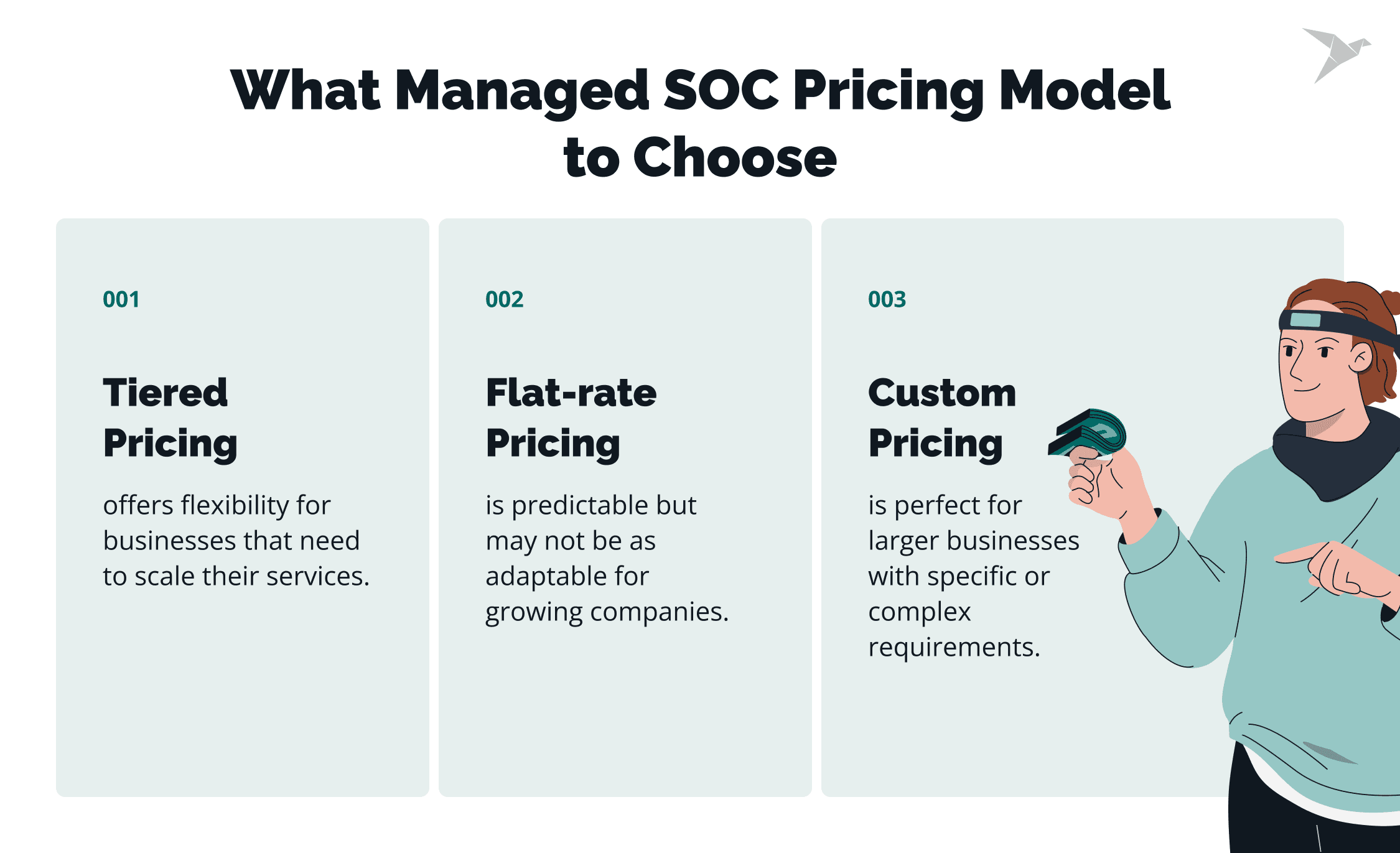
Managed SOC services come in a few pricing models, and each of them is suited to a different kind of business. Here is how the common ones work.
Tiered pricing
With tiered pricing, cost tracks the service level you choose. A tier is a bundle of cybersecurity features. The higher the tier, the more advanced the capabilities and the deeper the service.
A basic tier might cover only essential monitoring and alerting. A higher tier adds proactive threat hunting, advanced incident response, and compliance management. You pick the level that fits your size, budget, and risk, and you can start basic and move up as your needs grow.
Flat-rate pricing
Flat-rate pricing charges one fixed amount regardless of how many users or devices you have. Its main upside is predictable costs. The downside, on the other hand, is that it can fit poorly if your security needs swing up and down.
Custom pricing
When a business has specific needs, custom pricing usually fits best. It is built around your setup, weighing things like network complexity and the incident response you require. Larger companies with complex environments tend to land here.
Each model suits a different situation. Your main goal is to match the model to your budget and the level of service you actually need.
Hidden Costs of Managed SOC Services
The upfront costs of a managed SOC are usually clear enough. The hidden ones are where budgets slip, so watch for these, too.
Setup fees
Some providers charge a one-time setup fee to deploy the infrastructure, integrate with your existing systems, and configure the SOC to your environment. It is a single charge, but it can be a meaningful one.
Additional tools and integrations
If you need security tools or integrations outside the standard package, expect to pay extra. That might mean firewalls, intrusion detection systems, or other advanced controls the base service does not include.
Ongoing maintenance and upgrades
Providers keep their services current against new threats, and that upkeep can carry its own cost, especially if you need frequent upgrades or customized support.
Checklist: How to Choose a Managed SOC Service Based on Your Budget
Choosing a managed SOC is a decision worth slowing down for. Work through this checklist so you decide on the facts rather than the sales pitch.
Step 1. Define your security needs
We recommend starting with the level of monitoring and incident response you actually need. Then make sure any service you consider includes the features that matter most to you, whether that is real-time monitoring or advanced threat intelligence.
Step 2. Choose a suitable managed SOC model
Next, pick the model that fits how your organization works. Each one comes with its own price range and service scope.
Fully managed SOC
The provider handles everything, including monitoring, threat detection, and incident response. This fits businesses that want full coverage without running any of the infrastructure themselves.
Co-managed SOC
Here, the provider works alongside your in-house team. Responsibilities are shared, which gives you flexibility while still pulling in outside expertise.
SOC as a Service (SOCaaS)
SOCaaS is a subscription model for security monitoring and management. It is cost-effective and scalable, which suits businesses that want flexible, on-demand security.
Step 3. Check pricing models
Weigh whether a per-user, tiered, or custom model works best for your budget and needs. Look past the monthly figure to the long-term cost before you commit.
Step 4. Check for hidden costs
Ask directly about setup fees, tool integrations, and ongoing maintenance. You want every likely expense on the table before you sign, not after.
Step 5. Assess compliance and regulatory needs
If you operate in a regulated industry, confirm the provider can meet your compliance standards, and ensure those services are in the quoted price rather than a later add-on.
Step 6. Do not forget to consider future scalability
Check that the service can grow with you. A model that scales cleanly as your needs change will save you money and a migration down the line.
Ready to Secure Your Business with a Managed SOC?
Cyber threats are unpredictable. Yet, your defense against them doesn’t have to be. Rather than carry the full weight of building and running an in-house team, you can bring in skilled professionals for the parts that need them. And skip the recruitment, training, and overhead that come with permanent security staff.
You get experienced and certified cybersecurity specialists working on your defenses at a fraction of what an internal team would cost to assemble. Staffing, overhead, implementation, maintenance: that side of the work moves off your plate.
Our specialists focus on proactive threat detection, fast incident response, and continuous monitoring. You are not managing infrastructure or carrying the operational load. That frees your resources and your attention for growing the business.
We aim to be a true security partner, not a vendor you rarely hear from. With TechMagic, security becomes something that supports your next move and gives you access to real expertise.
Let's talk through what your business needs and where we can help.
Final Thoughts
Cyberattacks are getting more expensive to get wrong. Statista projects cybercrime will cost the world $15.63 trillion a year by 2029, and the attacks keep growing more complex. So, it is much cheaper to plan your defense early than to scramble after a breach.
A managed SOC is one practical way to build proper defense. It watches your systems around the clock, flags real threats as they happen, and steps in fast when something gets through, while you don’t have to hire and run a large internal team. In practice, we see that last part is what founders care about most, as their own people stay free for the work that actually grows the business.
What you pay depends on the scope of the service, how big your business is, and how much risk you carry. Broader coverage costs more. Larger or heavily regulated companies usually land on the advanced end, and we would rather tell you that upfront than have it surprise you later.
The part we like best is that a managed SOC moves with you. As your needs change, the service scales to match. Your protection keeps up, and your budget does not have to lurch to catch it.
FAQ

A Managed Security Operations Center (managed SOC) is an outsourced service that continuously monitors, detects, and responds to cybersecurity threats for a business. A team of experts uses advanced tools and defined processes to protect an organization's network, systems, and data. Unlike an in-house SOC, a managed SOC lets a business stay focused on its core work while its digital infrastructure stays protected around the clock.
Yes, most managed SOC providers offer scalable pricing that grows with the business. As a company expands, its security needs get more complex, and a good provider adjusts both the services and the price to match. Whether you are adding users, increasing monitoring, or turning on more advanced features, scalable pricing means the service evolves without sudden, unexpected jumps in cost.
Managed SOC pricing depends on several factors: the scope of services, the size of the organization, and the level of customization required. Businesses with more complex needs, such as regulatory compliance or advanced security features, generally pay more. The provider's location and the pricing model, whether per-user, tiered, or custom, also affect the final figure. Together, these elements set the level of protection and support a business receives.