 Software Development
 Security Services
 Cloud Services
 AI Services
 Other Services















 TechMagic Academy


Benefits of Serverless Architecture for Startups
Last updated:11 March 2026

Serverless computing is a perfect solution for startups — here are the benefits and examples of startups in serverless computing.
If you’re building a product from scratch, serverless can help you move quickly. But it’s not a default choice. It works best in specific scenarios, and understanding those upfront will save you time later.
In this article, we’ll look at where serverless actually helps startups, and where it introduces trade-offs.
Key takeaways
- Serverless helps startups launch faster by reducing infrastructure setup and ongoing management.
- It works well for MVPs, event-driven systems, and products with unpredictable traffic.
- The pricing model improves cost flexibility, but savings depend on workload patterns.
- Automatic scaling is one of the serverless benefits for startups, though platform limits still apply.
- Serverless is not ideal for every case, especially long-running or constantly high-load workloads.
- The best results come when serverless matches the product’s actual technical and business needs.

What Is Serverless (in Simple Terms)?
In a serverless model, developers do not provision, maintain, or scale servers themselves. Those tasks are handled by the platform.
A cloud provider runs the infrastructure, allocates resources when needed, and manages scaling in the background. The team focuses on application logic instead of server operations.
How serverless architecture works
- Code runs in response to events. Functions start when something happens, such as an HTTP request, file upload, or database update.
- Scaling is handled automatically. Resources increase or decrease based on demand without manual intervention.
- Costs depend on actual usage. Pricing is usually based on the number of requests and execution time rather than fixed server capacity.
Instead of setting up and maintaining infrastructure, teams deploy small pieces of code designed for specific tasks. Google Cloud Functions is one example of this model. It runs code when triggered and connects with other managed services.
For serverless architecture startups, this approach can simplify infrastructure decisions and support faster software development without adding operational overhead too early.
Serverless Benefits for Startups
Early-stage teams care about speed, cost control, and focus. Serverless aligns with all three, at least in the beginning.
#1 Faster time to market
Serverless reduces the amount of setup needed to launch a product. You don’t need to configure servers, manage scaling rules, or handle infrastructure provisioning, which leads to faster releases and reduced costs.
This approach relies on serverless functions, which handle specific tasks and run only when triggered. It removes the need to prepare infrastructure in advance and simplifies early-stage web application development.
This allows teams to:
- build MVPs faster;
- test ideas with fewer dependencies;
- iterate without heavy DevOps work.
In practice, small teams can ship production features using serverless solutions without hiring dedicated infrastructure engineers.
#2 Lower upfront costs (but not always lower total cost)
Serverless follows a pay-as-you-go pricing model. Costs apply only when code runs, not for idle server capacity.
This model works well when:
- traffic is unpredictable;
- usage is low or intermittent;
- a team is still validating the product.
In a serverless environment, teams do not pay for reserved compute resources that sit unused between requests. That can help reduce early infrastructure spending and create more flexibility in how budgets are allocated across product development, testing, and other business processes.
The cost advantage, however, depends on how the system is used. The main advantage is not guaranteed significant cost savings but the ability to match spending more closely to actual demand while the platform manages the underlying infrastructure.
This is one reason many software companies use serverless for APIs, background jobs, and automation tools, but choose other architectures for steady, high-load workloads.
#3 Built-in scalability
Serverless platforms scale automatically based on demand. When traffic increases, functions scale horizontally without manual setup or intervention, and this is one of the most important benefits of serverless for startups.
This is useful in situations where load is difficult to predict, such as product launches, marketing campaigns, or early growth stages with fluctuating usage. Compared to traditional servers, there is no need to define capacity in advance or adjust infrastructure as traffic changes. This simplifies development, as teams spend less time planning scaling strategies and more time working on application logic.
At the same time, automatic scaling is not unlimited. Serverless platforms enforce concurrency limits, apply throttling rules, and operate within regional constraints. In addition, dependencies such as database management systems can introduce their own limits, which affect overall system performance.
It’s highly scalable but still bounded.
#4 Less infrastructure management
One of the serverless startups advantages is that serverless removes much of the operational work that usually comes with running an application. Teams do not have to spend time on server management, operating system updates, or capacity planning. The platform handles the routine work needed to keep services available and responsive.
That gives developers more space to focus on product logic, user experience, and new features. Instead of maintaining backend servers, they can work on the parts of the product that directly support business goals and customer needs.
This model is especially useful when workloads vary throughout the day. Applications can respond to traffic spikes and run scheduled tasks without requiring teams to prepare and maintain infrastructure for those cases in advance.

#5 Good fit for event-driven architecture
Serverless works best when code runs in response to events. Common examples include APIs, file processing, background jobs, and notifications.
This model works well with microservices and modular system design because each function handles a specific task. For teams looking at serverless startup benefits, this can make systems easier to structure and extend over time.
It can also support serverless security by keeping functions limited in scope and access. That is one reason teams around the world use serverless for event-driven workloads.
#6 Easier experimentation and pivoting
Startups often change direction as they learn more about users and the market. Serverless supports this by keeping services loosely coupled and independently deployable.
This structure makes it easier to replace features without rewriting the entire system, test new ideas with minimal setup, and scale only the parts that show real usage. Teams can also work with different programming languages, depending on the function and use case.
Services like AWS Lambda enable this model by allowing small units of code to run independently. For teams exploring serverless startups benefits, this flexibility is a practical way to adapt product direction without rebuilding core systems.
In many cases, AWS serverless consulting helps teams design these systems so changes can be made quickly without affecting the rest of the application.
Serverless Architecture for Startups: Trade-Offs
Serverless can be a good choice for startups, but it is not a universal one. The right decision depends on workload, architecture, and performance requirements.
Where serverless becomes challenging:
- Cold starts can affect response time. Some functions need time to initialize, which can cause performance issues in APIs and other user-facing features.
- Debugging is more complex. Teams need to trace requests across multiple functions, review logs from different services, and monitor distributed execution paths.
- Vendor lock-in is a real risk. Serverless services are closely tied to a cloud platform, which makes migration harder later. This is one reason some teams use AWS serverless consulting when building with AWS Lambda.
- Not every workload fits the model. Serverless is often less efficient for long-running processes, real-time systems, or workloads that stay busy all the time. In those cases, pricing based on compute time may become less practical.
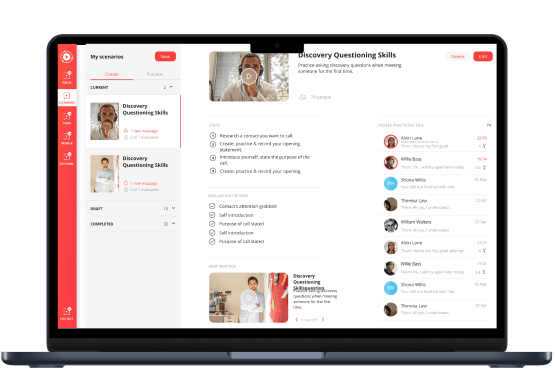
an E-Learning app for sales people using JS and Serverless on AWS
Conclusion
Serverless is a practical option for startups, but only when it fits the context of the project. It reduces maintenance effort, improves cost optimization, and helps manage resource consumption without upfront infrastructure planning.
Recent industry data shows that over 60% of organizations now use serverless in some form, and adoption continues to grow as cloud technology evolves. At the same time, teams are applying a strong focus on where serverless fits best, rather than using it by default.
Serverless usually works well when:
- you are building an MVP;
- traffic is unpredictable;
- the system is event-driven;
- the team wants to move fast with limited infrastructure work.
It becomes less effective when the system grows more complex, you need tight control over performance, or costs increase under constant high load.
Looking ahead, serverless will likely expand in areas such as authentication, automation, and event-driven systems. For startups, the value is not just in speed, but in choosing where serverless brings real benefits and where other approaches make more sense.
FAQ

Serverless offers scalability, cost-effectiveness, faster deployment, latency, flexibility, innovation and simple resource allocation.
Serverless architecture provides many advantages from security and scalability to robustness, cost-effectiveness and faster time-to-market. Also, it offers a different approach towards development focusing on innovations and reducing issues in system engineering.
Common use cases include APIs, backend endpoints, file processing, scheduled tasks, notifications, authentication flows, and background jobs. These workloads fit well because they run in response to specific events.
Serverless is a deployment and execution model, while microservices are a way to structure an application. They are often used together, but they are not the same thing. A microservices system can be serverless, and a serverless system can be built without a full microservices architecture.